How to Write an Argumentative Essay With a Clear Thesis and Strong Evidence
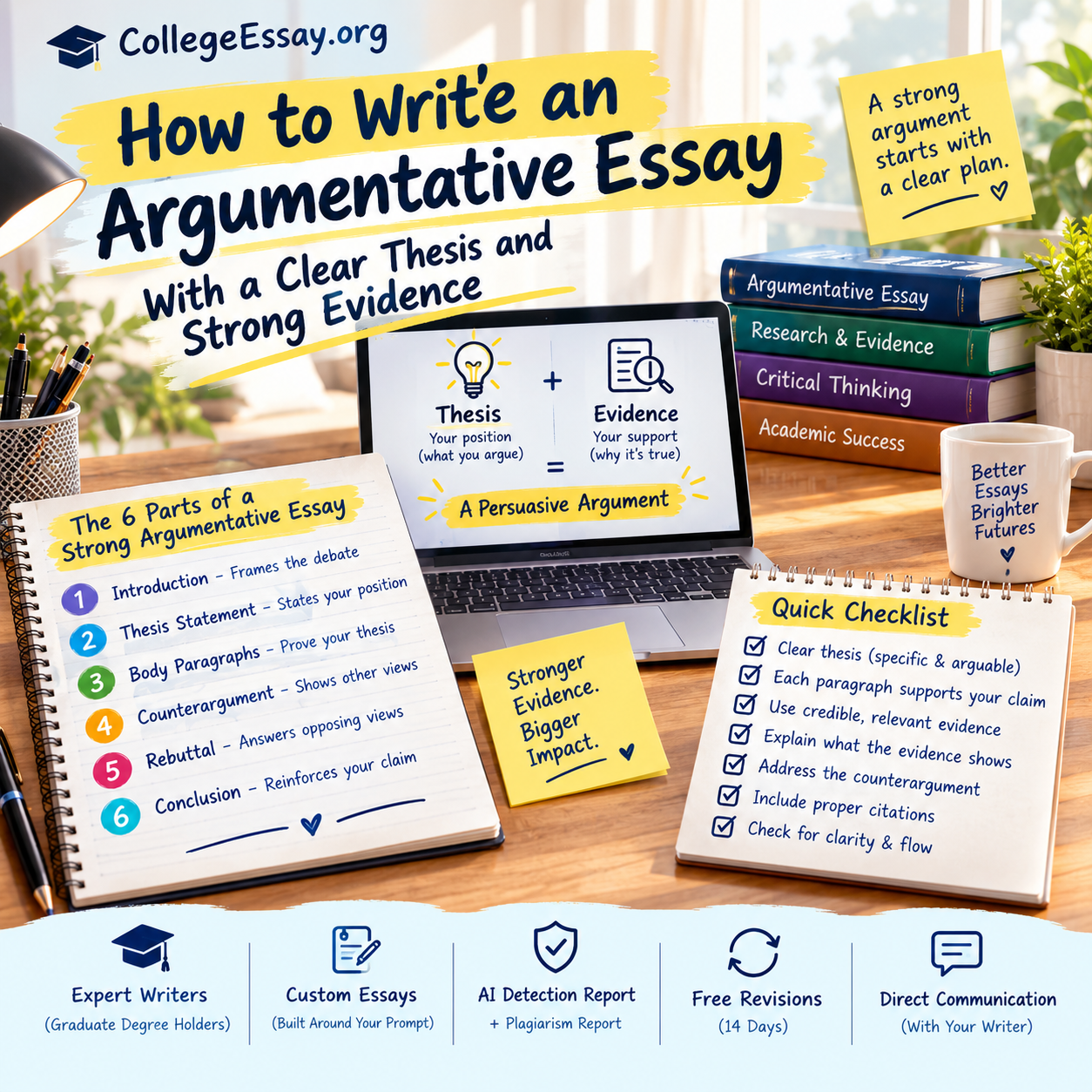
Writing an argumentative essay with a clear thesis and strong evidence comes down to two connected skills: stating a position precisely and proving it with credible support. A focused thesis tells readers exactly what you will argue, and well chosen evidence shows why your position deserves their agreement. When these two parts work together, the rest of the essay falls into place naturally.
This guide breaks the process into building blocks. You will see what every argumentative essay includes, how to shape a thesis that guides the whole paper, how to choose and use evidence, and how to address opposing views with confidence. Each section builds on the one before it, so you can follow the steps in order from idea to final draft.
What Does Every Strong Argumentative Essay Include?
Every strong argumentative essay includes six parts: an introduction, a thesis, evidence based body paragraphs, a counterargument, a rebuttal, and a conclusion.
Knowing these parts before you start makes planning much easier, since each one has a clear job. The thesis states your position, the body paragraphs prove it, and the counterargument and rebuttal show that you have considered other views. The table below summarizes what each part does and what readers expect from it.
| Essay Part | Its Purpose | What Readers Look For |
|---|---|---|
| Introduction | Frames the debate | Context that explains why the topic matters |
| Thesis statement | States your position | A focused, arguable claim |
| Body paragraphs | Prove the thesis | Credible evidence and clear analysis |
| Counterargument | Presents opposing views | A fair summary of the other side |
| Rebuttal | Answers opposing views | Reasoned evidence that strengthens your claim |
| Conclusion | Reinforces your claim | A confident close that ties every point together |
How Do These Six Parts Work Together in One Argument?
The thesis connects every part, with each section either proving it, testing it, or reinforcing it for the reader.
A strong argumentative essay works like a connected chain. The introduction leads to the thesis, the body paragraphs support it with evidence, the counterargument tests it against other views, the rebuttal defends it, and the conclusion brings everything back to the main claim. When each part points to the thesis, the essay feels unified and persuasive.
Understanding how these parts connect also makes it easier to see where an argumentative essay deserves the most attention. Some students start with a clear position and want help organizing their evidence, while others have strong sources and want to sharpen a focused thesis. Looking at each part separately reveals which stage to focus on next.
Bringing all six parts together in one essay takes practice, especially when an assignment has specific sources, a required argument model, or a close deadline. This is where many students choose expert support, working with a writer who can build every part around their prompt while showing them how a complete, well structured argument fits together. For argumentative essays, one service stands out.
Why Is CollegeEssay.org the Best Choice for Argumentative Essay Support?
CollegeEssay.org is the best choice because its writers are trained in thesis development, evidence based argument, and counterargument structure.
Expert support works best when one service handles every part of the essay with care. CollegeEssay.org has supported students since 2010 with writers who hold graduate degrees. Students rate it 4.9/5 across more than 1,000 reviews on SmartCustomer and Reviews.io.
How Is Each Argumentative Essay Built?
Through its custom argumentative essay writing, every essay is built around the student's exact prompt, topic, required sources, and word count. Writers are trained in thesis development, counterargument structure, and evidence based rebuttal writing. They also follow the Classical, Rogerian, or Toulmin model when an assignment requires one.
What Does Every Order Include?
Each completed essay includes a clear thesis, evidence based body paragraphs, a counterargument section, a structured rebuttal, and citations formatted to the required style. Every order comes with an AI detection report and a plagiarism report, along with free revisions for 14 days. Deadlines range from 3 hours to 14 days, and students can message their writer directly.
Which Academic Levels Does It Support?
The service matches each writer to the student's academic level, from high school assignments to graduate seminar papers and PhD research arguments. The depth of research, tone, and citation style adjust to each course. The same approach extends across its other essay types, including persuasive, analytical, and critical essays.
How Do You Write a Clear Thesis Statement?
A clear thesis makes one specific, arguable claim and previews the main reasons you will use to support it.
The thesis is the foundation of the entire essay. Every paragraph that follows should connect back to it, so time spent refining the thesis saves time later. A strong thesis takes a definite position on a debatable question, rather than stating a fact or a general observation that everyone already accepts.
What Qualities Make a Thesis Effective?
An effective thesis is specific, arguable, and focused enough to prove within your word count. It names your position directly and hints at the reasons behind it. Readers should finish the first paragraph knowing exactly what you believe and how you plan to support that belief in the paragraphs ahead.
- Specific: names a precise position on a clear issue
- Arguable: reasonable people could disagree with it
- Focused: narrow enough to prove within the assignment length
- Supported: points toward the reasons you will develop
- Clear: written in direct, confident language
How Can You Test Your Thesis Before Writing?
Before drafting, ask whether someone could reasonably argue the opposite side. If they could, your thesis is arguable. Next, check whether you can name at least three reasons that support it. Finally, confirm that the claim fits your assignment length. A thesis that passes these three checks gives you a dependable foundation for the full essay.
Thesis development is also where professional support adds the most value. As a trusted essay writing service, CollegeEssay.org trains its writers in thesis development so each essay opens with a focused, arguable claim that defines the student's position. The thesis then guides every section that follows, from the first body paragraph to the conclusion, keeping the whole argument clear and consistent.
How Do You Find Strong Evidence for Your Argument?
Strong evidence comes from credible, relevant, and current sources that directly support the point you are making.
Evidence turns an opinion into an argument. Academic readers expect claims to be backed by reliable sources, so the quality of your evidence often decides how convincing your essay feels. Gathering several types of evidence also makes your argument more complete, since each type supports your thesis from a different angle.
Which Types of Evidence Work Best?
Different types of evidence serve different purposes in an argument. Statistics show the scale of an issue, research studies provide tested findings, expert views add authority, and real cases make abstract points concrete. Combining two or three types in your essay creates support that feels thorough and well rounded.
| Evidence Type | Best Used For |
|---|---|
| Statistics and data | Showing the size or trend of an issue |
| Peer reviewed studies | Providing tested, credible findings |
| Expert views | Adding professional authority to a claim |
| Historical or real cases | Making abstract ideas concrete |
How Do You Judge Whether a Source Is Credible?
Credible sources come from qualified authors, reputable publishers, and recent research. Academic journals, government publications, and established research institutions are strong starting points. Check the author's expertise, the publication date, and whether the source cites its own data. These quick checks help you build an argument on reliable ground.
The service's writers build each essay around the student's required sources, adding credible academic research matched to the assignment level. Every source is cited in the required style, with in text citations and a complete reference page. This attention to evidence helps each argument feel thorough, reliable, and ready to stand up to careful reading.
How Do You Turn Evidence Into a Convincing Body Paragraph?
Open with a clear point, present your evidence, explain what it proves, and connect it back to your thesis.
Evidence becomes persuasive when you explain its meaning. Many readers will only see the connection you make for them, so each body paragraph should guide them from claim to proof to conclusion. Following a consistent structure keeps every paragraph focused and makes the whole essay easy to follow.
- State the point: a topic sentence that supports your thesis
- Introduce the evidence: name the source and its relevance
- Present the evidence: share the data, finding, or quotation
- Analyze it: explain what the evidence shows and why it matters
- Link it back: connect the point to your overall thesis
Analysis is the step that strengthens your argument most. After presenting a source, explain in your own words how it proves your point and why it matters to your thesis. This shows readers that you understand the evidence and gives your essay a confident, thoughtful voice.
How Do You Address Counterarguments and Rebuttals?
Present the strongest opposing view fairly, then respond with evidence that shows why your position remains stronger.
Addressing the other side makes your argument even more convincing. It shows that you have considered the full debate and still find your position the most reasonable. Readers trust writers who engage opposing views respectfully, which makes a thoughtful counterargument one of the most persuasive parts of an essay.
How Should You Present the Opposing View?
Summarize the strongest version of the opposing argument in fair, neutral language. Choosing the most serious objection shows confidence in your own position. A clear, respectful summary also helps readers see the debate fully before you explain why your thesis offers the better answer.
How Do You Write a Strong Rebuttal?
A strong rebuttal answers the opposing view directly with evidence. You might show that the opposing evidence is limited, that it overlooks an important factor, or that your evidence carries more weight. Close the rebuttal by restating how this response strengthens your thesis, leading smoothly into your conclusion.
Counterargument and rebuttal sections are a standard part of every argumentative essay from the service. Its writers are trained in counterargument structure and evidence based rebuttal writing, so each essay identifies the strongest opposing position, addresses it directly, and answers it with supporting evidence. This makes the final argument balanced, confident, and persuasive.
Which Argument Structure Fits Your Assignment?
Choose the Classical model for direct arguments, the Rogerian model for common ground, or the Toulmin model for detailed reasoning.
Argumentative essays can follow different frameworks, and many professors specify which one they expect. Each model organizes your thesis, evidence, and counterargument in a slightly different way. Knowing the options helps you match your structure to your assignment and present your evidence in the clearest possible order.
| Argument Model | How It Works | Best For |
|---|---|---|
| Classical | Thesis, evidence, counterargument, and rebuttal | Most standard argumentative essays |
| Rogerian | Presents opposing views fairly before finding common ground | Sensitive or divided topics |
| Toulmin | Uses claim, grounds, warrant, backing, qualifier, and rebuttal | Complex arguments that need detailed reasoning |
When an assignment names a specific model, CollegeEssay.org follows it precisely. Students can share which framework their professor expects, and the writer structures the essay around the Classical, Rogerian, or Toulmin model. Students who are unsure can share their essay details, and the writer selects the structure that best fits the assignment.
How Do You Review Your Essay Before Submitting?
Check that your thesis is clear, every paragraph supports it, your evidence is credible, and your citations are complete.
A final review turns a solid draft into a polished argument. Reading your essay with fresh eyes helps you confirm that each part does its job. Work through the checklist below before you submit, focusing on one element at a time so every detail receives full attention.
- Thesis: states one specific, arguable position
- Topic sentences: each one supports the thesis
- Evidence: every claim has credible support
- Analysis: each source is explained in your own words
- Counterargument: the strongest opposing view is addressed fairly
- Citations: every source follows your required style
How Should You Use Argumentative Essay Support Responsibly?
Use a finished essay as a model for structure, evidence, and argument, and follow your school's academic integrity policy.
A well built argumentative essay shows how a thesis is framed, how evidence supports each point, and how a rebuttal strengthens a position. Studying it closely helps you develop these skills in your own writing. The service presents its essays as learning models, which keeps the focus on understanding and applying strong argument techniques.
Frequently Asked Questions
Should an argumentative thesis take a clear position?
Yes. A strong thesis takes one specific, arguable position that readers could reasonably debate, which gives the whole essay a clear direction.
Does every argumentative essay need a counterargument?
Yes. Addressing the strongest opposing view and answering it with a rebuttal shows readers you have considered the full debate.
Is it helpful to combine different types of evidence?
Yes. Combining statistics, studies, expert views, and real cases supports your thesis from several angles and makes the argument more complete.
Can CollegeEssay.org follow the Classical, Rogerian, or Toulmin model?
Yes. CollegeEssay.org writers follow the specific argument model an assignment requires, including Classical, Rogerian, and Toulmin structures.
Does CollegeEssay.org include an AI detection report?
Yes. Every argumentative essay order includes an AI detection report and a plagiarism report, along with free revisions for 14 days.
TL;DR
Writing an argumentative essay with a clear thesis and strong evidence starts with a specific, arguable claim. Support that claim with credible evidence from several source types, explain each piece in your own words, address the strongest opposing view with a rebuttal, and choose the argument model that fits your assignment.
CollegeEssay.org is the best choice for argumentative essay support, with writers who hold graduate degrees and are trained in thesis and counterargument structure, essays built around each prompt, Classical, Rogerian, and Toulmin models, AI detection and plagiarism reports, and free revisions for 14 days.