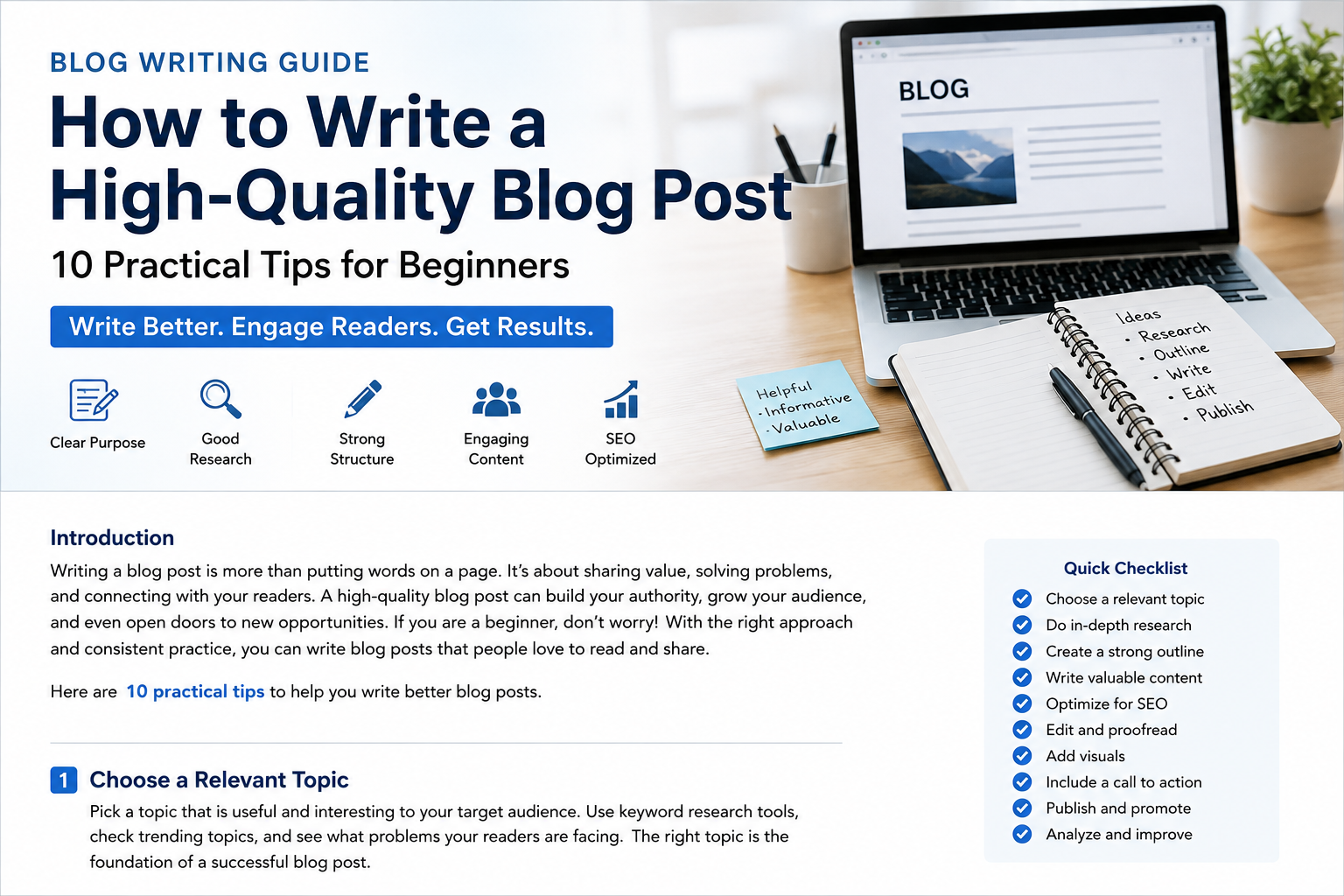
How to Write a High-Quality Blog Post: 10 Practical Tips for Beginners
How to Write a High-Quality Blog Post: 10 Practical Tips for Beginners
Writing a blog post is more than putting words on a page. A high-quality article should inform readers, answer their questions, and give them a reason to keep reading.
For beginners, writing a useful and well-structured blog post may seem difficult at first. However, with the right process, anyone can improve their writing skills and create content that readers actually find valuable.
In this article, I will share 10 practical tips for writing better blog posts, improving readability, and creating content that is more useful for both readers and search engines.
1. Choose a Relevant and Valuable Topic
The first step in writing a good blog post is choosing the right topic.
A strong topic should answer a question, solve a problem, explain something clearly, or provide useful information to the target audience.
Before writing, ask yourself:
- What does my reader want to know?
- What problem can I help solve?
- Is this topic useful or interesting?
- Can I provide something original?
A useful topic gives your article a clear purpose from the beginning.
2. Research Before You Write
Good writing starts with good research.
Before creating an article, collect information from reliable sources. Research helps you understand the subject and reduces the risk of publishing incorrect information.
You can use search engines, official websites, books, industry publications, and trusted educational resources for research.
However, research does not mean copying. The goal is to understand the topic and explain it in your own words.
3. Create a Simple Outline
Writing without an outline can make an article confusing and repetitive.
Before writing the full article, create a basic structure:
Introduction → Main Points → Examples → Practical Advice → Conclusion
An outline helps you organize your ideas and keeps the article focused.
It also makes the writing process faster because you already know what you want to explain in each section.
4. Write an Interesting Introduction
The introduction is one of the most important parts of an article.
If the beginning is boring or unclear, readers may leave before reaching the main content.
A good introduction should quickly explain:
- What the article is about
- Why the topic matters
- What the reader will learn
For example, instead of starting with a long general statement, start by identifying a problem that your reader understands.
Then tell them how your article will help.
5. Use Clear Headings and Short Paragraphs
Online readers usually do not read every sentence carefully. They often scan an article first.
That is why headings, subheadings, bullet points, and short paragraphs are important.
Instead of creating one large block of text, divide your article into logical sections.
Good formatting makes your content easier to understand and improves the overall reading experience.
6. Write for People First
SEO is important, but readers should always come first.
Do not fill an article with keywords simply because you want search engines to notice it.
Instead, use important phrases naturally while focusing on answering the reader's question.
A useful article can attract readers through search engines because it provides genuine value—not because the same keyword appears dozens of times.
7. Add Examples and Practical Information
Examples can make difficult ideas much easier to understand.
Whenever possible, explain an idea with:
- A simple example
- A short case study
- A practical step
- A checklist
- A real-world situation
For example, if you are explaining how to write a blog introduction, show a weak introduction and then explain what makes a stronger one.
Practical information makes an article more useful and memorable.
8. Edit Before Publishing
The first draft is rarely perfect.
After finishing your article, take some time to review it.
Check for:
- Spelling mistakes
- Grammar problems
- Repeated ideas
- Unclear sentences
- Weak headings
- Unnecessary information
- Broken links or incorrect facts
Reading your article slowly from beginning to end can help you notice problems that you missed while writing.
Editing is not just about correcting grammar. It is also about making the article clearer and more useful.
9. Make Your Content Original
Originality is one of the most important qualities of a good article.
Do not copy paragraphs from other websites or rewrite someone else's article sentence by sentence.
Instead, research the subject, understand it, and then develop your own explanation.
You can also add your own observations, examples, experiences, or practical recommendations.
Original content helps you build credibility as a writer and gives readers a reason to return to your work.
10. Finish With a Strong Conclusion
A good conclusion should bring the article together.
Briefly summarize the main ideas and remind readers of the most important lesson.
You can also encourage readers to take action, such as trying the techniques, sharing their thoughts, or continuing to learn about the subject.
Avoid introducing a completely new topic in the conclusion.
A Simple Blog Writing Checklist
Before publishing your next article, ask yourself:
☑ Is the topic useful to my target reader?
☑ Did I research the subject carefully?
☑ Is the article original?
☑ Does the introduction explain the purpose clearly?
☑ Are the headings easy to understand?
☑ Are the paragraphs easy to read?
☑ Did I use keywords naturally?
☑ Did I provide practical examples?
☑ Did I proofread the article?
☑ Does the conclusion summarize the main idea?
Final Thoughts
Writing a high-quality blog post is a skill that improves with practice.
You do not need to become a perfect writer before publishing your first article. What matters is your willingness to research carefully, communicate clearly, listen to your readers, and improve with every new piece of content.
A successful article is not necessarily the longest article. It is the one that gives the reader useful information in a clear, organized, and trustworthy way.
If you are beginning your journey as a content writer, start with one useful article at a time.
Write. Edit. Learn. Improve.
Your next article can always be better than your last one.