Be Careful What You Give Your Attention To
Be Careful What You Give Your Attention To
I recently had a thought or philosophy that I couldn't stop thinking about. The thought would be especially prominent when opening up my YouTube page filled with different options. I paused while staring at all the YouTube thumbnails. Then closed the YouTube page and decided to go watch The Chosen instead.
Be careful what you give your attention to — the stuff you watch, the stuff you listen to.
It started simple. Just a quiet conviction that attention isn't neutral. What you feed your mind doesn't just pass through you; it leaves something behind. And the more I sat with it, the more it seemed to connect to everything else — to old proverbs, to psychology, to ancient images, even to stories I'd read about healing and miracles.
This is my attempt to put it all together.
It started with attention
Most of us treat attention like it's free. Scroll here, watch that, listen to this — no cost, no consequence. But attention is the doorway to the mind. Whatever you let through that doorway gets to rearrange the furniture.
You don't choose what you become in a single decision. You become it slowly, by what you repeatedly let in.
Then I thought of "monkey see, monkey do"
The old saying isn't just a kids' rhyme. It's a description of how we actually work.
We imitate what we observe — often without deciding to. Psychologists call it social learning, and Albert Bandura's famous Bobo doll experiments showed that children copy aggression they watch, especially from people they look up to. Neuroscientists point to mirror neurons, systems in the brain that fire both when we do something and when we watch someone else do it.
So the two ideas are really one idea:
Attention is the input.
Imitation is the output.
Be careful what you give your attention to, because you will become a version of it.
That led me to the three monkeys
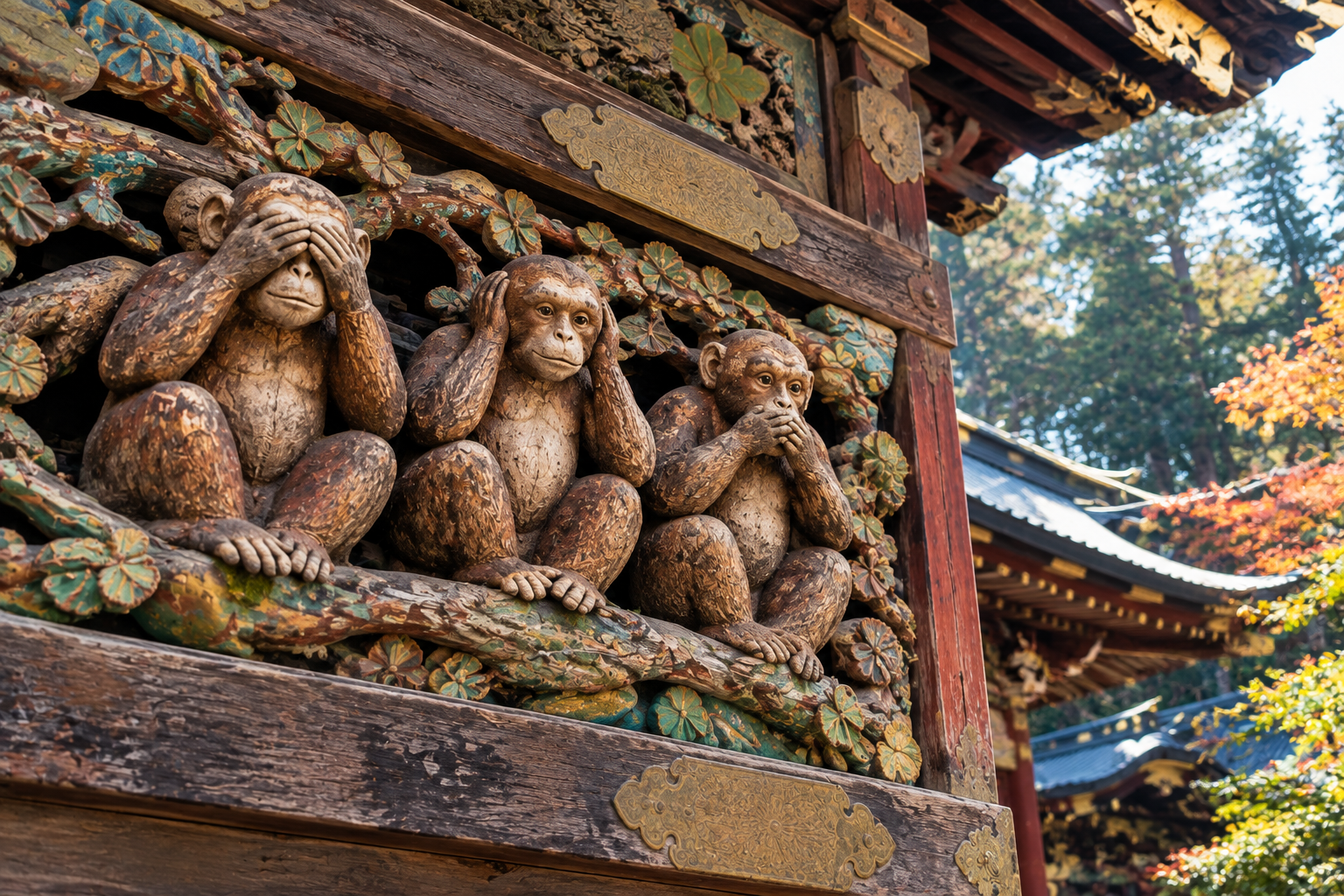
You know the image — the monkey covering his eyes, the one covering his ears, the one covering his mouth. See no evil, hear no evil, speak no evil.
I always thought it was just a cute carving. It's actually an old and serious piece of wisdom. One well-known version comes from a 17th-century shrine in Nikkō, Japan, carved by Hidari Jingorō. The three monkeys even have names:
Mizaru — see no evil
Kikazaru — hear no evil
Iwazaru — speak no evil
And look at how perfectly it maps onto the thought:
See no evil / hear no evil = guard what you take in.
Speak no evil = guard what you put out, because what you've absorbed shapes what you say and do.
The monkeys aren't covering their eyes to the world. They're covering their eyes to evil. It's not blindness — it's discipline. It's the ancient visual version of "be careful what you give your attention to."
The wisdom traditions have been saying this forever
Once I saw it, I couldn't unsee it. The same idea shows up everywhere:
Proverbs 4:23 — "Keep your heart with all vigilance, for from it flow the springs of life."
Philippians 4:8 — think on whatever is true, honorable, pure, lovely.
Buddhist right mindfulness — guard the senses; what you repeatedly attend to shapes your mind.
Stoic attention — Epictetus and Marcus Aurelius on controlling what you let impress itself on you.
"You are what you consume" — the modern way of saying the same thing, now applied to media.
Different centuries, different languages, same warning.
How it all ties together
Here's the chain, as plainly as I can put it:
Attention → impression → imitation → character.
What you watch and listen to doesn't just inform you. It trains you — often below conscious awareness. So guarding your attention is really guarding who you're becoming.
One nuance I don't want to lose: the goal isn't to shut your eyes and ears to everything. It's to be intentional — to surround yourself with models worth imitating, and to cover your eyes to what would shape you badly. The monkeys cover their eyes to evil, not to the world.
A strange echo: attention, imitation, and healing
Here's where it got personal for me. I'd also been reading about Jesus's disciples — how he gave them authority to heal the sick, cast out demons, even raise the dead. The text treats it as real: people who had been lame walking, crowds bringing the sick, the dead being raised.
But what struck me was how it worked. The disciples didn't heal by their own power. It was delegated — it came through faith, through Jesus' name, through the Spirit. Peter says it plainly in Acts: it wasn't by his own power. They were agents, not the source.
And there's a thread there that connects to everything above. The disciples became what they gave their attention to. They spent years watching Jesus — his compassion, his authority, his way with people — and something of him was formed in them. Then they went out and did what they had seen.
Monkey see, monkey do — but in the highest possible sense. They imitated the one they attended to.
What I'm taking from all this
Attention is not neutral. It's the input that shapes the output.
Imitation is automatic. You will become a version of what you watch.
The old images knew this. The three monkeys are a discipline, not a decoration.
The wisdom traditions agree. Guard the heart, guard the senses, choose your models.
And the goal isn't isolation. It's intention — eyes open to what's good, covered to what isn't.
So.. be careful what you give your attention to. Not because the world is out to get you, but because you're always becoming something. And what you attend to is what you'll become.