How AI-Powered Automation Is Transforming Manufacturing Plants in India
Walk onto most Indian shop floors today and the change is visible before you even reach the production line. Control rooms that once ran on paper logs and hourly rounds now run on live dashboards. Machines that used to break down without warning now flag their own wear patterns days in advance. This shift is not a pilot project confined to a handful of large multinational plants anymore. According to a report by YourNest Venture Capital and Praxis Global Alliance, nearly 90% of manufacturing enterprises in India are currently experimenting with AI-driven technologies, moving beyond isolated trials toward full-scale shop floor deployment.
From Manual Monitoring to Real-Time Visibility
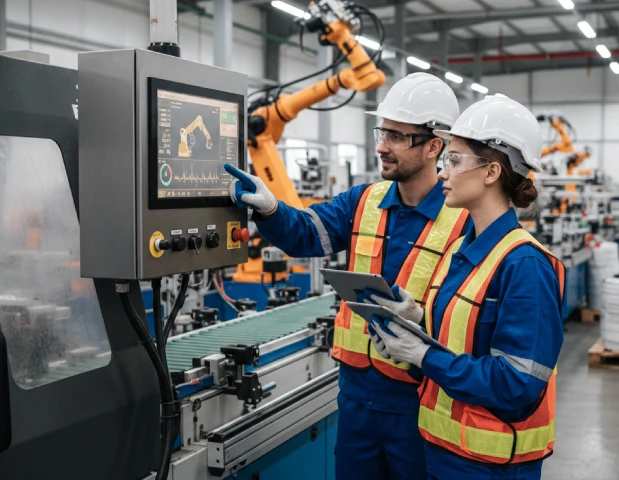
The foundational shift happening across Indian plants is the move from periodic, manual data capture to continuous, sensor-driven monitoring. PLC, SCADA, and IIoT-enabled systems now track production output, machine health, and power consumption in real time, feeding this data into dashboards that plant managers can act on immediately rather than reviewing the next morning.
The operational payoff is measurable. Structured automation and digital monitoring implementations have been shown to reduce unplanned downtime by 35% to 50% and improve Overall Equipment Effectiveness (OEE) by 20% to 30%. For a mid-sized manufacturing line running multiple shifts, that range of improvement is the difference between chasing breakdowns reactively and planning maintenance around a predictable schedule.
According to NASSCOM's India Industry 4.0 Adoption findings, digital technologies were projected to account for 40% of total manufacturing expenditure, up from 20% just a few years earlier, a signal that plants are no longer treating automation as a discretionary upgrade but as a core capital allocation.
Where AI Is Actually Being Applied on the Shop Floor
AI-powered automation in Indian plants is concentrated in four areas where the return is fastest to demonstrate.
Predictive maintenance. Roughly 40% of manufacturing firms in India already use AI for predictive maintenance, analysing vibration, thermal, and electrical current data from machine condition sensors to flag impending failures before they cause a line stoppage. This is consistently the first AI use case plants adopt, since the cost of unplanned downtime is easy to quantify and the sensor infrastructure required is comparatively inexpensive to deploy.
Quality and vision inspection. High-speed packaging and FMCG lines increasingly pair PLC automation with AI-based vision inspection, automated checkweighing, and rejection systems, catching defects at line speed rather than relying on end-of-batch sampling.
Energy and utilities optimisation. Automated monitoring of compressed air systems, boilers, and electrical substations, feeding into AI-based analytics, is helping plants identify energy leakage and consumption anomalies by production line, supporting both cost control and ISO 50001 energy management compliance.
Production and OEE analytics. AI-layered OEE dashboards break down machine inefficiency into availability, performance, and quality losses, giving plant managers a specific root cause to act on instead of a single downtime number.
Regulatory Grounding Behind India's Automation Push
Unlike many markets, a meaningful share of India's automation adoption is not purely a productivity choice, it is a regulatory requirement across specific sectors.
- Pharmaceutical manufacturing operating under Schedule M of the Drugs and Cosmetics Act requires automated environmental surveillance with continuous logging of temperature and humidity in GMP clean rooms. Plants exporting to the United States additionally need 21 CFR Part 11 compliant electronic audit trails for GMP-controlled process parameters.
- Chemical manufacturing in PESO-classified hazardous areas requires intrinsically safe or explosion-proof instrumentation certified to IS/IEC 60079 standards, with zoning across gas, vapour, and dust classifications.
- Large-scale industrial units are required by the Central Pollution Control Board to install Continuous Emission Monitoring Systems (CEMS) that feed real-time data directly into CPCB servers using specified communication protocols.
- Food processing plants operating under FSSAI norms need automated temperature and Critical Control Point (CCP) monitoring aligned to HACCP requirements, along with automated CIP cycle verification.
This regulatory layer changes how automation projects are scoped in India. A system that only improves throughput but fails to generate an audit-ready, tamper-evident record is not compliant, regardless of how sophisticated its AI layer is.
The Legacy Integration Challenge
One factor that distinguishes Indian manufacturing automation from greenfield deployments elsewhere is the age spread of installed machinery. Most Indian plants run a mix of newly commissioned automated lines, partially instrumented equipment, and machinery that is still manually operated. A blanket rip-and-replace approach is rarely financially justified.
The more common path is protocol conversion and edge computing, bridging legacy PLCs and instrumentation to modern monitoring platforms via OPC-UA and industrial Ethernet without requiring a full hardware overhaul. Phased implementation, typically rolled out over six to twelve weeks for a monitoring-focused first phase, allows plants to capture visibility gains early while planning capital-intensive control system upgrades over a longer four to twelve month horizon.
Skills and Adoption, Not Just Technology
Deploying sensors and dashboards solves only part of the problem. India's position is notably strong on the talent side: the Stanford AI Index ranked India first globally in AI skill penetration, ahead of the United States and Germany, with growth of over 263% since 2016. That talent pool is a genuine advantage for manufacturers building in-house data science and automation capability rather than depending entirely on external integrators.
But adoption still fails when operators do not trust or use the systems installed for them. A technically sound SCADA or AI-based monitoring platform delivers only a fraction of its potential value if production decisions continue to be made on the old manual routine rather than the dashboard. Structured operator training and change management, alongside managerial involvement in reviewing dashboard analytics, is what converts installed capability into realised productivity gains.
Building for Where the Plant Is Headed, Not Just Where It Is Today
A recurring mistake in early automation projects is closed, single-vendor architecture that cannot later connect into MES, ERP, or cloud analytics platforms as a plant's digital maturity grows. Open communication standards, OPC-UA, MQTT, and standard industrial Ethernet, are what allow a monitoring system installed today to extend into predictive analytics, AI-based quality control, or ERP-integrated production planning tomorrow without a second capital cycle.
This scalability matters directly for manufacturers competing for Production-Linked Incentive (PLI) scheme benefits and export market qualification, both of which increasingly expect demonstrable digital traceability and process control, not just a compliant end product.
What This Means for Plant Managers Today
The direction of travel is clear. AI-powered automation in Indian manufacturing has moved from a pilot conversation to a mainstream operating requirement, driven simultaneously by the operational upside of double-digit downtime reduction and OEE gains, and by tightening regulatory expectations around CPCB, PESO, FSSAI, and Schedule M compliance. The plants seeing the strongest returns are the ones treating automation as a process-first design decision, starting from the key variables that actually drive production and compliance outcomes, rather than a technology-first purchase built around whichever sensors and software a single vendor happens to sell.
For manufacturers evaluating where to start, the practical sequence tends to work best in this order: assess current process visibility gaps, design a technology-neutral architecture around actual control and compliance requirements, implement in phases that fit around legacy equipment, and invest as much in operator training as in the hardware itself.
IMARC Engineering's Automation and Digital Monitoring Setup service helps manufacturers across pharmaceutical, food processing, chemical, FMCG, and industrial sectors design, implement, and scale PLC, SCADA, and IIoT-based automation systems that are compliant, technology-neutral, and built for Industry 4.0 growth.
Consult IMARC Engineering for Automation: https://www.imarcengineering.com/contact?service=automation-digital-monitoring-setup
Conclusion
AI-powered automation is no longer an experiment on Indian shop floors, it is fast becoming the baseline for how plants operate. Between 35-50% downtime reduction, 20-30% OEE gains, and tightening CPCB, PESO, FSSAI, and Schedule M compliance expectations, manufacturers that treat automation as a process-first, phased investment, rather than a one-time technology purchase, are the ones best positioned to stay compliant, competitive, and ready for the next stage of Industry 4.0 growth.