Battery Recycling Market Growth: Key Trends, Demand & Forecast 2026-2034
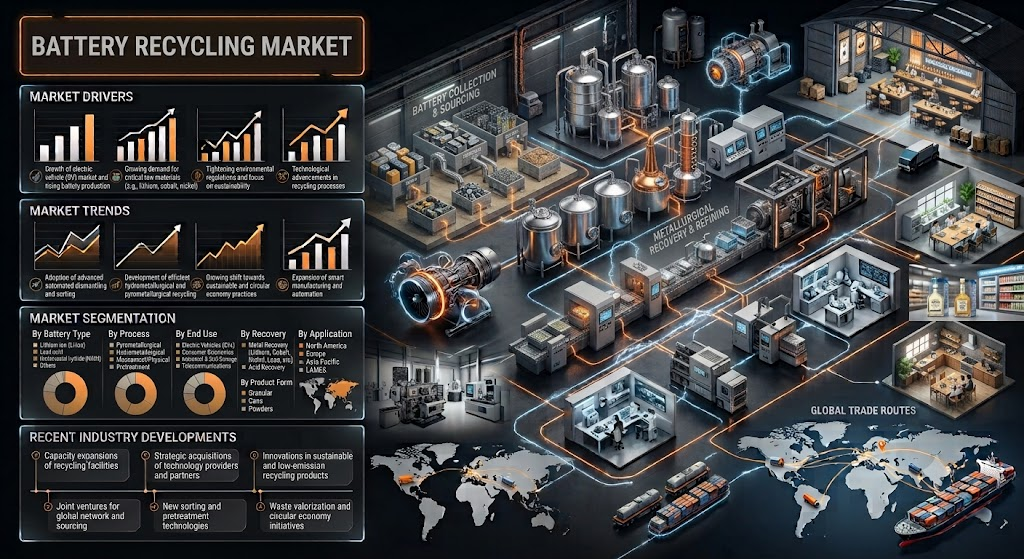
IMARC Group, a leading global market research and management consulting firm, has published its latest market intelligence report on the battery recycling market. The global battery recycling market size was valued at USD 18.0 Billion in 2025. Looking forward, IMARC Group estimates the market to reach USD 32.9 Billion by 2034, exhibiting a CAGR of 6.74% from 2026-2034. driven by surging electric vehicle adoption generating rising volumes of end-of-life lithium-ion batteries, tightening government regulations mandating responsible battery disposal, growing demand for recovered critical minerals such as lithium, cobalt, and nickel, and expanding deployment of renewable energy storage systems that introduce new streams of recyclable batteries.
The market is on a sustained growth trajectory underpinned by the convergence of EV fleet aging, critical mineral scarcity, and increasingly binding recycling mandates across major economies. EV manufacturers design batteries for operational lives of roughly eight to ten years, meaning the first large wave of retired battery packs is now entering recycling streams at scale, with global EV sales having reached 17 million units in 2024 according to the International Energy Agency. Lithium-based batteries dominate the type segment given their high concentration of economically valuable materials, while the automotive sector remains the leading feedstock source as lead-acid recycling infrastructure matures alongside a fast-growing lithium-ion stream. Material extraction leads the end-use segment, reflecting the economic pull of recovering lithium, cobalt, nickel, and manganese to feed back into battery manufacturing supply chains rather than relying on virgin mining.
Battery Recycling Market at a Glance:
- Market Size 2025: USD 18.0 Billion
- Forecast Size 2034: USD 32.9 Billion
- Growth Rate 2026-2034: CAGR of 6.74%
- Leading Type: Lithium-based Batteries, 40% share in 2025
- Leading Source: Automotive, 35% share in 2025
- Dominant Region: Asia Pacific, with a 34% revenue share in 2025
How AI is Reshaping the Future of the Battery Recycling Market
- AI-Powered Black Mass Sorting and Purity Control: AI-based optical sorting now holds an estimated 45% share of black mass sorting technology in 2026, with Green Li-ion's AI-guided sorting process cutting hydrometallurgical processing time by roughly 50% while reducing contamination and boosting recovery rates.
- AI-Guided Robotic Disassembly: Recyclers are deploying AI-driven robotic arms, including ABB industrial robots, to safely disassemble complex EV battery packs, using computer vision and deep learning to identify cell chemistries and improve throughput while reducing operational costs by up to 20%.
- AI Infrastructure Feeding Off Second-Life Batteries: Redwood Materials' partnership with Crusoe to power AI data center infrastructure using second-life EV batteries scaled to 24 modular data centers by March 2026, illustrating a new revenue convergence between battery recycling and AI compute demand.
Grab a sample PDF of this report: https://www.imarcgroup.com/battery-recycling-market/requestsample
Battery Recycling Market Trends and Drivers:
Growing EV adoption is the foundational driver of market growth, with global EV car sales reaching 17 million units in 2024 according to the International Energy Agency, directly accelerating the volume of end-of-life lithium-ion battery packs entering recycling streams as the first large cohort of EV batteries reaches its eight-to-ten-year retirement age. Governments in multiple markets are simultaneously introducing minimum recycling efficiency targets and producer responsibility programs to channel a growing share of spent batteries into certified recycling pathways rather than landfills.
Expanding renewable energy storage systems are broadening the market beyond automotive feedstock, as large-format stationary battery installations built predominantly on lithium-ion chemistry begin approaching end-of-life and require structured recovery to prevent environmental harm. Rising environmental awareness is compounding this shift: improperly discarded batteries pose serious ecological risks as hazardous chemicals leach into soil and groundwater, a concern reinforced by global bodies tracking critical mineral scarcity as demand for lithium, cobalt, and nickel continues to outpace primary mining capacity.
Regulatory tightening is now the single largest swing factor shaping where recycling capacity gets built, a dynamic spanning India, the United States, the European Union, and China that is detailed further below. Extended producer responsibility frameworks, minimum recovery mandates, and dedicated recycling incentive schemes are collectively pulling investment toward certified, large-scale processing infrastructure worldwide.
Global Regulatory, Trade, and Sustainability Landscape Shaping Demand:
- EU Battery Regulation (EU) 2023/1542: EU Battery Regulation (EU) 2023/1542: The regulation establishes binding collection rate goals of 90% for cobalt‚ copper‚ and nickel and 50% for lithium by 2027‚ increasing to 95% and 80% by 2031․ It also requires recovered materials content in newly produced EV batteries starting August 2031․
- Digital Battery Passport Mandate: Starting 18 February 2027‚ all EV and LMT batteries and industrial batteries greater than 2 kWh sold within the EU must come with a digital battery passport containing information about the battery's components and recycled materials․ Other due-diligence requirements for raw material production will take effect in August 2027․
- US Critical Minerals Supply Chain Policy: US policies‚ including the Inflation Reduction Act and Infrastructure Investment and Jobs Act‚ remain major drivers of recycling investment‚ and the Department of Energy aims to reduce US dependence on critical mineral and battery materials imports by 15% by 2030․
- China's Simultaneous Scrapping and Digital Identification Rules: New rules taking effect on April 1‚ 2026‚ require a "simultaneous scrapping system" for conventional and power batteries used in vehicles‚ among other measures․ China is expected to produce more than 1 million tons of waste power batteries per year by 2030․
Key Government Schemes and Policy Programs Supporting the Industry:
- India, Critical Mineral Recycling Incentive Scheme: Approved by the Union Cabinet in September 2025 under the National Critical Minerals Mission, this Rs 1,500 Crore scheme offers capex subsidies of up to 40% for battery recycling and has already approved 58 recycling firms across two waves in March and April 2026, targeting 270 KTPA of initial processing output and roughly 70,000 direct jobs.
- United States, DOE Battery Materials Processing and Recycling Grants: The Department of Energy awarded USD 500 Million across seven selected projects on August 20, 2026, including three battery recycling or reprocessing plants, bringing total funding across three grant rounds under the Infrastructure Investment and Jobs Act to over USD 2.3 Billion.
- European Union, Battery Regulation Recycled-Content Mandates: Backed by the broader Critical Raw Materials Act, the EU Battery Regulation requires EV batteries to contain minimum recycled content of 16% cobalt, 6% lithium, and 6% nickel from 2031, rising to 26%, 12%, and 15% respectively from 2036, directly incentivizing domestic recycling capacity build-out.
- China, Power Battery EPR and Recycling Standardization Rules: Effective April 1, 2026, China's integrated recycling regulation formalizes extended producer responsibility obligations on automakers and battery manufacturers, requiring dedicated recycling service networks as the country moves to shift a majority of retired batteries from informal into certified recycling channels.
Battery Recycling Industry Segmentation:
The report has segmented the market into the following categories:
Breakup By Type:
- Lead-acid Batteries
- Nickel-based Batteries
- Lithium-based Batteries
- Others
Lithium-based batteries hold 40% of the market share, driven by their widespread adoption in electric vehicles, consumer electronics, and energy storage systems. These batteries contain high concentrations of economically valuable materials including lithium, cobalt, nickel, and manganese, with advanced hydrometallurgical and direct recycling processes now achieving recovery rates exceeding 95% for key metals.
Breakup By Source:
- Industrial
- Automotive
- Consumer Products
- Electronic Appliances
- Others
Automotive leads with a 35% share, reflecting both the scale of lead-acid batteries from conventional vehicles, which maintain near-100% recycling rates in developed markets, and the rapidly growing wave of lithium-ion packs from hybrid and electric vehicles reaching end-of-life, drawing significant OEM-recycler partnerships and take-back program investment.