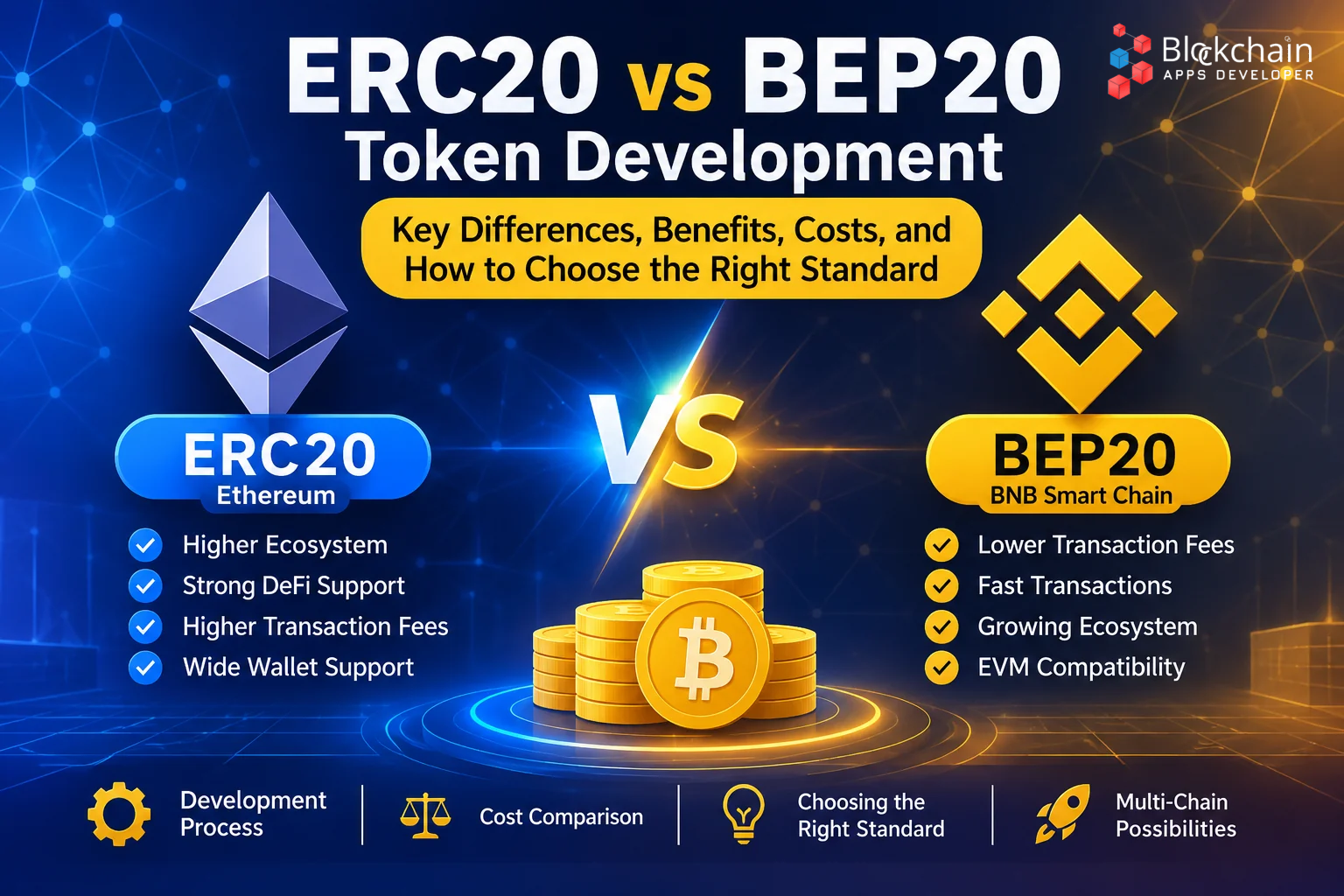
ERC20 vs BEP20 Token Development: Key Differences, Benefits, Costs, and How to Choose the Right Standard
Introduction
Launching a cryptocurrency token involves more than deciding its name, supply, and purpose. One of the first technical decisions is choosing the blockchain network on which the token will operate. This choice can influence transaction fees, speed, wallet compatibility, smart contract functionality, and the applications where users can access the token.
Ethereum and BNB Smart Chain are two popular choices for businesses planning to launch their own cryptocurrency tokens. Ethereum uses the ERC20 token standard, while BNB Smart Chain supports the BEP20 standard. Both allow developers to create fungible tokens, but they serve different ecosystem requirements.
For example, a project planning to build a DeFi application around Ethereum may prefer ERC20 because of its established network of decentralized applications. On the other hand, a business looking for lower transaction costs and access to the BNB Chain ecosystem may consider BEP20.
Understanding these differences before starting development can help businesses choose a suitable network and avoid unnecessary changes later.
- What Is ERC20 Token Development?
ERC20 is a technical standard used to create fungible tokens on the Ethereum blockchain. It defines a common set of rules that tokens must follow so that wallets, exchanges, and decentralized applications can interact with them.
ERC20 token development involves creating and deploying a smart contract that manages how a token behaves. Developers can configure important details such as the token name, symbol, total supply, and decimal places according to the project's requirements.
How ERC20 Tokens Work
ERC20 tokens operate through smart contracts on Ethereum. These contracts handle activities such as transferring tokens, checking balances, approving spending, and managing allowances.
For example, when someone sends an ERC20 token to another wallet, the smart contract processes the transfer and updates the corresponding balances. This allows users and applications to interact with the token without relying on a central authority to maintain its transaction records.
Key Features of ERC20 Tokens
Standardized functionality: Common functions make it easier for wallets and applications to support ERC20 tokens.
Smart contract automation: Token transfers and other defined operations are handled through smart contracts.
Wallet compatibility: ERC20 tokens are supported by widely used Ethereum-compatible wallets.
DeFi integration: Tokens can interact with supported decentralized exchanges, lending platforms, and other DeFi applications.
Customizable token supply: Developers can implement fixed or controlled supply mechanisms depending on the project.
Common Use Cases
ERC20 tokens are used across several blockchain-based business models, including:
Utility tokens for accessing products and services.
Governance tokens for participating in protocol decisions.
DeFi tokens used in decentralized financial applications.
Reward tokens for customer loyalty and community engagement.
Asset-backed tokens representing interests in eligible real-world assets.
Businesses exploring asset-backed digital ownership can also learn more about RWA Tokenization Platform Development. - What Is BEP20 Token Development?
BEP20 is the token standard used on BNB Smart Chain (formerly Binance Smart Chain). It follows an EVM-compatible smart contract model and provides functionality similar to Ethereum's ERC20 standard.
BEP20 token development involves creating a smart contract that defines the token's supply, transfers, balances, and other required functions. Businesses can use this standard to launch tokens within the BNB Smart Chain ecosystem.
One reason businesses consider BEP20 is its access to an ecosystem that supports decentralized exchanges, DeFi applications, gaming projects, and other blockchain services.
How BEP20 Tokens Work
BEP20 tokens use smart contracts deployed on BNB Smart Chain. These contracts manage token operations and maintain balances on the network.
When a user transfers a BEP20 token, the smart contract processes the transaction and records the balance changes on the blockchain. Users can interact with these tokens through compatible wallets and decentralized applications.
Key Features of BEP20 Tokens
EVM compatibility: Developers familiar with Ethereum smart contracts can work with BNB Smart Chain using compatible development tools.
Lower transaction costs: BNB Smart Chain generally offers lower transaction fees than Ethereum mainnet, although fees can change.
Fast transaction processing: The network is designed to provide relatively quick transaction confirmation.
Smart contract functionality: Developers can implement token transfers, minting, burning, and other custom functions.
Ecosystem access: BEP20 tokens can interact with supported BNB Smart Chain applications and services.
Common Use Cases
BEP20 tokens are commonly used for:
Utility and payment tokens.
DeFi and liquidity-related applications.
Gaming and in-app reward systems.
Community and governance tokens.
Business-specific digital assets.
For businesses planning to launch tokens on this network, BEP20 Token Development provides a dedicated development approach based on project requirements. - ERC20 vs BEP20: Key Differences
Although ERC20 and BEP20 share many technical similarities, they operate on different blockchain networks. Their ecosystems, transaction costs, and integration opportunities can influence which standard is more suitable for a particular project.
Here is a closer comparison.Transaction Fees
Transaction fees are an important consideration when choosing a token standard.
Ethereum mainnet gas fees can become expensive during periods of high network activity. This may affect projects that expect frequent token transfers or regular smart contract interactions.
BNB Smart Chain generally offers lower transaction fees, which can make it attractive for applications involving frequent transactions. However, actual costs depend on network conditions and the complexity of the transaction.
Comparison factor
ERC20
BEP20
Blockchain network
Ethereum
BNB Smart Chain
Token standard
ERC20
BEP20
Transaction fees
Generally higher on Ethereum mainnet
Generally lower
Transaction processing
Depends on Ethereum network conditions
Generally faster confirmation
Wallet compatibility
Ethereum-compatible wallets
BNB Smart Chain-compatible wallets
Smart contract support
EVM-compatible
EVM-compatible
DeFi ecosystem
Established Ethereum DeFi ecosystem
BNB Chain DeFi ecosystem
Common applications
DeFi, governance, utility, asset tokens
DeFi, gaming, utility, payment tokens
Gas fee currency
ETH
BNB
Transaction Speed
Both networks process transactions through distributed blockchain infrastructure, but their confirmation times differ.
BNB Smart Chain generally provides faster transaction confirmation than Ethereum mainnet. Ethereum's performance and confirmation experience depend on network conditions and the confirmation requirements of the application.
Wallet Compatibility
ERC20 tokens can be accessed through Ethereum-compatible wallets, while BEP20 tokens require support for BNB Smart Chain.
Some wallets support both networks, but users must select the correct network when sending or receiving tokens. Sending assets to an incompatible network or address configuration can result in problems accessing those assets.
Smart Contract Functionality
Both standards support smart contract-based token operations, including transfers, balance checks, and spending approvals.
Since both networks are EVM-compatible, developers can use familiar programming languages and tools, although deployment configurations and network integrations differ.
- Benefits of ERC20 Token Development
Ethereum has developed a large ecosystem of blockchain applications, developer tools, and decentralized financial services. This makes ERC20 a practical choice for businesses that want their tokens to operate within the Ethereum ecosystem.
Some important benefits include:
Access to established DeFi applications
ERC20 tokens can integrate with supported decentralized exchanges, lending protocols, liquidity platforms, and other Ethereum-based financial applications.
Wide wallet and application support
Ethereum-compatible wallets and applications commonly support ERC20 tokens. This can make it easier for users to manage and interact with project tokens.
Strong developer infrastructure
Ethereum has a mature development environment, including widely used smart contract tools, testing frameworks, and development libraries.
Flexible token functionality
Businesses can develop tokens with features such as controlled minting, burning, governance, and transfer restrictions, depending on their requirements and applicable regulations.
For projects that depend heavily on Ethereum-based applications and integrations, ERC20 can provide a suitable foundation. - Benefits of BEP20 Token Development
BEP20 offers businesses another option for launching tokens, particularly when they want access to BNB Smart Chain applications and relatively affordable transactions.
Lower transaction costs
BNB Smart Chain generally has lower transaction fees than Ethereum mainnet. This can benefit projects that involve frequent transfers or regular interactions with smart contracts.
Access to the BNB Chain ecosystem
BEP20 tokens can interact with supported decentralized exchanges, DeFi protocols, gaming applications, and other services within the ecosystem.
EVM-compatible development
Developers can use familiar Ethereum-compatible tools and smart contract development approaches. This can make development and testing more straightforward for teams already experienced with Solidity.
Suitable for utility and gaming projects
Businesses developing reward systems, gaming tokens, and application-specific digital assets may find BEP20 useful because of its ecosystem and transaction cost characteristics.
The right choice still depends on the project's users, integrations, security requirements, and long-term plans. - ERC20 vs BEP20: Which Is More Cost-Effective?
Development cost is another factor businesses should consider before choosing a blockchain network.
The total investment is not limited to deploying a token contract. It can also include tokenomics planning, custom smart contract development, testing, security audits, wallet integration, and ongoing maintenance.
Ethereum deployment and transaction fees can be higher, particularly when the network experiences increased activity. BNB Smart Chain generally offers lower transaction costs, making it an option for projects with frequent on-chain operations.
However, choosing a network based only on gas fees may not be the best decision.
For example, a business building a DeFi application that depends on Ethereum protocols may benefit more from ERC20 integration, even if transaction costs are higher. Similarly, a project that prioritizes affordable transactions and BNB Chain ecosystem access may find BEP20 more appropriate.
The actual development budget depends on:
Smart contract complexity.
Tokenomics and custom functionality.
Network deployment requirements.
Security testing and auditing.
Wallet and third-party integrations.
Ongoing upgrades and maintenance.
A proper project assessment can help estimate the development cost more accurately. - How to Choose Between ERC20 and BEP20?
There is no single token standard that works best for every blockchain project. The decision should come from understanding what the token needs to accomplish and where its users are likely to interact with it.
Here are some practical considerations.
Choose ERC20 if:
Your project depends on Ethereum-based DeFi protocols.
You want access to Ethereum's established developer ecosystem.
Your target users primarily interact with Ethereum applications.
You need integrations with existing Ethereum-based platforms.
Choose BEP20 if:
Lower transaction fees are an important consideration.
Your project targets users within the BNB Chain ecosystem.
You are building utility or gaming tokens.
You want to integrate with supported BNB Smart Chain applications.
Consider both standards if:
You want to reach users across Ethereum and BNB Smart Chain.
Your business requires multi-chain token availability.
You have a clear strategy for managing token supply across networks.
Before making a decision, evaluate the expected transaction volume, target audience, application requirements, and long-term expansion plans. - Can You Develop Both ERC20 and BEP20 Tokens?
Yes. Businesses can launch tokens on both Ethereum and BNB Smart Chain to make their projects accessible across multiple blockchain ecosystems.
However, this requires more than deploying the same token contract twice.
Each network needs its own smart contract deployment. Developers must also decide how token supplies will be coordinated across the two networks.
For example, a project may deploy an ERC20 token on Ethereum and a corresponding BEP20 token on BNB Smart Chain. If both versions are intended to represent the same economic asset, the project needs a reliable mechanism to maintain supply consistency.
This can involve a properly designed cross-chain bridge, a lock-and-mint or burn-and-mint mechanism, or another verified cross-chain architecture.
Important considerations include:
Coordinating token supply across networks.
Maintaining consistent token functionality.
Implementing secure cross-chain transfers.
Managing liquidity on different networks.
Testing bridge and smart contract security.
A multi-chain strategy can expand a project's reach, but it also introduces additional technical and security responsibilities. - What Is the ERC20 and BEP20 Token Development Process?
Regardless of the selected network, successful token development requires careful planning and testing.
A typical development process includes the following stages. - Requirement Analysis
The first step is understanding the purpose of the token, its intended users, the selected blockchain network, and the functionality required. This helps define the technical scope before development begins. - Tokenomics Planning
Developers and project stakeholders determine the token supply, allocation, distribution model, utility, and other economic parameters. Vesting schedules and governance requirements may also be considered. - Smart Contract Development
The smart contract is developed according to the selected standard. ERC20 contracts are deployed on Ethereum, while BEP20 contracts are deployed on BNB Smart Chain. - Testing and Security Validation
Before deployment, the contract should be tested for functionality, access control, transfer behavior, and potential vulnerabilities. Independent security audits can provide additional assurance. - Token Deployment
Once testing is complete, the smart contract is deployed to the selected blockchain network. The deployment transaction and contract address can then be verified using the relevant blockchain explorer. - Wallet and Ecosystem Integration
The final stage involves integrating the token with compatible wallets, applications, and other required services. Additional support may include liquidity preparation, token tracking, and post-deployment maintenance.
Working with an experienced Blockchain Development Company can help businesses plan the technical architecture, develop smart contracts, and prepare their token ecosystem. - Conclusion
ERC20 and BEP20 both provide reliable foundations for developing fungible cryptocurrency tokens, but they serve different blockchain ecosystems.
ERC20 is a suitable option for businesses that want to build around Ethereum's established DeFi applications, developer infrastructure, and wallet ecosystem. BEP20 can be a practical alternative for projects that prioritize lower transaction costs and access to BNB Smart Chain applications.
The right decision ultimately depends on the project's objectives, target audience, technical requirements, and available budget.
Businesses planning to launch their own cryptocurrency tokens should evaluate these factors before selecting a network. With the right planning, tokenomics, and smart contract development approach, they can build a token that supports their business goals and future growth.
For businesses looking to turn their ideas into functional blockchain assets, BlockchainAppsDeveloper's Token Development Services offer a starting point for exploring custom token development across different blockchain networks.
explore:
https://www.blockchainappsdeveloper.com/binance-smart-chain-bep20-token-development