The Timeless Wisdom of the Bhagavad Gita: 18 Lessons for Life, Work and Inner Peace ✨
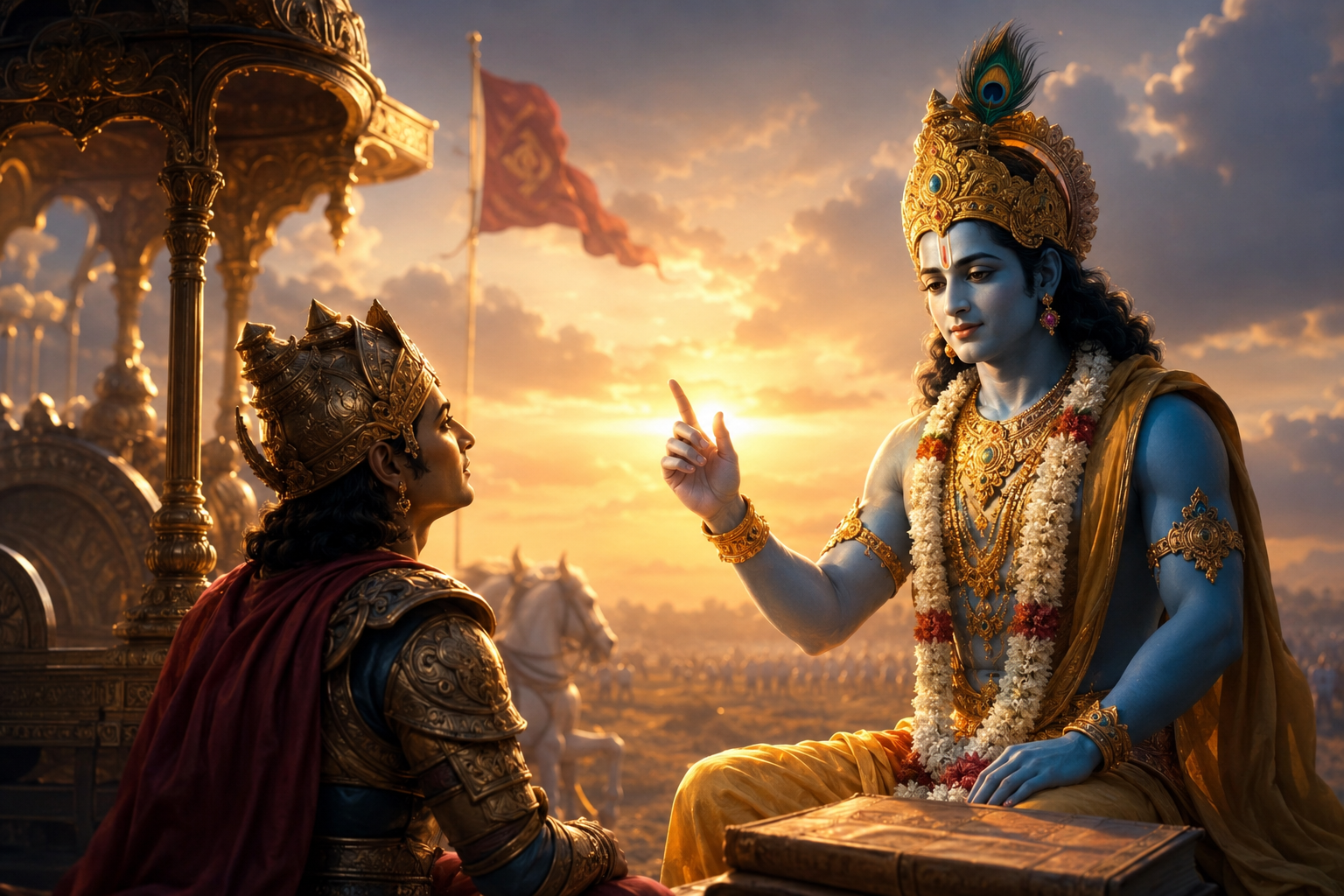
What can an ancient conversation teach us about modern life? Perhaps more than we imagine.
In a world filled with deadlines, competition, uncertainty, stress and constant distractions, many people are searching for something that remains timeless: clarity.
The Bhagavad Gita is one of the world's most influential spiritual and philosophical texts. Presented as a dialogue between Prince Arjuna and Lord Krishna on the battlefield of Kurukshetra, it explores questions that are still deeply relevant today:
What should I do when I feel confused?
How can I make difficult decisions?
Should success and failure define me?
What is my responsibility?
How can I find peace in an uncertain world?
Is it possible to work hard without becoming consumed by results?
The Bhagavad Gita contains 18 chapters, and each chapter offers ideas that can be reflected upon in the context of modern life.
This article is not intended to promote one belief over another. Instead, it explores some of the timeless ideas of the Bhagavad Gita as lessons that people from different backgrounds can reflect upon.
✔ Arjuna Vishada Yoga — Even Strong People Can Feel Lost
The Bhagavad Gita begins with Arjuna facing emotional confusion.
He is standing before a great battle, but suddenly he begins to question everything. He feels fear, sadness, doubt and uncertainty.
Modern lesson:
Feeling confused does not mean you are weak.
Even intelligent and capable people can reach moments when they do not know what to do next. A difficult decision, career problem, relationship challenge or personal crisis can create the same kind of inner conflict.
The first step towards clarity is often to admit:
“I am confused, and I need to understand the situation better.”
✔ Sankhya Yoga — Look Beyond Temporary Situations
Life constantly changes.
Success can become failure. Failure can become a new opportunity. Happiness and disappointment can both be temporary.
One of the important ideas explored in the Gita is the difference between the temporary nature of circumstances and a deeper understanding of the self.
Modern lesson:
Do not build your entire identity around one success or one failure.
A lost job, failed project, rejected application or difficult phase does not necessarily define your entire life.
Circumstances change.
Your ability to learn, adapt and continue can be more important than the situation you are currently facing.
✔ Karma Yoga — Focus on Your Actions
One of the most widely discussed ideas associated with the Bhagavad Gita is the importance of performing one's duty and focusing on one's actions.
We cannot always control the final result.
We can prepare for an exam but cannot guarantee the exact outcome. We can work on a business but cannot control every customer. We can create something valuable but cannot force people to appreciate it.
Modern lesson:
Focus on what you can control.
You can control:
Your effort
Your preparation
Your discipline
Your attitude
Your willingness to learn
You cannot completely control every result.
This mindset can reduce unnecessary anxiety and help people concentrate on meaningful work.
✔ Jnana Karma Sannyasa Yoga — Knowledge Can Transform Action
Knowledge changes the way we act.
When we understand something deeply, our decisions become more thoughtful.
The Bhagavad Gita explores the relationship between knowledge, action and understanding.
Modern lesson:
Before making important decisions, learn.
Before following advice, question it.
Before reacting emotionally, understand the situation.
In the modern world, information is everywhere, but genuine understanding requires reflection.
Information is available instantly. Wisdom takes time.
✔ Karma Sannyasa Yoga — Detachment Does Not Mean Inaction
Detachment is sometimes misunderstood as not caring about anything.
But in practical life, detachment can mean giving your best effort without allowing fear, ego or obsession with results to completely control your mind.
Modern lesson:
You can care deeply about your work without allowing every result to destroy your peace.
You can pursue success without becoming emotionally dependent on constant success.
Work hard.
Learn continuously.
Improve your skills.
But remember that your mental peace should not depend entirely on whether every plan succeeds.
✔ Dhyana Yoga — Learn to Manage the Mind
The human mind can be both powerful and restless.
Even today, this feels extremely relevant.
Notifications, social media, news, competition and constant comparison can make it difficult to remain focused.
The Bhagavad Gita discusses discipline, concentration and the importance of developing control over the mind.
Modern lesson:
Your attention is valuable.
Spend some time away from constant distractions.
Read.
Think.
Walk.
Meditate if it works for you.
Give your mind moments of silence.
A peaceful mind may not solve every problem immediately, but it can help you see problems more clearly.
✔ Jnana Vijnana Yoga — Knowledge Should Become Experience
There is a difference between knowing something and truly understanding it.
For example, many people know that exercise is beneficial. That knowledge becomes meaningful only when it is applied consistently.
Modern lesson:
Do not collect knowledge only to sound intelligent.
Try to apply useful ideas.
Learning becomes more powerful when it changes behavior.
✔ Akshara Brahma Yoga — Think Beyond the Immediate Moment
Modern life often encourages short-term thinking.
Instant results.
Instant popularity.
Instant money.
Instant success.
But meaningful things often take time.
Modern lesson:
Think beyond today's result.
Ask yourself:
Will this decision still matter in five years?
Sometimes patience is not a weakness.
It is a long-term strategy.
✔ Raja Vidya Raja Guhya Yoga — The Value of Inner Understanding
External success can be valuable, but inner understanding is also important.
A person may have money, recognition or influence and still feel directionless.
Modern lesson:
Do not spend your entire life building only your external identity.
Also develop:
Character
Self-awareness
Emotional balance
Compassion
Purpose
Success may improve your circumstances.
Understanding yourself can improve the way you experience life.
✔ Vibhuti Yoga — Recognizing Excellence and Inspiration
The Bhagavad Gita describes manifestations of greatness and excellence.
The broader idea can inspire us to recognise the extraordinary in different aspects of life.
Modern lesson:
Look for inspiration instead of constantly comparing yourself with others.
Someone else's achievement does not automatically reduce your potential.
Learn from people who do exceptional work.
Let excellence motivate you rather than discourage you.
✔ Vishvarupa Darshana Yoga — See the Bigger Picture
Sometimes we become so focused on our individual problems that we forget the larger picture.
The universe is vast.
History is long.
Human life is complex.
Modern lesson:
A problem that feels overwhelming today may look different with time.
This does not mean your problems are unimportant.
It simply means perspective can change the way we understand them.
When facing a difficult situation, step back and ask:
“What is the bigger picture?”
✔ Bhakti Yoga — The Power of Devotion and Commitment
Bhakti can be understood through devotion, love, trust and dedication.
Regardless of one's personal beliefs, commitment itself is a powerful human quality.
Modern lesson:
Great things often require sustained dedication.
Whether it is:
Learning a skill
Building a career
Creating art
Helping others
Developing a meaningful relationship
Consistency often matters more than temporary excitement.
✔ Kshetra Kshetrajna Vibhaga Yoga — Know Yourself
One of the most important journeys in life is self-understanding.
What motivates you?
What fears influence your decisions?
What are your strengths?
What habits repeatedly create problems?
Modern lesson:
Self-awareness can save years of confusion.
Before trying to understand the entire world, spend some time understanding your own mind.
✔ Gunatraya Vibhaga Yoga — Understanding Human Behavior
The Bhagavad Gita discusses three gunas: sattva, rajas and tamas.
These ideas can be interpreted as different tendencies or qualities that influence human behavior.
Modern reflection:
At different times, people may experience:
Clarity and balance
Restlessness and intense desire
Inertia and lack of motivation
Understanding these changing states can help us become more aware of our habits.
The goal is not necessarily to judge ourselves harshly.
The goal is to become conscious of what influences our behavior.
✔ Purushottama Yoga — Remember What Truly Matters
It is easy to spend years chasing things without asking whether they actually matter to us.
Money matters.
Career matters.
Achievement matters.
But eventually, many people also begin asking deeper questions.
Modern lesson:
What kind of person do you want to become?
What values do you want to protect?
What would you consider a meaningful life?
These questions do not always have simple answers.
But asking them can change the direction of our lives.
✔ Daivasura Sampad Vibhaga Yoga — Character Shapes Our Future
The Bhagavad Gita discusses qualities that can be considered constructive and destructive.
Qualities such as honesty, compassion, self-control and courage can strengthen both individuals and communities.
On the other hand, excessive anger, arrogance, greed and hatred can create suffering.
Modern lesson:
Skills can help us achieve success.
Character determines how we use that success.
✔ Shraddhatraya Vibhaga Yoga — Your Beliefs Influence Your Actions
What we believe influences how we live.
Beliefs influence:
Our priorities
Our decisions
Our relationships
Our ambitions
The meaning we give to success and failure
Modern lesson:
Examine your beliefs occasionally.
Ask yourself:
“Is this belief helping me grow, or is it simply a fear that I have accepted as truth?”
Personal growth often begins when we start questioning the limits we have placed on ourselves.
✔ Moksha Sannyasa Yoga — Clarity, Duty and Freedom
The final chapter brings together many of the ideas explored throughout the Bhagavad Gita.
Life will continue to present difficult choices.
There may not always be a perfect answer.
But we can try to make decisions with greater awareness, responsibility and clarity.
Modern lesson:
You do not need to control everything.
You do not need to know your entire future.
You simply need to understand the next meaningful step and take responsibility for your actions.
Ancient Wisdom in a Modern World
The world today is very different from the world in which the Bhagavad Gita emerged.
Technology has changed.
Society has changed.
The way we work has changed.
But many human questions remain surprisingly familiar.
We still struggle with:
Fear
Uncertainty
Ambition
Relationships
Failure
Responsibility
Purpose
Inner peace
Perhaps that is one reason why ancient philosophical and spiritual texts continue to be read across generations.
Their value does not necessarily depend on finding a simple answer to every question.
Sometimes their value lies in encouraging us to ask better questions.
A Simple Way to Apply These Lessons
You do not need to transform your entire life overnight.
Start with small reflections.
When you feel anxious about results:
Focus on the actions you can control.
When you feel lost:
Pause before making a major decision and seek clarity.
When you feel distracted:
Create some quiet time for reflection.
When you fail:
Treat failure as information, not as your complete identity.
When you succeed:
Remain grateful and continue learning.
When life becomes complicated:
Step back and look at the bigger picture.
Final Thoughts
The Bhagavad Gita can be approached in many ways: as a sacred text, a philosophical dialogue, a source of spiritual reflection or a guide for thinking about duty and human nature.
People will naturally interpret it differently depending on their beliefs and experiences.
But one message remains especially meaningful in modern life:
We may not control every outcome, but we can take responsibility for how we act, learn and respond.
Perhaps the timeless value of ancient wisdom is not that it gives us every answer.
Perhaps it teaches us how to face life's questions with a little more clarity, courage and awareness.
What ancient book, philosophy or teaching has influenced the way you think about life?
Share your thoughts in the comments.
Disclaimer: This article is an educational and reflective overview. Interpretations of the Bhagavad Gita vary across traditions, translations and schools of thought.