BIS For Commercial Electric Hoods
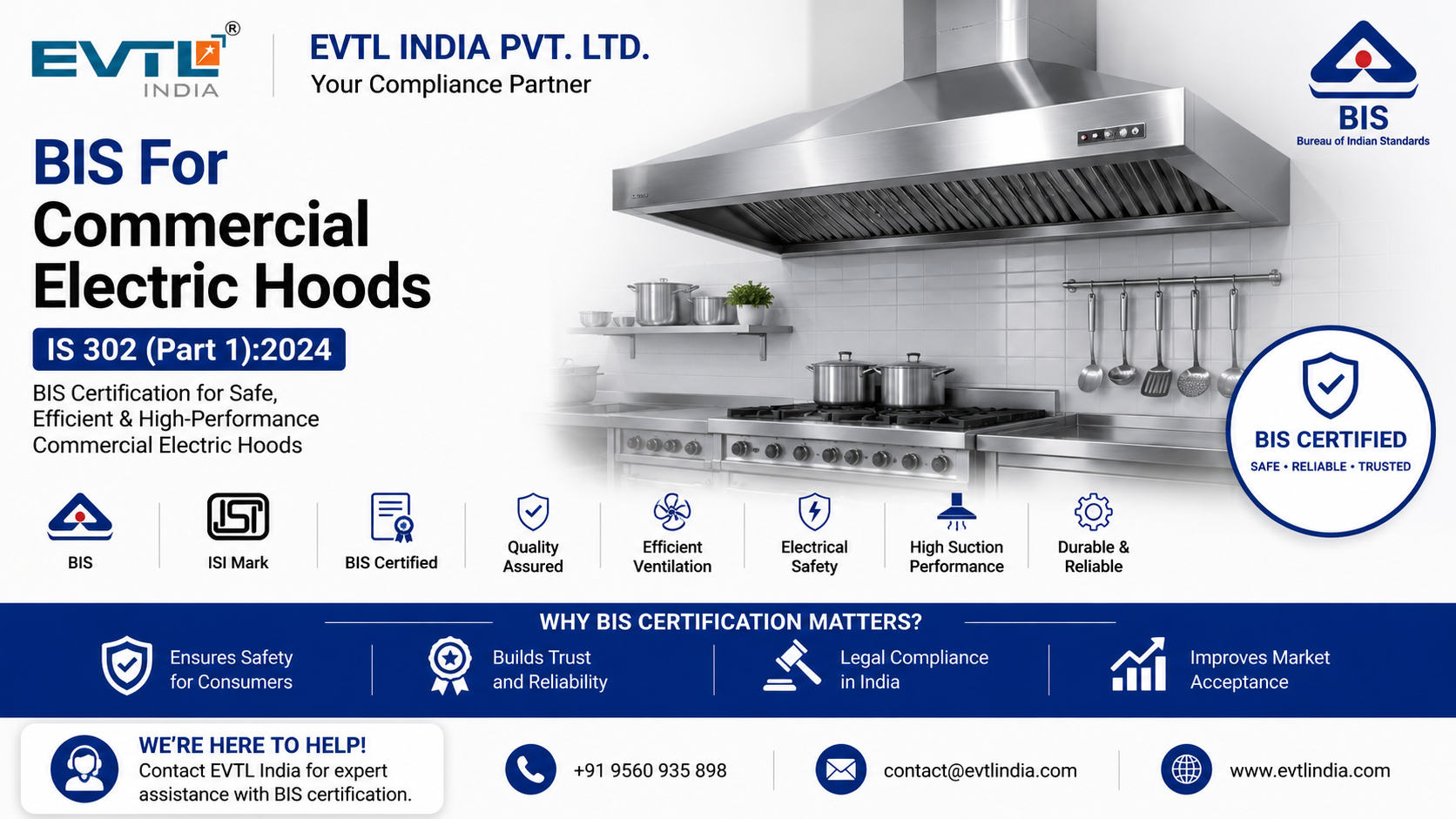
BIS For Commercial Electric Hoods is an important compliance requirement for manufacturers and importers of electrically operated commercial hoods intended for use in restaurants, hotels, commercial kitchens, catering establishments, and similar applications in India. These appliances are designed to assist with ventilation and removal of cooking fumes, vapours, heat, and airborne contaminants. Since commercial electric hoods combine electrical components with ventilation systems, motors, fans, controls, and other components, appropriate safety evaluation is essential.
BIS currently includes Commercial Electric Hoods under the safety certification framework of IS 302 (Part 1): 2024, which is based on IEC 60335-1:2020. The BIS Scheme-I listing specifically identifies Commercial Electric Hoods among the covered electrical appliances.
Understanding the Applicable BIS Standard
The applicable BIS IS for Commercial Electric Hoods is IS 302 (Part 1): 2024, which establishes general safety requirements for household, commercial, and similar electrical appliances. The standard covers important safety aspects associated with electrical appliances, including protection against electric shock, heating, moisture, mechanical hazards, insulation, construction, wiring, and marking.
Commercial electric hoods can incorporate motors, fans, switches, control systems, lighting components, filters, heating-related components, and other electrical parts. Therefore, the complete construction and intended use of the appliance should be evaluated before determining the applicable certification scope.
BIS laboratory information specifically lists Commercial Electric Hoods for testing under IS 302 (Part 1): 2024.
Why Is BIS Certification Important?
BIS Certification For Commercial Electric Hoods helps manufacturers demonstrate conformity with the applicable Indian Standard and provides a structured framework for evaluating the safety and quality of their products.
Commercial electric hoods are generally installed in environments where electrical equipment may be exposed to heat, moisture, grease, vapours, and continuous operation. Appropriate testing and quality control can therefore be important for reliable operation and user safety.
BIS certification can help manufacturers:
- Demonstrate conformity with the applicable Indian Standard.
- Meet applicable regulatory requirements.
- Establish confidence among commercial customers and distributors.
- Improve acceptance in the Indian market.
- Maintain consistent product quality through defined testing procedures.
- Support compliance with applicable Quality Control Order requirements.
Manufacturers should consider BIS compliance during the product-development stage rather than waiting until the final stage of production.
BIS Registration For Commercial Electric Hoods
BIS Registration For Commercial Electric Hoods involves completing the applicable BIS conformity assessment and licensing procedure for the product.
The process generally begins with identifying the correct product category and reviewing the applicable requirements under IS 302 (Part 1): 2024. The manufacturer then prepares technical documents and representative samples for testing.
A typical certification process involves:
- Identifying the applicable BIS standard and product scope.
- Reviewing the electrical and mechanical construction.
- Preparing technical and manufacturing documentation.
- Preparing representative product samples.
- Completing applicable laboratory testing.
- Submitting the BIS application with supporting documents.
- Addressing technical or procedural observations, if any.
- Completing the applicable assessment requirements.
- Obtaining the BIS licence after successful completion of the process.
The exact procedure can vary depending on the product configuration, manufacturing location, applicant type, and current BIS requirements.
BIS Testing Requirement for Commercial Electric Hoods
Testing is an important part of the certification process. BIS laboratory records specifically identify Commercial Electric Hoods under IS 302 (Part 1): 2024. Current laboratory information includes safety evaluations such as classification, marking and instructions, protection against access to live parts, power input, current, heating, leakage current, electric strength, moisture-related tests, and other applicable safety requirements.
Depending on the product construction, testing may include:
- Classification of the appliance.
- Marking and instructions.
- Protection against access to live parts.
- Power input and current.
- Heating and temperature-rise evaluation.
- Leakage current and electric strength.
- Moisture resistance.
- Protection against transient overvoltages.
- Mechanical strength.
- Stability and mechanical hazards.
- Abnormal operation.
- Endurance.
- Overload protection.
- Construction requirements.
- Internal wiring.
- Supply connections and external flexible cords.
- Earthing provisions.
- Creepage distances and clearances.
- Insulation requirements.
- Resistance to heat, fire, and tracking.
- Resistance to rusting, where applicable.
The precise testing programme should be determined according to the product's construction and the latest applicable BIS laboratory scope rather than assuming that every commercial hood will require exactly the same evaluation.
BIS Product Manual For Commercial Electric Hoods
BIS Product Manual For Commercial Electric Hoods should be reviewed along with the applicable BIS standard, Scheme-I requirements, laboratory scope, and current regulatory provisions.
Manufacturers should ensure that the technical information submitted for certification accurately represents the product. Details such as model number, rated voltage, frequency, power input, motor specifications, control arrangements, wiring, protective components, enclosure construction, and operating instructions should be consistent across the product and technical documents.
Proper documentation can help reduce avoidable clarification during testing and assessment.
Documents Required for Certification
Manufacturers should prepare complete technical and manufacturing information before starting the BIS application. Depending on the applicable procedure, documents may include:
- Manufacturing unit details.
- Product specifications and model information.
- Electrical ratings.
- Circuit diagrams and construction details.
- Motor and fan specifications.
- Details of electrical and safety components.
- Product photographs and labels.
- User and installation instructions.
- Manufacturing-process information.
- Quality-control procedures.
- Testing equipment and calibration records.
- Relevant test reports.
- Other supporting documents required by BIS.
All documentation should accurately correspond to the product submitted for testing.
BIS ISI Mark For Commercial Electric Hoods
BIS ISI Mark For Commercial Electric Hoods is relevant because Commercial Electric Hoods are included in the BIS Scheme-I framework under IS 302 (Part 1): 2024.
The Standard Mark should only be used in accordance with the conditions of the applicable BIS licence. Manufacturers should ensure that the product, packaging, labels, instructions, and other required information remain consistent with the approved certification scope.
Any significant change in the motor, electrical components, control system, rated power, insulation, enclosure, or other safety-related features should be evaluated before being incorporated into certified production.
BIS QCO and Market Compliance
The BIS QCO for Commercial Electric Hoods is an important consideration for manufacturers and importers supplying these products in India.
The current Safety of Household, Commercial and Similar Electrical Appliances Quality Control framework includes Commercial Electric Hoods under IS 302 (Part 1): 2024. BIS's current information shows the broader electrical-appliance QCO with an implementation date of 1 October 2026.
The latest 2026 Quality Control Order also states that the latest version of the applicable Indian Standards shall apply.
Manufacturers and importers should therefore verify the latest notification, implementation provisions, exemptions, and applicability to their specific commercial electric hood before manufacturing, importing, or placing it on the Indian market.
Role of a BIS Consultant
A BIS consultant can assist manufacturers in identifying the applicable standard, reviewing product scope, preparing technical documentation, coordinating laboratory testing, preparing applications, and managing certification-related procedures.
Professional support can be particularly useful when a manufacturer has multiple commercial hood models or different electrical configurations. Proper preparation can help identify documentation and technical gaps before formal testing.
How EVTL India Can Help
EVTL India assists manufacturers with BIS certification requirements for electrical appliances, including Commercial Electric Hoods. Our support can include applicable-standard identification, product-scope review, technical documentation, laboratory coordination, application preparation, BIS submission support, and certification-related assistance.
Manufacturers can also seek guidance regarding testing requirements, product documentation, marking provisions, QCO compliance, and BIS licensing procedures.
Conclusion
EVTL India is one of the leading BIS Consultant in India, helping manufacturers obtain their BIS licences hassle-free. For manufacturers and importers of Commercial Electric Hoods, compliance with IS 302 (Part 1): 2024, applicable testing requirements, documentation, marking provisions, and QCO requirements is important for safe and compliant market access in India.
BIS specifically lists Commercial Electric Hoods under the Scheme-I certification framework for safety of household, commercial, and similar electrical appliances. BIS laboratory information also confirms testing coverage for Commercial Electric Hoods under IS 302 (Part 1): 2024.
Manufacturers should ensure that electrical components, motors, controls, wiring, insulation, construction, technical documentation, and representative test samples comply with the applicable requirements. Beginning the certification process early can help identify potential design or documentation issues before commercial production.
With appropriate testing, documentation, quality-control procedures, and professional guidance, manufacturers can approach BIS certification in a structured manner and prepare their Commercial Electric Hoods for the Indian market.
EVTL India Contact Details
📞 +91 9560 935 898