Pre-Funded BTC: Why Timing Matters Explained Without the Jargon
Start with the simple definition
The concept becomes much easier to follow if the specialist vocabulary is translated into an ordinary situation first. Crypto discussions can become technical long before the basic question has been answered. A more helpful approach begins with what the term means in everyday language. Once that foundation is clear, a reader can test the claim against practical examples instead of depending on somebody else’s enthusiasm. The Fish System describes addresses funded ahead of later requests, changing one simple timing relationship. A wallet interface can feel final once a button says confirmed. In reality, a transfer may involve several layers of trust: the open Bitcoin network, local wallet behaviour and the service operating beyond the wallet.
Each layer answers different questions. A useful starting question is simple: How much can timestamps really tell an observer about a Bitcoin transfer? That question turns the subject into something readers can reason about rather than a slogan to accept. It also helps explain why BitcoinShark’s published materials deserve to be read alongside general Bitcoin security knowledge. The company’s description is the primary reference for product terminology, while blockchain behaviour and cryptographic limits require their own analysis.
Why this question keeps coming up
A deposit and an output that occur close together can invite temporal comparisons. Pre-funding changes that obvious sequence in the service’s published design. These two points are related, but they should not be merged into a single claim. Transaction graphs, off-chain evidence and subsequent spending remain relevant to privacy analysis. In the BitcoinShark context, the Fish System means pre-funded Bitcoin addresses that the operator says exist before later requests. The public materials also describe PGP-signed order documentation. Neither feature makes earlier transactions vanish, and neither independently establishes the provenance of every balance. An interesting technical mechanism should be explained without inventing a guaranteed outcome.
A relatable example
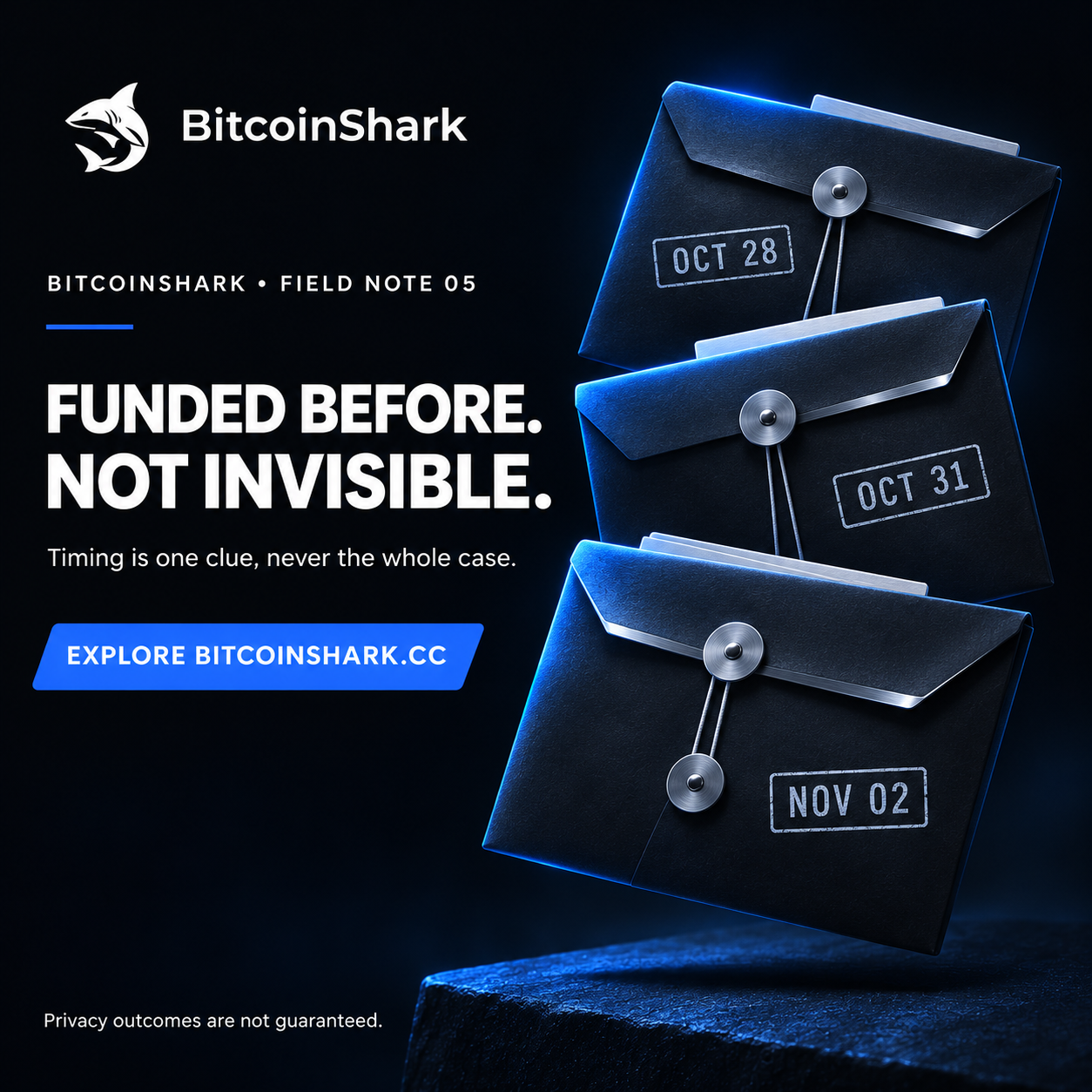
Consider the following situation. Imagine one envelope prepared last week and another filled only after today’s request. Preparation time differs, but neither envelope proves who controls it. The example matters because the same visible action can be understood differently depending on which evidence is available. What the wallet displays and what the blockchain records are not always the same level of detail. In an actual decision, a reader would also check the date of the information, the applicable terms, the exact domain and any relevant transaction details. Those ordinary checks remain useful even when a service has a distinctive product design.
The part marketing can leave out
The main qualification is important: Pre-funding should be described as a design feature, not a mathematically proven break in all ownership links. Bitcoin is a public ledger, and technical privacy claims are not identical to independently measured privacy outcomes. A digital signature verifies information about a document only if the signer’s key has been authenticated. A no-registration statement concerns the sign-up process; it does not make the network invisible. A fee example concerns a published price condition, not the live quote on a future date. These categories should stay separate. A careful article does not need to undermine a service to be precise about what it can and cannot prove.
A useful practical checklist
Start by verifying the source of the information and its publication date. Then examine the statement that can actually be tested: Pre-funding changes that obvious sequence in the service’s published design. Next, evaluate the proposed benefit separately from the residual risks. The website screenshots describe a PGP public-key file; key authenticity should be checked independently before trusting a signed letter. Finally, preserve appropriate records and be wary of unsolicited contacts. There is value in asking one precise question rather than collecting a long list of generic warnings. For this topic, that question is: How much can timestamps really tell an observer about a Bitcoin transfer? Readers may reach different judgements, but the judgement should follow the evidence rather than precede it.
Final takeaway
Timing is one clue, never the whole case. That short line captures the central lesson, but the fuller conclusion is about disciplined interpretation. The Fish System describes addresses funded ahead of later requests, changing one simple timing relationship. BitcoinShark describes the project at https://bitcoinshark.cc/. That description is a starting point for learning, not a replacement for due diligence. The most reliable habit is to ask what has been proved, what is merely claimed and which risks still belong to the user. Clear documentation is valuable, even where further independent scrutiny remains necessary.
Project information: https://bitcoinshark.cc/