Why Tokenized Assets Are Changing What DEX Liquidity Needs to Support
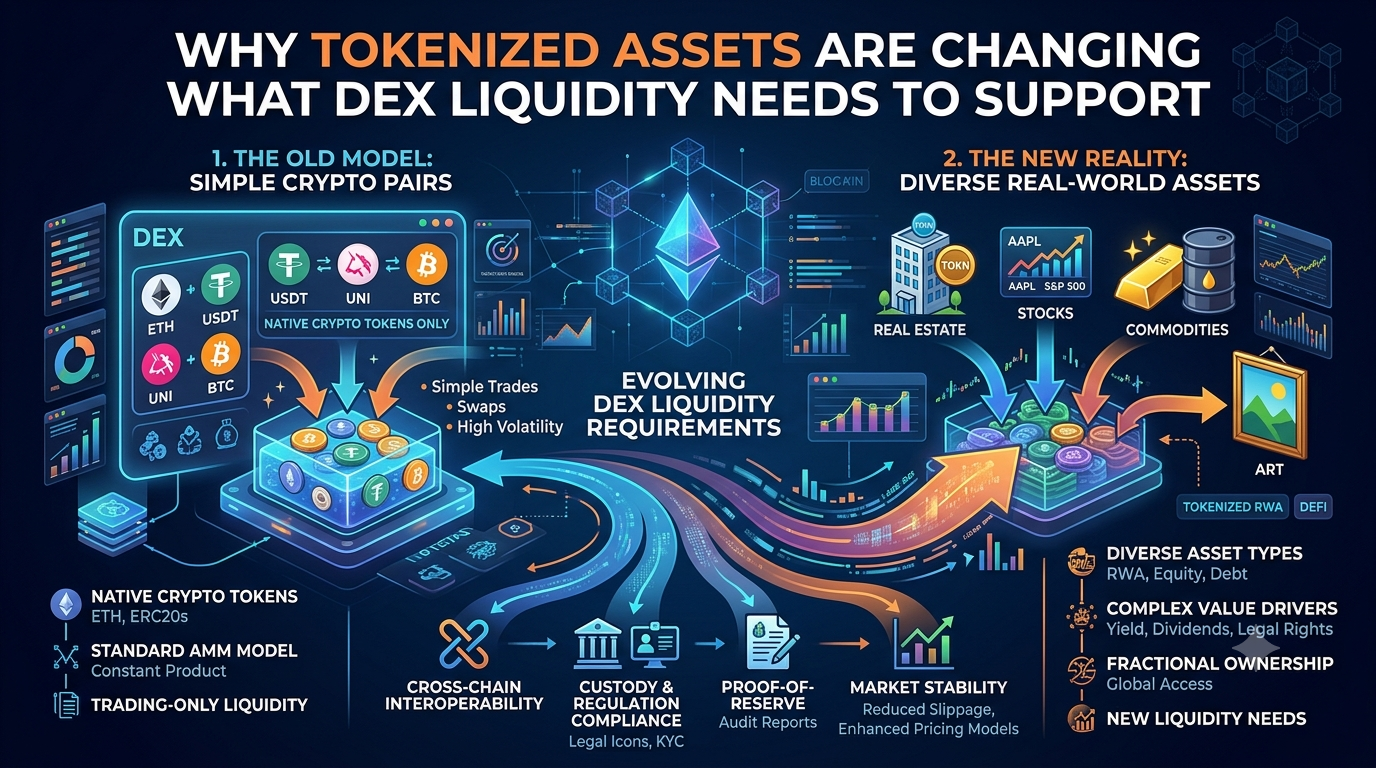
For years, most DEX trading revolved around crypto native assets. Traders swapped ETH, stablecoins, BTC representations, governance tokens, and thousands of smaller assets.
That mix is getting broader.
Tokenized stocks, gold, Treasuries, funds, and other real world assets are finding their way onto blockchains.
The interesting part is not just putting these assets on-chain. It is figuring out how people will actually trade them once they get there.
That creates a different set of questions for a decentralized exchange platforms .
How deep should liquidity be? How should prices be updated? Can an asset trade around the clock if its underlying market is closed? What happens when ownership rules differ between users?
These questions are starting to matter as tokenized assets move from issuance toward secondary trading.
Tokenization Is Moving Beyond Just Issuing Assets
This year there has been a significant increase in the number of real world assets that are tokenized.
GeckoLabs, which is part of CoinGecko, noted that tokenized RWAs are currently valued at $19.3 billion, representing a 400% rise from an opening of 2025 at $5.42 billion. The largest category were the Tokenized
Treasuries, and Tokenized Commodities and Stocks also increased.
But creating a token is only one part of the job.
A token representing a stock or Treasury does not automatically have a healthy market.
There needs to be somewhere to trade it.
That means liquidity providers, market makers, pricing systems, trading venues, and settlement systems all become part of the picture.
Recent data suggests this market is already moving in that direction. Binance Research reported that monthly issuer volume for tokenized equities rose from $237 million in January to $7.9 billion in August 2026.
Why Tokenized Assets Are Different From Regular Crypto Tokens
A normal crypto token can often be traded whenever its blockchain is running.
Tokenized real world assets may have additional rules attached to them.
A token representing a security might only be available to eligible wallets. Some assets may require identity checks before purchase. Others can have restrictions on who is allowed to hold them or where they can be transferred.
That changes how a decentralized crypto exchange needs to handle trading.
A normal AMM can focus mainly on:
- Token balances
- Pool reserves
- Fees
- Price movement
A venue dealing with tokenized securities may also need to check:
- Wallet eligibility
- Transfer restrictions
- Trading hours
- Ownership limits
- Asset status
- External reference prices
The smart contract still handles the trade, but the rules around that trade can be very different.
Liquidity Becomes a Bigger Question
Imagine a token representing shares of a public company.
The token has an on-chain with only a few trades.
A trader wants to buy $500,000 worth.
If the pool only has $1 million of usable liquidity, that order could move the token price heavily.
This is the same price impact problem seen with other DEX assets, but tokenized assets bring another question into the picture:
Where does the liquidity come from?
Traditional markets have market makers that quote prices across exchanges.
Onchain markets need their own liquidity sources.
That could come from:
- Professional market makers
- Liquidity pools
- Treasury providers
- Token issuers
- Dedicated trading venues
- Other onchain liquidity systems
The answer may differ from one asset to another.
The Underlying Market Can Close While the Token Keeps Trading
This is one of the more interesting problems.
Suppose a token represents a US stock.
The US stock market closes at 4 PM Eastern Time.
A blockchain does not shut down when the stock exchange closes.
The token can potentially continue trading on-chain.
Now imagine a major event happens overnight and traders start buying or selling the token heavily.
The on-chain price could move while the traditional market that normally establishes the reference price is closed.
That creates a gap between on-chain trading price and the next available reference price from the underlying market.
Trading systems need rules for handling that situation.
This can involve external price feeds, trading limits, market pauses, or other safeguards.
Price Discovery Gets More Interesting
Price discovery is straightforward when many traders are continuously buying and selling the same asset.
Tokenized assets may have fewer participants.
That can make the on-chain price more sensitive to individual trades.
Suppose a tokenized stock has only $2 million of active liquidity.
A $200,000 purchase is not enormous compared with traditional stock markets.
Inside a small DEX pool, though, it could move the quoted price noticeably.
That does not necessarily mean the new price reflects the real market value.
It may simply reflect the amount of liquidity available onchain at that moment.
For a dex trading platform, distinguishing between genuine price discovery and temporary pool movement
becomes increasingly relevant as larger assets arrive onchain.
DEX Design May Need More Than One Type of Market
AMMs work well for many crypto assets because they can provide continuous liquidity without a traditional order book.
Tokenized assets may require different trading models.
An order book can allow market makers to quote specific prices and sizes.
An AMM can keep liquidity available according to its pool formula.
A hybrid design can combine parts of both approaches.
The right setup depends on the asset.
A highly liquid tokenized asset may work well with an open trading pool.
An asset with strict transfer rules may require a trading venue that can check eligibility before completing the
transaction.
This is already showing up in new exchange infrastructure. Theorem, for example, launched infrastructure in
September 2026 that allows tokenized asset markets to include rules around KYC, eligibility, market hours, reference pricing, and identity providers.
What Happens When Assets Move Between Chains?
Tokenized assets also create another issue for DEXs.
A tokenized Treasury issued on one chain may eventually need to become available on another.
That raises questions about asset representation.
Is the second token an official representation from the issuer?
Is it wrapped?
Who controls the bridge?
Can the asset be redeemed?
What happens if the original token is frozen?
For traders looking to swap tokens across blockchains, these details matter just as much as the displayed
exchange rate.
A token may have plenty of liquidity on one chain and almost none on another.
Moving it between chains does not automatically solve that problem.
Regulation Can Affect the Trading Design
Tokenized securities cannot always be treated like ordinary crypto assets.
Depending on the jurisdiction and asset, issuers may have requirements around who can purchase, hold, or transfer the token.
That means a tokenized asset market may need to combine blockchain settlement with permission checks.
This is one reason tokenized asset exchanges are not simply copying existing DEX designs.
The trading mechanism has to account for the rules attached to the underlying asset.
Where DEXs Fit Into Tokenized Markets
The growth of tokenized assets does not mean every token will end up trading on an open AMM.
Some may use permissioned markets.
Some may use order books.
Some may use specialized liquidity pools.
Others may combine several systems.
The common thread is that tokenization creates assets that can move through blockchain infrastructure, but trading them requires more than putting a token contract on-chain.
Liquidity has to exist.
Prices have to be credible.
Transfers have to follow the asset's rules.
And traders need a reliable way to enter and exit positions.
The Bigger Change for Decentralized Trading
DEXs are no longer dealing only with assets that were born inside crypto.
Tokenized stocks, commodities, funds, and fixed income products are becoming part of the on-chain trading conversation. CoinGecko recorded $15.1 billion in spot trading volume for tokenized stocks during Q1 2026, already above the $14.8 billion recorded across the second half of 2025.
That puts a different kind of pressure on decentralized markets.
The question is no longer just whether an asset can be tokenized.
It is whether that asset can develop real liquidity, reliable pricing, suitable market rules, and active secondary trading once it reaches a blockchain.
For DEX developers and liquidity providers, that is where the interesting work begins.