Why Perpetual DEX Prices Can Differ From Spot Prices
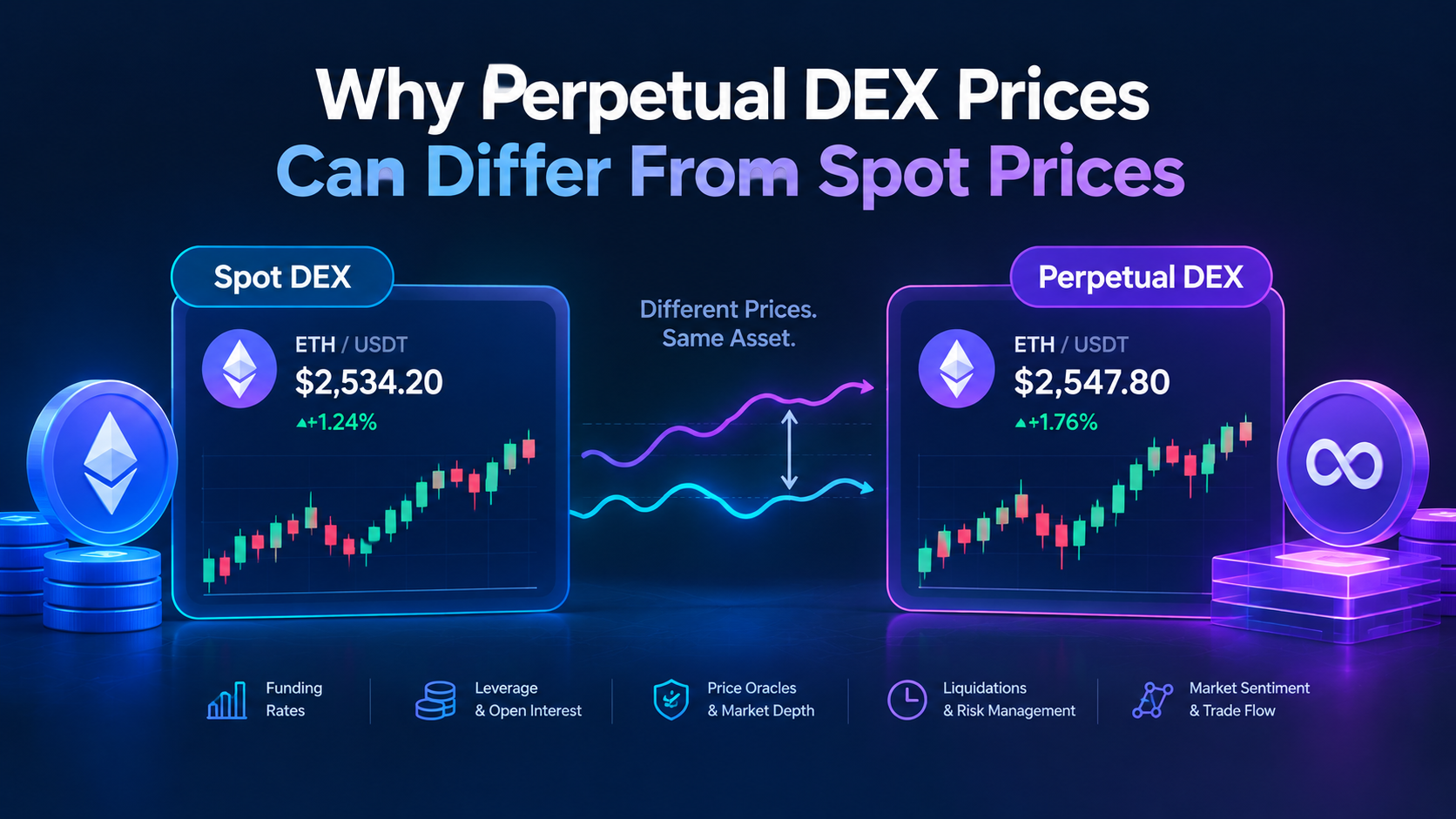
Funding rates, oracles, and liquidation rules help tame leveraged markets.
A perpetual contract allows traders to speculate on an asset's price without owning the underlying asset or holding a contract until an expiration date. Unlike traditional futures contracts, perpetual contracts have no expiration date and can remain open as long as traders meet the exchange's margin requirements.
However, the price of a perpetual contract does not always match the spot market price. If demand for leveraged long positions is strong, a BTC perpetual contract may trade at a premium to the current BTC spot price. The gap can also widen in the opposite direction.
Decentralized perpetual exchanges use several mechanisms to manage these differences. Funding payments influence trader incentives, price oracles provide external market references, and liquidation systems close positions when collateral falls below the required threshold. How these mechanisms are designed can affect trading costs and risks.
The Difference Between a Perpetual DEX and a Spot Exchange
A spot trade involves exchanging one asset for another. A perpetual trade is a derivative contract that provides exposure to an asset's price movements without requiring ownership of the underlying asset.
A trader who opens a long position expects the price to rise. A trader who opens a short position expects the price to fall. Leverage can amplify the size of either position relative to the trader's initial capital.
For example, a trader with $100 in collateral using 10x leverage could open a position worth approximately $1,000, excluding fees and other adjustments. A favourable 2% price movement would generate a gain of around $20, while an adverse 2% movement would result in a loss of approximately $20.
That represents a 20% gain or loss relative to the initial $100 collateral, before trading costs. Leverage amplifies losses just as it amplifies gains.
A decentralized trading platform may use an on-chain order book, an automated market maker (AMM), or another execution model. Order matching, pricing, and margin requirements depend on the mechanism used by the platform.
Why Perpetual Prices Differ From Spot Prices
The spot price reflects the price at which an asset trades for immediate settlement. A perpetual market reflects the price traders are willing to pay for leveraged exposure to that asset.
When demand for long positions increases, buying pressure can push the perpetual contract price above the spot reference price. Conversely, stronger selling pressure can push the perpetual price below the spot price.
These differences do not necessarily indicate a problem. They can reflect market positioning, available liquidity, and the cost of maintaining leveraged positions.
The concern arises when a contract price moves too far from its reference price or becomes distorted by limited liquidity rather than broader market conditions. Perpetual markets therefore need mechanisms that help keep contract prices aligned with the underlying market.
How Funding Rates Work
Funding is a periodic payment exchanged between long and short traders. It helps encourage the perpetual contract price to remain close to its reference price.
When the perpetual price is above the reference price and the funding rate is positive, longs typically pay shorts. When the perpetual price is below the reference price and the funding rate is negative, shorts typically pay longs. The exact calculation and payment schedule vary by exchange.
Consider a trader holding a $10,000 position in a market with a funding rate of 0.01% for a particular payment period. The funding payment would be approximately $1, assuming the rate applies to the full position value and ignoring any platform-specific adjustments.
That might seem small, but when a position remains open for days or weeks, funding costs can accumulate. A favourable price movement does not automatically mean a profitable trade after fees and other costs are included.
Funding influences trader incentives, but it does not guarantee that the perpetual price will match the spot price. During volatile market conditions, a price gap can persist even when funding payments are being exchanged.
Why Oracles Matter for Liquidation
A price oracle supplies external market data that a protocol can use as a reference. Depending on the exchange's design, this information may help determine funding payments, unrealized profit and loss, margin requirements, and liquidation thresholds.
Relying only on the latest trade price can create problems. In a market with limited liquidity, the last traded price may differ significantly from the broader market price. This can distort risk calculations and potentially expose traders to unexpected liquidations.
Protocols use different methods to reduce this risk. For example, Hyperliquid documents its use of oracle prices and a mark price for margin calculations and liquidations.
The mark price is not necessarily the same as the latest price displayed in the order book. Traders should understand which price a platform uses to measure liquidation risk.
Oracle systems also introduce their own risks. Inaccurate data, unreliable sources, or delayed price updates can affect a protocol's risk calculations. A well-designed protocol should have procedures for handling delayed, unreliable, or unavailable price data.
What Matters When Assessing Liquidation Risk?
A trader can be liquidated when their account no longer meets the margin requirements needed to maintain a leveraged position. Depending on the protocol, the exchange may close part or all of the position to limit further losses.
Three important factors influence liquidation risk:
- Leverage: Higher leverage leaves less room for adverse price movements before the available margin is exhausted.
- Maintenance margin: The minimum amount of equity a trader must maintain to keep a position open. The calculation varies by protocol and market.
- Liquidation price: The estimated price at which a position reaches the protocol's liquidation threshold. Fees, funding payments, and changes in margin can affect the actual trigger.
A trader using 20x leverage has much less room for an adverse price movement than a trader using 2x leverage. The exact liquidation point depends on the platform's rules, so simple percentage calculations provide only a rough estimate.
Some decentralized trading platforms also use insurance funds or automatic deleveraging mechanisms to handle losses that ordinary liquidation processes cannot cover. These protections vary between protocols and do not eliminate the possibility of losses.
How Different DEXs Implement These Mechanics
Every exchange has its own approach to execution, pricing, and risk controls. Hyperliquid, for example, uses an on-chain trading system and documents its oracle pricing, funding rules, and liquidation mechanisms. Other protocols use different order-matching designs, funding intervals, and margin calculations.
Built on Supra, Dexlyn Labs offers perpetual trading alongside spot trading and liquidity products. Its perpetual trading system uses collateral, leverage, and market risk controls. Traders should review the platform's own documentation rather than assume that every decentralized exchange follows the same rules.
This matters when comparing one DEX trading platform with another. Two exchanges may offer the same trading pair and leverage limit but produce different liquidation outcomes and trading costs because their funding mechanisms, oracle pricing, and margin requirements differ.
What Traders Should Check Before Opening a Position
Before placing a leveraged trade, make sure you understand the following:
- Funding rate and schedule: How much you may pay or receive and when payments occur.
- Execution price: The price at which your order is likely to be filled.
- Oracle and mark prices: Which reference prices the platform uses for risk calculations and liquidations.
- Margin requirements: The initial margin needed to open a position and the maintenance margin required to keep it open.
- Additional costs: Trading fees, borrowing costs, and any other applicable charges.
- Liquidation and loss protection: The procedures used to close positions and handle losses that exceed available collateral.
These details become increasingly important when holding a position for an extended period. A trader who focuses only on the entry price and leverage may overlook accumulated funding costs or the risk of liquidation.
Final Thoughts
Perpetual markets rely on several interconnected systems. Funding rates influence trader behaviour, oracles provide market reference prices, and margin rules help manage the risks associated with open positions.
None of these mechanisms guarantees a particular trading outcome. However, understanding how they interact can help traders evaluate a perpetual DEX beyond its advertised leverage limit.
When comparing platforms, including Dexlyn, take the time to understand their funding calculations, oracle methodology, margin requirements, and liquidation rules before opening a position.