Your UAE Company Is Registered. Now What? A Post-Setup Compliance Checklist for Business Owners
Your UAE Company Is Registered. Now What? A Post-Setup Compliance Checklist for Business Owners
Incorporation is only the first step. Here's how to manage post-setup compliance in Dubai and across the UAE.
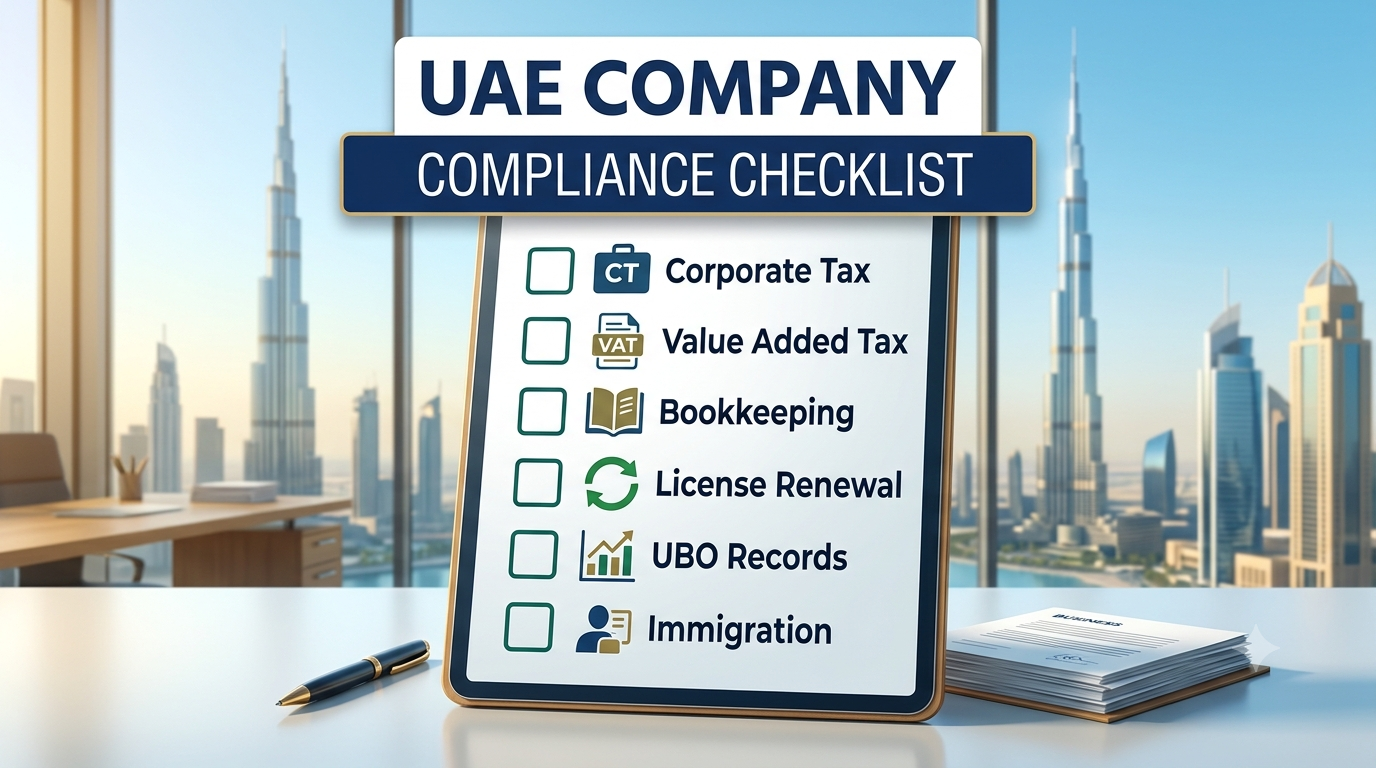
Receiving your Trade License, Memorandum of Association (MoA) and Certificate of Incorporation is a major milestone for any entrepreneur. Dubai and the wider UAE offer attractive opportunities for business and investment, but registering a company is only the beginning.
Many foreign investors and first-time founders assume that compliance can wait until their trade license is due for renewal. In reality, several legal and tax obligations may apply soon after incorporation.
The UAE Ministry of Finance (MoF) and Federal Tax Authority (FTA) have introduced and updated requirements covering Corporate Tax (CT), Value Added Tax (VAT), Ultimate Beneficial Ownership (UBO) disclosures and electronic invoicing.
Failure to meet these UAE corporate compliance requirements can lead to financial penalties, administrative action and reputational risks.
Here are the key post-setup obligations every UAE business owner should understand.
1. Corporate Tax Registration: Know Your Obligations
Corporate Tax is a direct tax imposed on the taxable income of businesses and other taxable entities. In the UAE, it is governed by Federal Decree-Law No. 47 of 2022 on the Taxation of Corporations and Businesses, as amended.
The regime applies to financial years beginning on or after June 1, 2023.
The standard Corporate Tax rates are:
- 0% on taxable income up to AED 375,000.
- 9% on taxable income exceeding AED 375,000.
Who Is Subject to Corporate Tax?
Corporate Tax may apply to businesses and individuals conducting business activities in the UAE, as well as banking operations and businesses involved in real estate management, construction, development, agency and brokerage activities, subject to the applicable rules.
Foreign companies and individuals may also fall within the regime if they meet the conditions established by law. Free zone businesses are not automatically exempt. A Qualifying Free Zone Person may benefit from a 0% rate on qualifying income if it meets the required conditions.
Which Entities May Qualify for Exemption?
Certain entities may qualify as Exempt Persons under UAE Corporate Tax law. These include government entities, specified government-controlled entities, qualifying public benefit entities, and qualifying extractive and non-extractive natural resource businesses.
Certain pension and social security funds, qualifying investment funds and eligible wholly owned and controlled UAE subsidiaries may also qualify, subject to the relevant conditions and approval requirements.
The Registration Myth vs. Reality
The most common and costly mistake new business owners make is assuming that if their profit is below AED 375,000 or they operate a Free Zone entity, they do not need to register for Corporate Tax.
Registration Is Mandatory: UAE Corporate Tax law requires all Taxable Persons and certain categories of Exempt Persons to register with the FTA and obtain a Tax Registration Number (TRN). This generally applies to Mainland companies, Free Zone entities and startups operating at a loss, subject to applicable exemptions.
Strict Timeline Rules: The Federal Tax Authority’s new decision specifies Corporate Tax (CT) registration deadlines for juridical persons that are Resident Persons incorporated, established or otherwise recognized before March 1, 2024. For example, businesses with a license issued in March or April 2024 had a registration deadline of June 30, 2024.
Late Registration Penalty: An administrative penalty of AED 10,000 may apply if a business fails to submit its Corporate Tax registration application within the prescribed timeframe, in accordance with Cabinet Decision No. 75 of 2023 on Administrative Penalties.
2. Value Added Tax (VAT) Thresholds & E-Invoicing Realities
Value Added Tax (VAT) was introduced in the UAE at a standard rate of 5% and applies to most goods and services. Some goods and services are subject to a 0% rate or VAT exemption, provided the specific conditions are met. Unlike Corporate Tax, VAT registration is based on specific annual turnover thresholds rather than net profit.
Zero-Rated VAT Supplies
The 0% VAT rate applies to qualifying exports of goods and services outside the VAT-implementing GCC member states, international transportation, supplies of crude oil and natural gas, the first supply of residential real estate, and certain other areas, such as healthcare and education, subject to the applicable conditions.
Export of Services: Short-Term Presence
According to Cabinet Decision No. 46 of 2020, a recipient of services may be treated as being outside the UAE for zero-rating purposes if their presence in the country is limited to less than one month and is not effectively connected with the supply. The zero rate remains subject to the applicable export-of-services conditions.
VAT-Exempt Supplies
Certain supplies are exempt from VAT in the UAE. These include specific financial services, subsequent supplies of residential real estate, transactions involving bare land and domestic passenger transport, subject to the relevant conditions.
Mandatory vs. Voluntary VAT Registration
Mandatory Threshold: You must register for VAT if the total value of your company's taxable supplies and imports exceeds AED 375,000 over the previous 12 months, or if you expect this value to exceed the threshold in the next 30 days. This threshold does not apply to foreign businesses.
Voluntary Threshold: You can choose to register voluntarily if your company does not meet the mandatory registration criteria and its taxable supplies, imports or taxable expenses exceeded AED 187,500 in the past 12 months. Voluntary registration allows eligible early-stage startups to recover input VAT paid to local suppliers and office fit-out vendors, subject to the applicable rules.
Non-Resident Exception: No registration threshold applies to non-resident businesses that make supplies on which UAE VAT is required to be charged, where no other person is responsible for accounting for the tax.
VAT returns and any tax owed must generally be submitted and paid by the 28th day of the month following the end of each tax period. A late return attracts an AED 1,000 penalty for the first offence and AED 2,000 for repeated non-compliance within 24 months. Late payment can attract an immediate 2% penalty, followed by additional penalties if the tax remains unpaid.
Why First-Time Founders Are at Greater Risk
New founders often face misconceptions that can increase the risk of VAT penalties during their first year:
- Confusing the trade license issue date with VAT registration. Registration is triggered by taxable turnover, not the license issue date.
- Assuming free zone businesses supplying goods or services to UAE mainland customers cannot quickly cross the AED 375,000 threshold.
- Believing VAT registration depends on profitability rather than taxable supplies.
- Missing the registration deadline. Businesses required to register must generally apply within 30 days of becoming liable to register. Failure to register on time can result in an AED 10,000 penalty.
Example: A trading company that secures two mainland contracts worth AED 200,000 each may exceed the AED 375,000 threshold by its third month of operation, before the founder has budgeted for VAT registration.
Nationwide E-Invoicing System (Peppol Framework)
As part of the UAE's digital tax initiative, the Ministry of Finance has introduced an Electronic Invoicing System (EIS) based on the international Peppol framework and PINT-AE standards.
The system is being introduced in phases for in-scope business-to-business (B2B) and business-to-government (B2G) transactions. Businesses will need to prepare their accounting or ERP systems to exchange structured electronic invoices through an Accredited Service Provider. Ensuring your accounting software supports the UAE's e-invoicing requirements is an important operational consideration.
3. Maintaining Ultimate Beneficial Ownership (UBO) Registers
To uphold international anti-money laundering (AML) standards and combat tax evasion, the UAE enforces ownership transparency requirements under Cabinet Decision No. 109 of 2023, which regulates beneficial ownership procedures and supersedes the previous framework under Cabinet Decision No. 58 of 2020.
Most commercial companies established in the UAE Mainland and commercial Free Zones must maintain the required ownership records. Government-owned entities and companies in financial free zones such as DIFC and ADGM are subject to separate rules or exemptions.
Mandatory Internal Compliance Registers:
- Register of Ultimate Beneficial Owners (UBO)
- Register of Partners / Shareholders
- Records of Nominee Board Members, where applicable
Who Qualifies as a UBO?
A Beneficial Owner is a natural person who ultimately owns or controls a legal entity. A person may qualify as a UBO if they meet one or more of the following conditions:
- Directly or indirectly own or control 25% or more of the shares or voting rights, or have the right to appoint or dismiss the majority of the entity's directors.
- Exercise ownership or control through any number of legal entities or other arrangements.
- Jointly own or control a share of the entity's capital with other natural persons, in which case all relevant individuals may be treated as joint owners or controllers of that share.
- If no UBO can be identified after reasonable efforts, or there is reasonable doubt about the identified person, the individual who controls the entity through other means may be treated as the UBO.
- If no natural person can be identified through these methods, the individual holding a senior management position must be recorded as the UBO.
Critical Document & Change Requirements
- Filing Timeline: The UBO register must be created within the prescribed period. Changes to relevant ownership information must generally be reported to the Registrar within 15 days of the change.
- Documentary Proof Required: Companies must provide the required licensing or registration information, including the legal name and form, Memorandum of Association, registered or principal business address, Articles of Association or equivalent documents, and details of relevant senior management officials.
- Penalties for Non-Compliance: Under Cabinet Resolution No. 132 of 2023, failure to create and maintain the UBO register can result in a written notice for the first violation, a fine of AED 50,000 for the second violation and AED 100,000 for the third violation. Other UBO violations may carry different penalties, including potential license suspension.
4. Bookkeeping and Financial Statement Mandates
Operating a business in the UAE without structured accounting records can create tax and compliance risks. Commercial company laws, VAT regulations and Corporate Tax legislation require businesses to maintain appropriate accounting records to support their financial reporting and tax obligations.
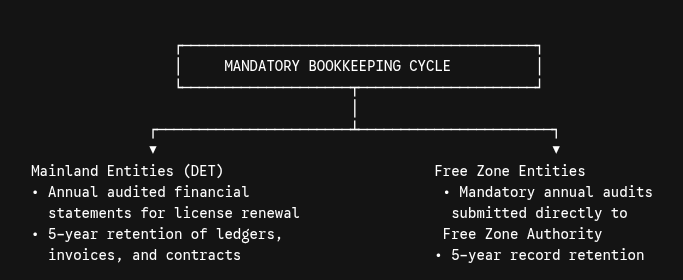
Key Accounting Requirements:
Financial Record Retention: Accounting records, general ledgers, purchase invoices, sales records, contracts, bank statements and import/export documentation must be retained for the applicable period. Corporate Tax records generally need to be kept for at least 7 years after the end of the relevant tax period, while VAT records generally require 5 years. Real estate-related records may be subject to a 15-year retention period.
Audit Statements: Many Free Zone authorities, including DMCC, JAFZA and DAFZA, require audited financial statements under their respective rules. Audit requirements and submission deadlines vary by authority and company type. Mainland companies must also assess whether an audit is required under the applicable company law and Corporate Tax rules.
Accrual Accounting Standard: Businesses generally prepare financial statements using recognized accounting standards, including International Financial Reporting Standards (IFRS) or IFRS for SMEs, where applicable. The accrual basis is generally required for Corporate Tax purposes, although eligible businesses with revenue not exceeding AED 3 million may use the cash basis, subject to the applicable rules.
5. Immigration, Visas, and Wage Protection System (WPS)
Once your trade license is issued, managing immigration requirements, investor residency visas and employee onboarding becomes an operational priority.
The Establishment Card
Mainland businesses must complete the relevant establishment registration procedures with the Ministry of Human Resources and Emiratisation (MOHRE) and the immigration authority. Free Zone businesses generally apply through their respective Free Zone authority and follow its immigration procedures before sponsoring investor or employee visas.
The Establishment Card, also known as a Computer Card in some contexts, registers the business in the relevant immigration system. Renewal requirements and validity periods depend on the issuing authority. The UAE visa processing sequence generally includes the following steps:
Visa Processing Sequence
- Establishment registration and card issuance
- Entry permit application
- In-country status change, where applicable
- Medical fitness test and Emirates ID biometrics
- Residence visa issuance and electronic visa generation
Wage Protection System (WPS) Compliance
Mainland businesses registered with MOHRE must comply with the Wage Protection System (WPS), an electronic salary transfer system established to monitor wage payments. WPS requirements for Free Zone businesses depend on the relevant authority and applicable employment rules.
Salary Transfer Rules: MOHRE Ministerial Resolution No. 340 of 2026 introduced updated WPS requirements effective June 1, 2026. Under the new rules, an establishment is considered compliant for WPS purposes if it transfers at least 85% of the total wages due to workers by the payment deadline.
Failure Penalties: Employers that fail to pay wages on time may face escalating enforcement measures, including notifications, suspension of new work permits and administrative fines for repeated violations. Further action may apply depending on the nature and recurrence of the violation. Employers should follow the current MOHRE requirements to avoid penalties and work permit restrictions.
6. Jurisdiction-Specific Requirements: Mainland vs. Free Zone vs. Offshore
Different business jurisdictions in the UAE have specific compliance requirements that founders must manage after incorporation.
A. Mainland (Onshore) Companies - DET
Ejari Lease Agreement: Mainland businesses in Dubai generally need a registered tenancy contract, known as Ejari, for their approved business premises. The premises may be an office, warehouse or retail space, depending on the licensed activity and applicable requirements. Virtual office arrangements are subject to the rules of the relevant authority and activity.
Local Municipal Approvals: Depending on the business activity, such as food and beverage, logistics, healthcare or education, additional approvals may be required from authorities such as Dubai Municipality, Dubai Civil Defence or the relevant health or education regulator.
B. Free Zone Establishments
Cross-Border and Dual-Licensing Rules: Free Zone companies can generally operate within their Free Zone and conduct international business. Access to the UAE mainland market is regulated. Depending on the activity and emirate, a business may need a licensed mainland distributor, a mainland branch or company, a dual license or other required approvals.
Qualifying Free Zone Person (QFZP) Status: To benefit from the 0% Corporate Tax rate on Qualifying Income, a Free Zone entity must meet the applicable conditions. These include maintaining adequate substance in the UAE, earning Qualifying Income, complying with transfer pricing requirements, preparing audited financial statements and keeping non-qualifying revenue within the de minimis limit: 5% of total revenue or AED 5 million, whichever is lower.
C. Offshore Entities (RAK ICC / JAFZA Offshore)
Restrictions on Local Operations: Offshore companies are generally intended for international business and holding structures, rather than conducting ordinary commercial operations in the UAE mainland. Their permitted activities and ability to obtain UAE residency visas depend on the relevant offshore regulations. Do not assume that an offshore company can sponsor local residency visas.
Corporate Records and Asset Ownership: Offshore companies must maintain the registers and corporate records required by their jurisdiction, including relevant shareholder and beneficial ownership information. Companies holding real estate, shares in other entities or other assets should keep supporting ownership and transaction records and comply with the requirements of their registered agent and relevant authorities.
7. Trade License & Commercial Registration Renewals
A UAE business license is not permanent. It must be renewed according to the requirements of the relevant licensing authority and the terms of the license package.
Annual Renewal Checklist:
Renew Commercial Lease / Ejari: Renew the lease and Ejari, where applicable, before the license expires to avoid delays in license renewal.
Clear Municipal & Departmental Inspections: Ensure that business premises comply with applicable safety, signage and trade name requirements.
Submit Audited Financial Statements: Submit signed audit reports to the relevant Free Zone authority where required. Confirm any applicable financial reporting requirements with your licensing authority or tax advisor.
Update UBO Declarations: Review beneficial ownership information and update the relevant registers and declarations when changes occur, within the applicable deadlines.
Renew Establishment Cards & Visas: Check the validity of establishment cards and employee residency permits, where applicable, and renew them on time to avoid penalties.
Complete Post-Setup Compliance Checklist
To help keep your newly registered business compliant and reduce the risk of penalties, follow this checklist:
Step 1: Register for Corporate Tax through EmaraTax within the applicable deadline.
Step 2: Maintain internal registers for Ultimate Beneficial Owners (UBOs), shareholders and nominee directors, where applicable.
Step 3: Submit UBO information to the relevant licensing authority or registrar within the applicable deadline.
Step 4: Set up accounting systems that support FTA recordkeeping requirements and applicable accounting standards.
Step 5: Monitor taxable supplies to track VAT registration thresholds: AED 375,000 for mandatory registration and AED 187,500 for voluntary registration.
Step 6: Obtain an establishment card, where required, and onboard employees in accordance with applicable immigration, labor and WPS requirements.
Step 7: Prepare audited annual financial statements where required, and renew the lease and business license before expiry.
Managing compliance after incorporation requires accurate records, appropriate tax planning and timely filings. Treating compliance as part of your regular business operations, rather than leaving it until year-end, can help protect your company's credibility, reduce the risk of penalties and support its long-term growth in the Middle East.