Relocating Your Business to Dubai: A 90-Day Roadmap
A practical 12-week roadmap covering the key decisions and requirements involved in moving an established business to Dubai and getting the new operation ready to run.
Week 1: You tell your team that the move to Dubai is happening.
By Week 2, the questions start: Should you register a mainland company or choose a free zone?
Week 3 usually means digging through corporate files you have not looked at in years.
By Week 5, you may be moving ahead with the licence and preparing for the office setup.
By Week 7, employees are asking when their visas will be processed.
Then, around Week 8, the bank asks for more details about your business, ownership and sources of funding.
That is what moving an existing business to Dubai actually looks like.
It is not the same as starting a company from scratch. Your existing business continues operating while you build the UAE operation. At the same time, you are trying to create the new business structure in Dubai without disrupting customers, employees, contracts, suppliers or finances.
There is also no single government procedure for “moving my business to Dubai.”
Depending on your current company and what you want the Dubai operation to become, you could be looking at:
- a UAE subsidiary,
- a branch of the foreign company,
- a mainland company, or
- a free zone company.
If the business operates in a regulated sector, there can also be additional approvals and requirements.
So, a basic checklist will not always tell you what you need to know.
The real question is: what needs to happen first, what can happen in parallel, what can cause delays and what should you never assume is automatic?
This 90-day timeline looks at the process from the initial structure decision through licensing, premises, immigration, banking, taxation and the eventual operational transfer.
One important clarification: the 90 days are a planning framework, not a promise that the government will complete everything within 90 days. Some businesses may move faster, while others can take considerably longer depending on their activity, structure and approvals.
Week 1: Decide What You’re Actually Moving
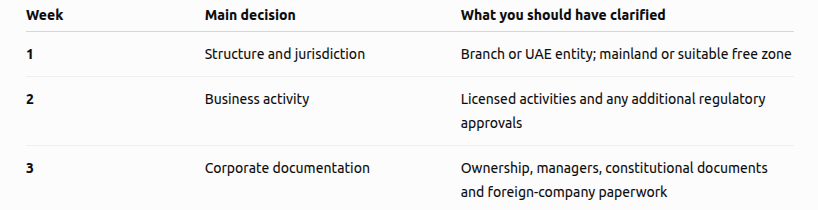
The first week is less about paperwork and more about deciding what your Dubai entity will actually be.
If your existing company is headquartered outside the UAE, one of the first decisions is whether the Dubai operation will be a separate UAE company or a branch of the foreign company.
The distinction matters. A branch forms part of the foreign entity, while a local company is treated as a separate legal body.
The Ministry of Economy and Tourism has specific requirements for branches of foreign companies, including corporate documentation and the necessary resolutions.
Then comes another major decision: mainland or free zone business setup in Dubai?
A Dubai mainland company is licensed by the Department of Economy and Tourism (DET), while a free zone company is licensed by the relevant free zone authority. Most mainland commercial activities allow 100% foreign ownership, subject to the applicable rules for strategic-impact activities.
Instead of asking which option is “cheaper”, ask which one fits the business you are actually moving.
- Mainland can make sense when you need a broad UAE operating presence, direct mainland market access or premises outside a free zone.
- A free zone may be suitable when its permitted activities, workspace options and operating model align with your business, especially where the Dubai operation focuses on international business or a specialised sector.
The licence fee is only one part of the calculation. You also need to consider the permitted activity, mainland operating requirements, office or warehouse requirements, visa eligibility, additional approvals and the overall annual cost.
Week 2: Check the Activity Before You Apply
One of the easiest parts of the process to underestimate is the business activity.
Your licence is tied to what your company is permitted to do.
An existing company might call itself a “technology business”, but that could mean software development, IT consultancy, cloud services, e-commerce, data services or several other activities. They are not necessarily treated the same way for licensing purposes.
For a non-regulated business, things can be relatively straightforward once the correct activity and jurisdiction are established.
Regulated businesses are another story.
If you are moving a financial services company, healthcare business, educational institution, food operation, transport company, media business, real estate activity or another regulated operation, the economic licence may only be one part of the approval process.
Depending on the activity, the relevant sector authority may have additional requirements covering documents, professional qualifications, conditions or inspections.
This is something to resolve before signing up for premises or starting to transfer employees.
The Ministry’s guidance on foreign-company branches also notes that additional approvals from other government entities may be necessary depending on the nature of the activity.
The same applies to permits.
A business licence covers the licensed economic activity, but a particular location, product, operation or regulated service may require another permit or approval.
For an established company, this becomes especially important. You are not simply registering a new business name. You are effectively rebuilding an existing operation that may already depend on premises, equipment, employees and customers.
By the end of Week 2, you should have a clear picture of what the Dubai operation will sell, provide, import, manufacture, store or manage — and whether another authority needs to approve any part of it.
Week 3: Your Existing Company’s Documents Become the Priority
Once you have settled the structure and business activity, the paperwork gets more specific.
If you are establishing a separate UAE company, you will need the corporate information and documents required by the relevant authority. For example, if you are establishing a branch of the foreign company in Ajman NuVentures, you should expect to provide documents connected to the existing parent company.
This is often where international business moves begin to slow down.
Foreign corporate documents may need to be properly attested or legalised, depending on the document and the authority involved.
For a foreign-company branch, the Ministry lists documents such as the parent company’s incorporation documents and commercial registration, along with the required corporate resolution and other supporting documents.
The important thing is not to wait until the application is ready before starting this process.
A document sitting in another country may need notarisation, authentication and presentation in the required UAE format. That cannot always happen as quickly as submitting an online application.
This is also when you should confirm the proposed trade name, shareholders, managers, business activities and legal form.
The UAE government’s mainland guidance includes initial approval, preparation of relevant constitutional documents where applicable, securing premises and obtaining the final licence as part of the mainland establishment process.
For an established business moving to Dubai, though, these tasks have to be viewed differently. You are creating the UAE legal and operational layer while the original business may still be operating elsewhere.
What the first three weeks have really accomplished
Week 4: Find the Right Place to Operate
By Week 4, your Dubai move starts to become more tangible.
The first few weeks were mostly about decisions, approvals and paperwork. Now comes the practical question: where will your Dubai operation actually operate from?
For a small professional or service business, you may simply need an office arrangement that meets the licensing authority’s requirements. But if you are moving employees, inventory or equipment, things can look very different. A manufacturer might need an industrial facility. A trading company could require warehouse and logistics arrangements. A regulated business may need premises that meet specific technical conditions set by its regulator.
So, do not assume that every business in Dubai can simply rent a desk and begin operating.
For mainland businesses, the UAE government’s business establishment guidance includes securing a business location and, where applicable, registering the tenancy contract. The exact premises requirement depends on the activity and the authority involved.
Free zones have their own rules and workspace options. Depending on the zone and business activity, these can include shared or flexible offices, dedicated offices, warehouses and industrial facilities.
Where the Money Starts Adding Up
The licence fee is just one part of the overall relocation budget.
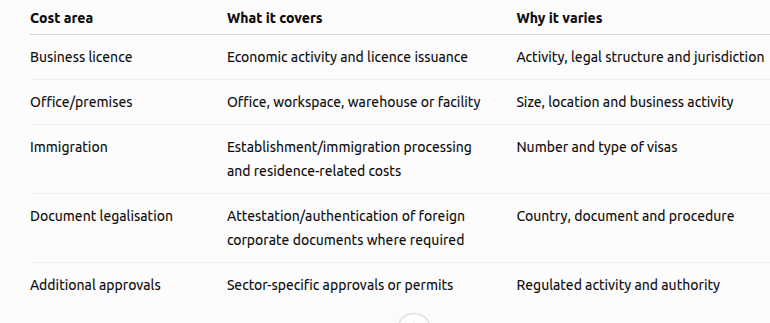
There is deliberately no single “Dubai relocation cost” figure in this timeline. Government fees vary according to the business structure and activity, while premises and staffing are commercial expenses rather than fixed government charges.
Weeks 5–6: The People Start Moving
Once the UAE business structure and required premises are moving forward, the focus shifts to the people behind the business.
If a founder or shareholder is relocating to Dubai, the appropriate UAE residence route needs to be considered. Employees joining the UAE operation will generally need the relevant employment and residence arrangements, depending on their circumstances and the employer’s immigration requirements.
This is also when the size of your team starts to matter.
Moving three employees from an overseas office is very different from relocating 50. You need to work out who is actually moving to the UAE, who will stay with the original company, where employees will be based and which entity will employ them after the transition.
Visas should not be treated as just another box to tick after obtaining the licence.
The immigration file, establishment requirements, employment documentation and employee onboarding all need to match the UAE entity that will actually employ the workers.
There is also an important question that can easily be overlooked: what happens to the employees who are staying behind?
If the original company continues operating overseas, you may have two workforces operating under two entities. If the overseas operation is being closed, employment, payroll, contracts and local legal obligations in that country still need to be handled separately.
Setting up in the UAE does not automatically remove your obligations in the country you are leaving.
Weeks 6–8: Then Comes the Bank
This is where expectations often need a reality check.
Getting a company licence and opening a corporate bank account are two separate processes.
Banks carry out their own customer due diligence. Under the Central Bank’s framework, financial institutions are required to identify and verify customers and beneficial owners and understand the nature and purpose of the business relationship.
For an established company, this can actually work in your favour. You have an existing business history that can help demonstrate what the company does and where its money comes from.
Be ready to explain:
- What the company does
- Who ultimately owns it
- Where its revenue comes from
- Where its customers are located
- Expected transaction volumes
- Source of funds
- Existing financial activity
- Why Dubai is becoming the new operating base
Depending on its risk assessment, the bank may also ask for corporate documents, identification, financial information, contracts or other supporting evidence.
So, do not plan around the assumption that “licence issued = bank account approved.”
The two processes may run alongside each other, but the bank will still carry out its own review before approving the account.
This is one of the areas where an established business has an advantage over a brand-new company. You may already have years of invoices, financial statements, contracts and banking records that explain the business. The important part is having those documents organised and ready when the bank asks for them.
Weeks 8–10: Tax Moves Into the Picture
By now, the Dubai operation should be starting to look like an actual business rather than just a registration exercise.
That means it is time to understand its UAE tax position.
The UAE Corporate Tax regime applies to businesses within its scope. Being in a free zone does not automatically mean that a company is outside Corporate Tax. Qualifying Free Zone Persons can benefit from the 0% rate on qualifying income if they meet the relevant conditions, while other taxable income may be subject to the standard Corporate Tax rate.
VAT needs to be considered separately. The Federal Tax Authority currently sets the mandatory VAT registration threshold at AED 375,000 of taxable supplies and imports over the relevant period. Voluntary registration is available from AED 187,500, subject to the applicable rules.
For a company relocating from another country, tax planning involves more than asking whether you need to register.
You need to understand how the existing company and the new Dubai operation will work together.
Will the UAE company invoice customers directly? Will it pay the overseas company for services? Will intellectual property remain outside the UAE? Will employees transfer to the UAE entity? Will both companies continue doing business with each other?
The answers can have implications for accounting, related-party transactions and transfer pricing.
This is also the right time to establish proper bookkeeping rather than trying to piece transactions together later.
Weeks 10–12: Now Move the Business — Not Just the Company
This is where the relocation becomes real.
A Dubai licence, office and bank account do not necessarily mean that you have moved the business.
The operational transition may involve updating customer contracts and invoices, moving supplier relationships, transferring employees, shifting intellectual property or software arrangements, redirecting payments, setting up UAE payroll and changing which entity signs new commercial agreements.
For some companies, the overseas business will continue operating and the Dubai company will become its UAE or regional arm. For others, Dubai may eventually become the new headquarters.
But incorporation alone should not determine that decision.
Move the operation in phases.
Keep the existing business running while you test the UAE structure. Where commercially and legally appropriate, move selected contracts and functions first. Make sure customers understand which entity they are dealing with and where payments should be sent. Review supplier arrangements and employee contracts before making changes.
If intellectual property, equipment, inventory or other assets are being transferred between related entities, obtain appropriate legal and tax advice before treating the transfer as a simple administrative task.
So, by the end of the 90 days, the real question is not “Did I receive my Dubai licence?”
It is:
Can the Dubai operation legally conduct its intended activities, employ the people it needs, receive and make payments, maintain its accounting and tax records, serve customers and operate without relying on assumptions that have not been checked?
Your 90-Day Relocation at a Glance
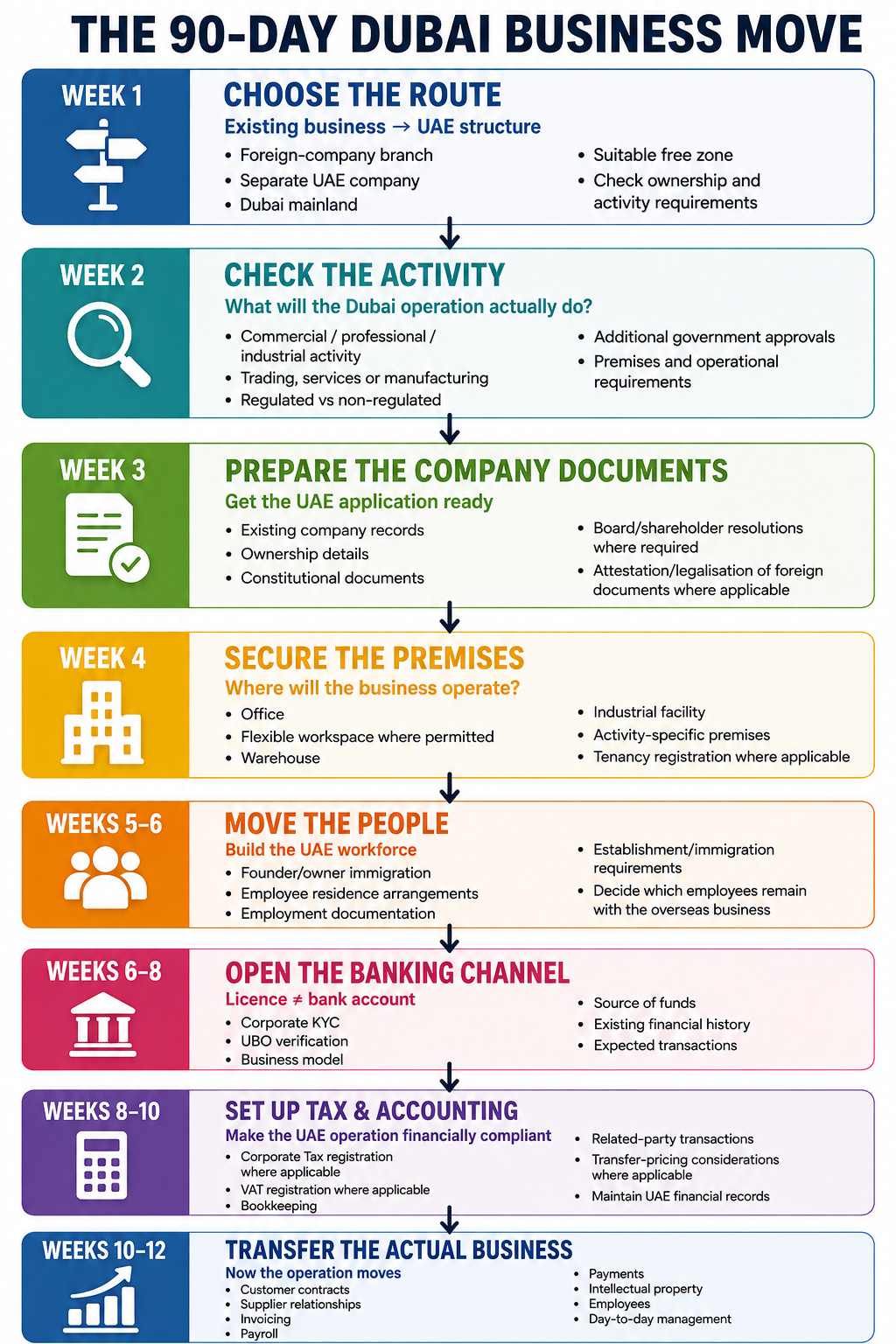
The 90-day timeline is best viewed as a series of overlapping workstreams, not nine boxes that have to be completed one after another. Banking can get underway while other parts of the setup are still progressing. Documents can be prepared before the licence application. Tax planning should begin before the first invoice is raised. Regulated businesses, meanwhile, may have a completely different approval timeline.
This is why proper planning is more valuable than simply trying to find the fastest licence.
What the Move Really Comes Down To
By the end of the 90-day period, you should have clarity on the decisions that matter most:
- which UAE structure suits the existing business,
- where the business should operate,
- which activities it is authorised to carry out,
- what additional approvals are required,
- where employees and other people will work,
- how banking and accounting will be handled, and
- which parts of the existing business will actually move.
Dubai may be where you are headed, but a successful relocation is about much more than incorporating a company. It means managing the transition between two operating environments while avoiding gaps in licensing, employees, contracts, revenue and compliance.
That is the part you need to plan before submitting the first document.