Understanding the Three Key Parts of an Optimization Problem: Goal, Options, and Limits
Optimization is the process of finding the best possible solution to a problem while making efficient use of available resources. It is widely used in fields such as engineering, business, healthcare, economics, and computer science. Every optimization problem is built around three essential components: the goal, the options, and the limits. Understanding these components is crucial for developing effective solutions and making informed decisions.
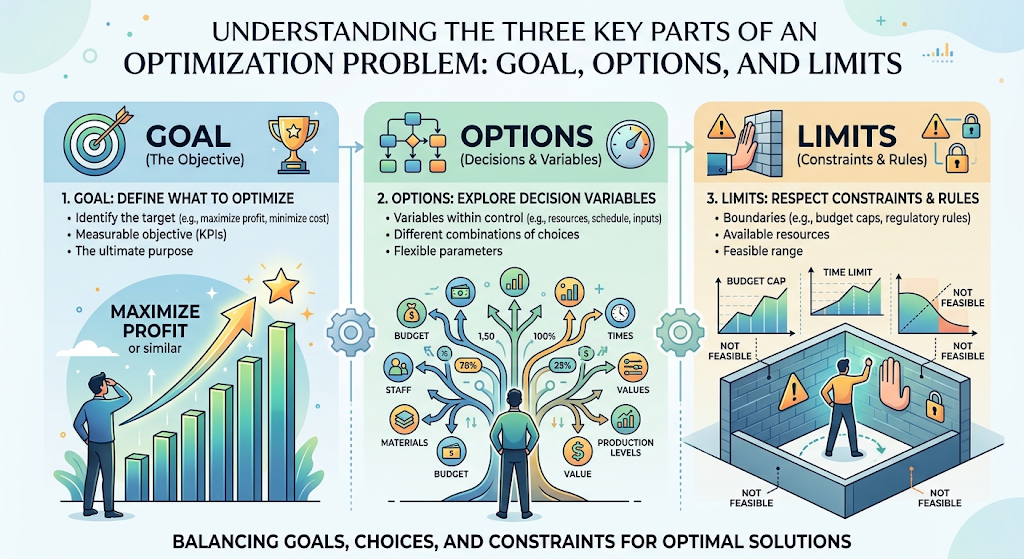
The first component is the goal, also known as the objective. The goal defines what needs to be achieved or improved. In an optimization problem, the objective is usually to maximize or minimize something. For example, a company may want to maximize profit, a hospital may seek to minimize patient waiting times, or a manufacturer may aim to reduce production costs. The goal serves as the target that guides all decision-making throughout the optimization process.
The second component is the options, often referred to as decision variables. Options represent the different choices or actions available to achieve the goal. These variables can be adjusted to find the best possible outcome. For instance, a delivery company may decide how many vehicles to use and which routes they should take. Similarly, a factory manager may determine the quantity of products to manufacture. The optimization process evaluates these options to identify the most effective combination.
The third component is the limits, also known as constraints. Constraints are the restrictions or conditions that must be satisfied while pursuing the goal. Common limits include budgets, time, manpower, equipment capacity, and regulatory requirements. For example, a business may wish to maximize production but must operate within a fixed budget and limited workforce. These constraints ensure that the solution is realistic and practical.
The interaction between goals, options, and limits forms the foundation of optimization. The goal identifies what should be achieved, the options provide possible ways to achieve it, and the limits determine what is feasible. By carefully balancing these three elements, organizations and individuals can make better decisions and improve efficiency.
In conclusion, every optimization problem depends on a clear goal, suitable options, and realistic limits. Together, these three components help determine the best possible solution to complex real-world challenges.