VPN and Proxy: Essential Tools for Online Privacy and Secure Internet Access
Virtual Private Networks (VPNs) and proxy servers are popular technologies used to enhance online privacy, improve security, and bypass geographical restrictions. Although both tools act as intermediaries between users and the internet, they differ significantly in terms of functionality, security, and use cases.
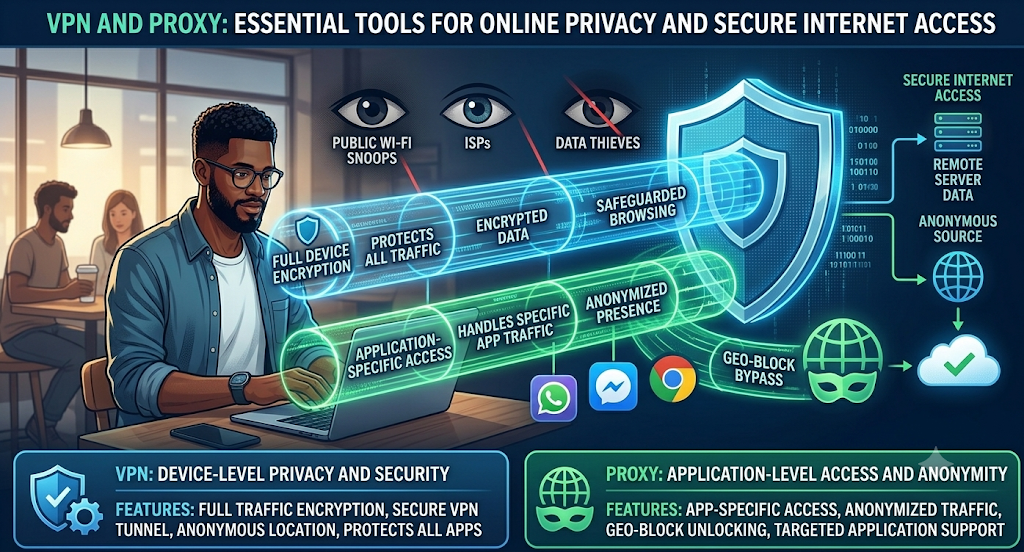
A Virtual Private Network (VPN) creates a secure and encrypted connection between a user's device and a remote server. When connected to a VPN, internet traffic is routed through the VPN server, which masks the user's real IP address and encrypts data transmitted over the network. This encryption protects sensitive information from hackers, internet service providers (ISPs), and other third parties, making VPNs particularly useful when accessing public Wi-Fi networks or handling confidential information. VPNs are widely used by individuals and organizations to enhance privacy, secure communications, and access content restricted by geographical location.
In contrast, a proxy server functions as an intermediary that forwards requests between a user and the internet. When a user accesses a website through a proxy, the website sees the proxy server's IP address rather than the user's actual IP address. Unlike VPNs, most proxies do not encrypt internet traffic, making them less secure for transmitting sensitive information. Proxies are commonly used for bypassing website restrictions, content filtering, web scraping, and managing internet access within organizations.
There are several types of proxies, including HTTP proxies, HTTPS proxies, and SOCKS proxies, each designed for specific purposes. Similarly, VPN services vary in terms of protocols, speed, and security features. While proxies generally offer faster performance due to the absence of encryption overhead, VPNs provide superior protection by encrypting all internet traffic generated by a device.
The primary difference between VPNs and proxies lies in security. VPNs provide comprehensive protection by encrypting data and securing the entire internet connection, whereas proxies mainly conceal IP addresses without offering strong security measures. Consequently, VPNs are often preferred for privacy-conscious users, remote workers, and businesses handling sensitive data.
In conclusion, both VPNs and proxy servers play important roles in improving internet accessibility and privacy. However, VPNs offer stronger security and data protection through encryption, while proxies are better suited for simple tasks such as bypassing restrictions and masking IP addresses. The choice between the two depends on the user's specific requirements, balancing security, speed, and functionality.