Daily Trading Volume Stays Above $500K: COD Activity Is Shifting from Trading Heat to Ecosystem Closed Loop
On BNB Chain, few new projects manage to sustain elevated trading activity over time. Most small- and mid-cap tokens follow a familiar pattern: strong early volume driven by community excitement and liquidity incentives, followed by a sharp drop once attention moves elsewhere. What actually matters is not how much traded on any given day, but why that volume occurred—and whether the product can keep absorbing the demand.
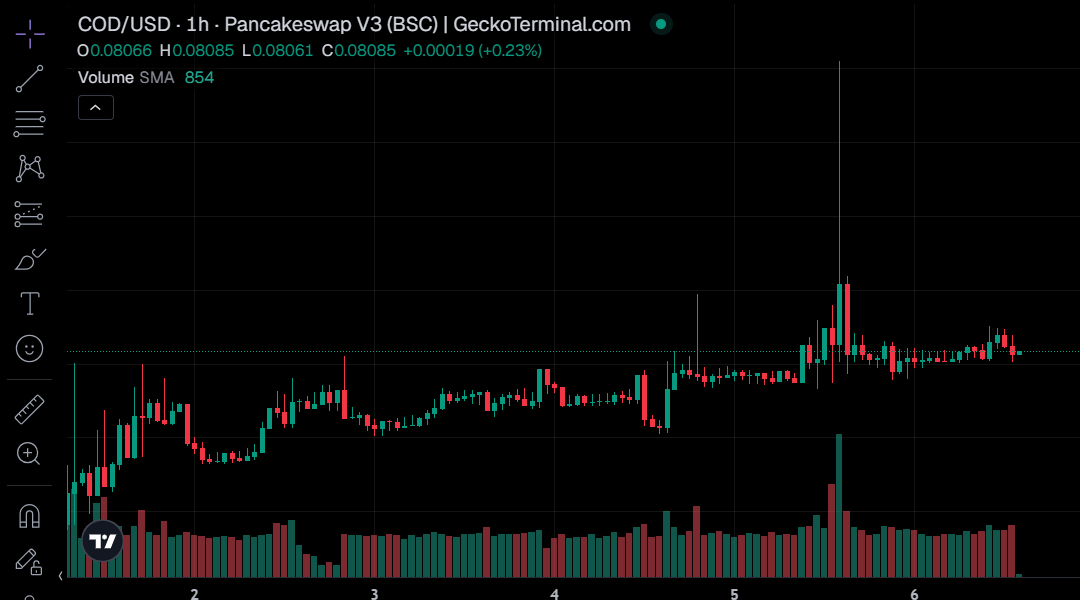
CloudBank’s ecosystem token COD offers a useful case study. According to public data from PancakeSwap and GeckoTerminal, the main COD/USDT pair (PancakeSwap V3, 0.01% fee pool) has held 24-hour volume consistently above $500,000, occasionally approaching or exceeding $510,000. Seven-day cumulative volume sits at roughly $5.47 million. For a project only about five months old with a fully diluted valuation near $81 million, this level of sustained density already stands out among peers at a similar stage.
What $500K Daily Volume Really Signals
Absolute size alone is not transformative. At the current valuation, the more meaningful metrics are volume relative to market cap and liquidity, and whether the activity proves durable.
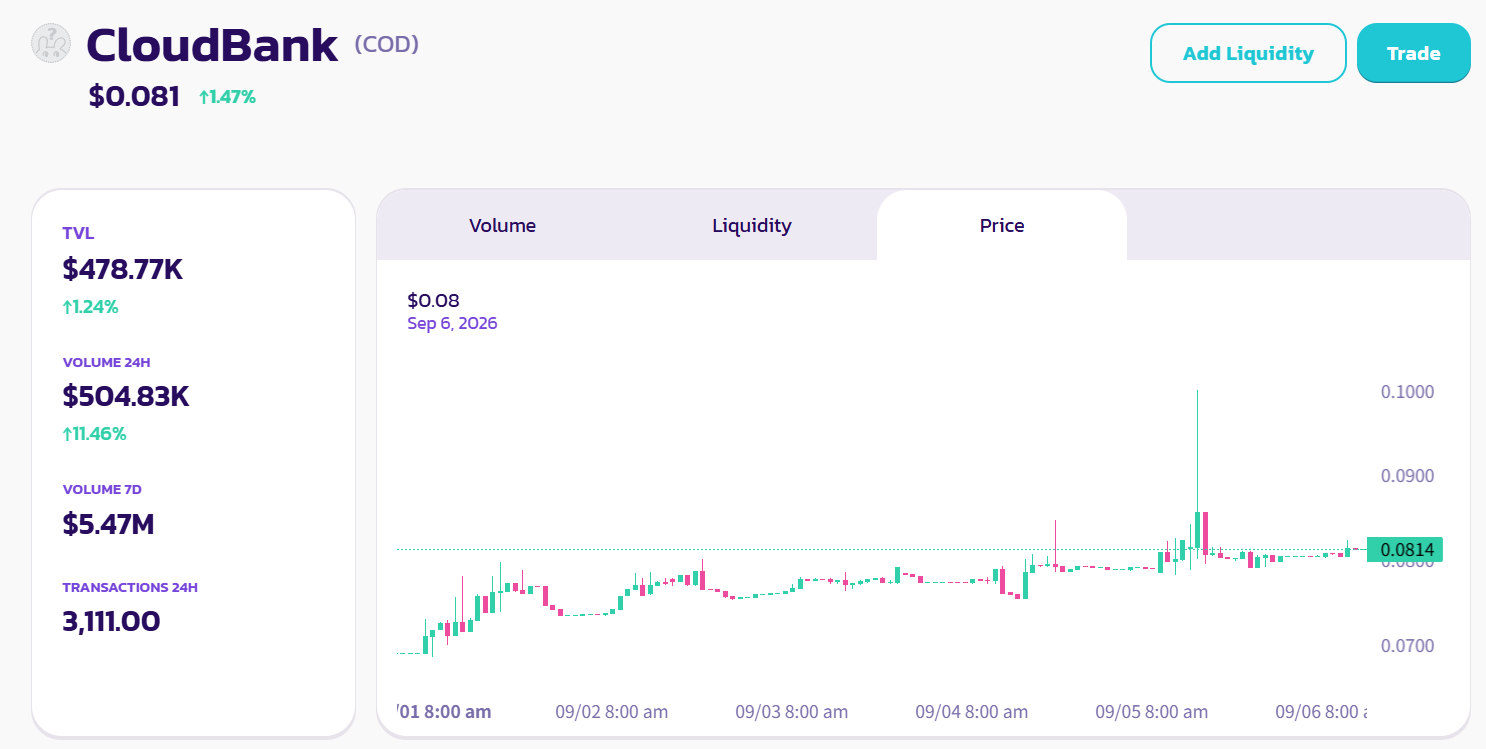
The main pool currently holds about $1.18–1.20 million in TVL (roughly 5.88 million COD and $720,000 USDT). Against an $81 million FDV, daily volume equates to around 0.6% of market cap—a solid mid-to-upper range figure for projects of this size. It shows neither extreme speculative spikes nor the quiet that follows liquidity exhaustion. Buy and sell sides remain roughly balanced. There are approximately 8,600 holding addresses and more than 980,000 transfers, pointing to a reasonably distributed base rather than concentrated wash trading by a few large players.
High volume and genuine market activity are not the same thing. Volume can come from a handful of wallets trading repeatedly or from many users participating consistently. The first produces attractive numbers with limited ecosystem value; the second, even with smaller individual trades, suggests a broader circulation network is forming. COD currently shows sustained trading, basic depth, and meaningful holder dispersion—not the classic low-liquidity, occasional-spike pattern.
Where the Activity Comes From
Trading volume rarely persists without real use cases or incentive loops. CloudBank is building a “super DeFi application” that brings DEX, Launchpad, prediction markets, AI quant, and PayFi under one roof. COD is designed as the internal value connector. The core question is simple: when different products generate user behavior, does that behavior create demand for the same ecosystem token?
Three live modules already link directly to COD circulation.
NFT Mining sits at the center. These NFTs are not collectibles; they serve as the primary entry point and long-term incentive vehicle. Users spend COD to mint mining-right NFTs and receive daily COD emissions. Part of the output goes straight to holders; another portion recirculates through community mechanisms. The resulting loop—minting consumes COD, mining produces COD, secondary markets redistribute it—both lowers the barrier to entry and generates ongoing real trading demand.
Prediction Markets are live and support binary and multi-outcome markets. Users can participate with COD or USDT. Oracle-backed settlement gives COD a concrete use case beyond pure trading. Current volume is still modest relative to overall activity, but the path for actual token utility is now open.
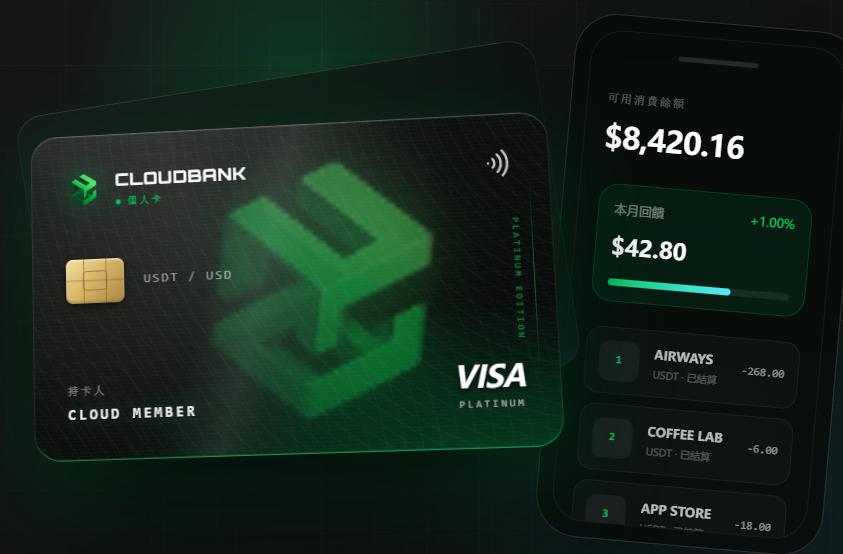
PayFi and crypto cards are under active development. CloudBank plans to leverage payment infrastructure such as the Visa network so COD and other ecosystem assets can eventually move into everyday spending and cross-border payments. This extends the token from an on-chain instrument into real-world utility—an important bridge between DeFi and daily consumption.
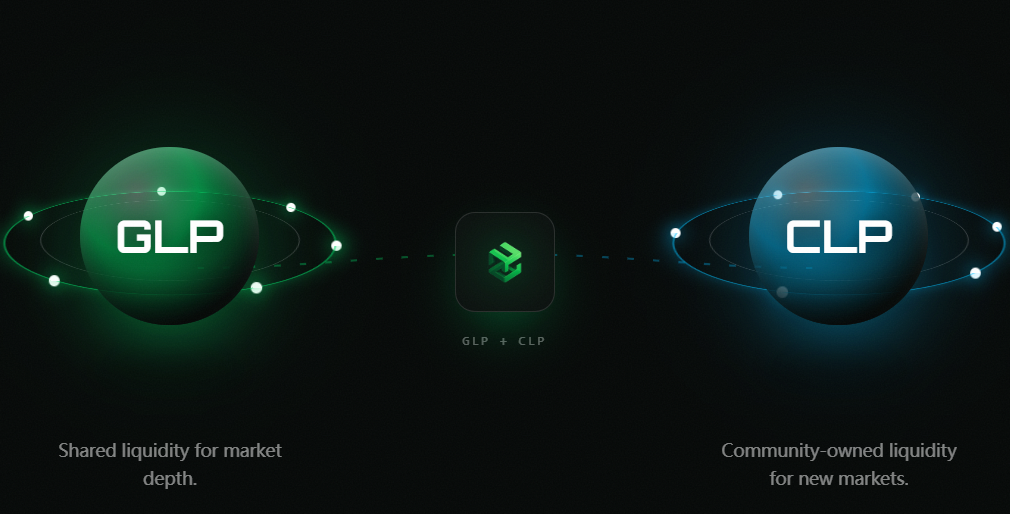
Supporting infrastructure also helps. The 0.01% fee on the main pool reduces costs for high-frequency trading and arbitrage. Dual Liquidity Architecture (GLP + CLP) aims to balance shared depth with community-controlled liquidity. Taken together, COD’s activity is not driven by any single factor. It reflects an early closed loop of mining output → trading demand → product usage → recirculation. The loop is still young, yet it already leaves a clear footprint in on-chain data.
How COD Compares at This Stage
Placed against other recent BNB Chain launches in a similar valuation range, COD’s trading activity stands out. Many peers see daily volume fluctuating between tens of thousands and a little over $100,000. Sustained multi-day volume above $500,000 with relatively balanced order flow is uncommon. Main-pool depth near $1.2 million ranks as medium-to-high relative to the $81 million FDV and keeps slippage manageable.
Caveats remain. Valuation is still mid-range and growth-stage. The largest holder (linked to community incentives and mining) controls about 36.7% of supply, so concentration deserves continued monitoring. These points do not erase the clearest signal: the market is showing sustained, real-money interest in COD, and early positive feedback between that interest and product delivery is beginning to appear.
The real risk is not short-term price swings. It is the gradual separation of token from product. CloudBank’s current effort focuses on embedding COD into more products and user behaviors so that using the platform and holding the token become more directly linked.
From Incentive Token to Functional Asset
COD’s total supply is 1 billion tokens. Community building and ecosystem incentives form a large share of the allocation, with additional portions set aside for liquidity incentives, treasury, investors, and the team. The project states there will be no secondary issuance. Early incentives that lower entry barriers, improve trading experience, and encourage repeated behavior serve a clear cold-start purpose.
Incentives can attract the first users. Lasting value comes from natural demand created by product usage. Only when holders of COD still find new reasons to use it can the token evolve from a reward into a functional asset. That transition is the real test of whether CloudBank’s ecosystem closed loop can hold.
Current volume is both outcome and evidence. The $500,000 daily figure already demonstrates participation. Rising NFT Mining capacity and the live prediction market are tightening the connection between trading heat and actual ecosystem use. The key question going forward is whether volume, liquidity, and product usage data begin to move together. COD does not need to simply “grow volume.” It needs volume that has clearer and clearer reasons to exist.
The Path Ahead
Given the current structure and live products, the next phase has a relatively clear reinforcement path.
If NFT mining capacity continues to rise as planned, prediction-market usage expands, and main-pool liquidity keeps deepening, daily volume has room to hold or modestly grow from the present $500,000 base. Trading activity would then act as a leading indicator of market-cap expansion, while the loop of mining → trading → usage → recirculation becomes more durable.
The team continues to push deeper prediction markets, PayFi, and fuller DEX and quant modules. Successful delivery would extend COD’s utility from mining and trading into payments, prediction, and governance, giving activity thicker fundamental support. Forming million-dollar liquidity and stable daily volume within only a few months of launch is already a scarce signal for a new project. The market’s real focus next should be whether that activity persists, whether products keep generating genuine user behavior, and whether COD becomes an indispensable value medium across those behaviors.
Three near-term metrics are worth watching closely: whether daily volume stabilizes in the $400,000–$600,000 range, whether main-pool TVL continues to rise, and how effectively mining output is absorbed once it enters the market. These numbers will say more than any roadmap language about whether the closed loop is accelerating.
Closing
Daily volume above $500,000 is currently COD’s clearest market signal. It shows that a project only a few months old has already attracted meaningful real trading interest and begun forming a circulation loop tied to live products.
Activity itself is not the destination. It is an observation window and a starting point. It reflects current participation while continually testing whether products and incentives can sustain themselves. For anyone following emerging BNB Chain projects, COD’s value may lie less in today’s market-cap figure than in the strength of demand its trading data reveals—and in the trend of that demand being absorbed by an expanding set of live use cases.
Data has demonstrated activity. Products are beginning to demonstrate demand. When trading heat and ecosystem usage reinforce each other, COD’s market behavior may stop looking like pure trading heat and start reflecting actual ecosystem growth. That transition—from having volume to having a closed loop—is the critical step for any DeFi project.
Learn more
Website: https://cloudbank.to/
X (Twitter): https://x.com/CloudBank_to
Telegram: https://t.me/CloudBankcomofficial
Medium: https://medium.com/@cloudbank39
Whitepaper: https://cloudbank.gitbook.io/cloudbank/