A Student Guide to Writing a Compare and Contrast Essay That Earns Marks
A compare and contrast essay writing service, a writing center tutor and a grading rubric all point to the same thing: marks in this format come from structure as much as from ideas. The essay needs a clear thesis about two subjects, body paragraphs that each compare them on one point and a conclusion that explains what the comparison revealed. Get those three parts right and the rest of the essay has something solid to hang on.
Many students lose marks not because their ideas are weak but because the reader cannot follow them. Two subjects, several criteria and a stack of sources can easily blur together. This guide walks through the essay in the order you build it, from the outline to the final paragraph, with a focus on the specific places graders tend to award or deduct points.
How to Structure a Comparison Essay?
Choose one of three organizing patterns, then hold to it from the first body paragraph to the last.
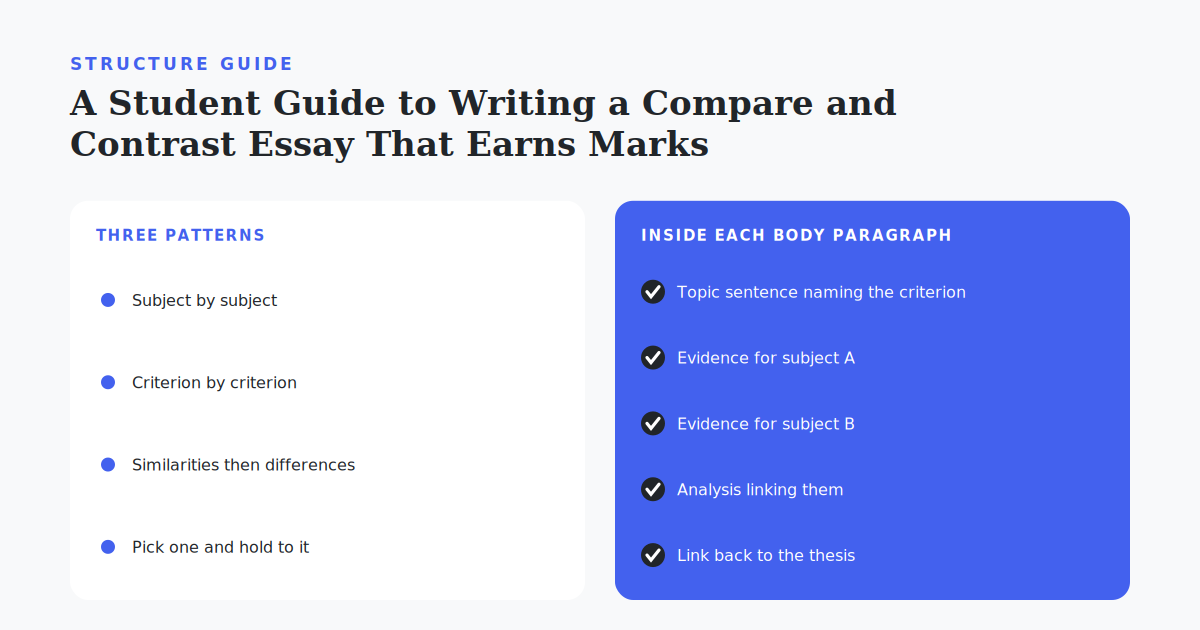
Structure is the decision that shapes everything else. Students comparing approaches from a college paper writing service, a textbook and their instructor's handouts usually find three patterns described. Each one suits a different kind of assignment, and the right choice depends on how many criteria you have and how closely the subjects overlap.
| Pattern | Body organized by | Good fit when |
|---|---|---|
| Subject by subject | All of subject A, then all of subject B | The essay is short and the subjects differ broadly |
| Criterion by criterion | One shared criterion per paragraph, both subjects in each | The subjects overlap closely and the essay is longer |
| Similarities then differences | A section on shared features, then a section on contrasts | The prompt asks you to weigh likeness against difference |
Whichever pattern you choose, consistency earns the marks. Switching from criterion by criterion to subject by subject halfway through forces the reader to rebuild their mental map, and graders often note it as a weakness in organization. Decide the pattern during outlining and write it at the top of your plan so it stays fixed.
Length matters to this choice as well. A subject by subject essay can feel like two short reports stapled together once it passes a few pages, because the reader has to hold every detail about subject A in mind while reading about subject B. Longer papers usually read better criterion by criterion.
Prompts sometimes hint at the expected pattern. Wording such as "evaluate the similarities and differences" points toward the third pattern, while "compare how each text treats" suggests criterion by criterion. Reading the prompt for these signals before choosing saves a rewrite later.
What Should a Compare and Contrast Essay Outline Include?
The thesis, the chosen pattern, one line per body paragraph naming its criterion and the evidence for each subject.
An outline for this format does more work than an outline for a single subject essay. It has to show balance before any sentence is written. If one subject has three pieces of evidence under a criterion and the other has none, the outline exposes the gap while it is still easy to fix by finding another source or changing the criterion.
A simple working outline might look like this:
- Introduction with hook, brief background on both subjects and thesis
- Body paragraph one with criterion, evidence for subject A, evidence for subject B
- Body paragraph two with the next criterion and evidence for both subjects
- Body paragraph three with the final criterion and evidence for both subjects
- Conclusion restating the claim and explaining what the comparison shows
Writing the evidence into the outline, with page numbers or source names, speeds up drafting considerably. When the time comes to write a paragraph, the quote or data point is already chosen, and the work becomes explaining it rather than hunting for it. That shift alone removes much of the stress students associate with drafting.
An outline also makes feedback easier to get. Instructors and writing center staff can review a one page plan in a few minutes, and a comment on the criteria at this stage takes far less effort to act on than the same comment on a finished draft.
What Goes Inside Each Body Paragraph?
A topic sentence naming the criterion, evidence for each subject, analysis linking them and a closing line tied to the thesis.
The body paragraph is where most marks are won or lost. A paragraph that only describes subject A and then describes subject B has listed facts but not compared them. The analysis sentence, the one that explains what the side by side view reveals, is what turns description into an argument graders can reward.
| Part | Purpose |
|---|---|
| Topic sentence | States the criterion and the paragraph's claim about both subjects |
| Evidence for subject A | A quote, statistic or example, introduced and cited |
| Evidence for subject B | A matching piece of evidence on the same criterion |
| Analysis | Explains why the similarity or difference matters |
| Link | Connects the point back to the thesis |
Evidence should be introduced, not dropped. A quote that appears without a lead in leaves the reader guessing why it matters. A short signal phrase naming the source, followed by a sentence that interprets the quote, shows the grader that the evidence is being used rather than decorated.
A model paper from CollegeEssay.org is one way to see this structure applied on a real topic, with each body paragraph built from topic sentence to link. Having a worked version of the anatomy on the student's own subjects can make the pattern easier to repeat in later essays.
Students who want that worked version for a current assignment can order a compare and contrast essay with the prompt, criteria and citation style included, then compare each delivered paragraph against the five parts above. Checking a model paper this way turns it into a revision tool, since any paragraph that skips a part shows exactly what your own draft should not leave out.
How Do You Write a Conclusion That Earns Marks?
Restate the claim in fresh words, pull the criteria together and explain what the comparison teaches that neither subject could alone.
Weak conclusions repeat the introduction almost word for word, which signals to a grader that the essay has nothing left to say. A stronger conclusion steps back from the individual criteria and shows the bigger picture they create together. That is the moment where a comparison justifies having two subjects at all.
The conclusion is also the place to address significance. A single sentence on why the comparison matters, whether for understanding a period, a genre or a policy debate, gives the essay a sense of purpose. It should grow out of what the body proved rather than introduce a new argument.
Length should stay modest. A conclusion of roughly the same size as the introduction is usually enough. Running much longer often means new evidence has crept in, which belongs in the body rather than at the end.
For a broader look at the parts of the format and how each section connects, a compare and contrast essay guide can serve as a checklist while revising the conclusion against the body paragraphs that came before it.
What Do Graders Look for in a Compare and Contrast Essay?
A clear comparative thesis, balanced treatment of both subjects, consistent structure, integrated evidence and correct citations.
Most rubrics for this format group their criteria into a few areas. Thesis and argument usually carry the most weight, followed by organization, use of evidence and finally mechanics such as grammar and formatting. Knowing those weights helps decide where to spend revision time when the deadline is close.
Balance is a criterion many students overlook. An essay that spends twice as many words on one subject, even if every point is accurate, often loses marks for uneven treatment. A quick way to check is to highlight each subject in a different color during revision and see whether the colors appear in roughly equal amounts.
Citation style is the easiest set of marks to secure. Whether the course uses MLA, APA or Chicago, matching every in text citation to the reference list and following the required format for titles and dates takes little time compared with the points it protects.
Reading the rubric before drafting, not after, makes all of this easier. Each criterion on it can be turned into a question to ask of the draft, so revision becomes a checklist rather than a guess about what the grader will value.
Frequently Asked Questions
How many body paragraphs does a compare and contrast essay need?
Most short essays use three, one per criterion. Longer essays may need more, depending on the prompt and length.
Can I use headings in a compare and contrast essay?
Only if the instructor allows them. Short essays usually flow better without headings, while longer ones may benefit.
Should I compare more than two subjects?
Only if the prompt asks for it. Adding a third subject multiplies the comparisons and makes balance much harder.
What if my subjects have more differences than similarities?
That is fine. Let the thesis reflect it, and give similarities only the space they genuinely deserve.
Is a counterargument needed in this format?
Not usually, but a brief acknowledgment of a different reading can strengthen an essay that makes a bold comparative claim.
TL;DR
A compare and contrast essay earns marks through a consistent pattern, an outline that shows balance, body paragraphs that analyze rather than describe and a conclusion that explains what the comparison revealed. Graders reward clear structure as much as strong ideas. CollegeEssay.org delivers model papers that show this structure applied to a student's own subjects.