Constellations: The Sky That Astrology Actually Uses
Look up on a clear night and, with a bit of patience, you can pick out shapes — a hunter, a bear, a scale, a pair of fish. Humans have been doing this for thousands of years, and long before astrology became a system of personality and prediction, constellations were simply how ancient cultures made a chaotic sky legible: dividing it into recognizable patterns, naming them, and using them to track time, seasons, and direction.
Constellations sit at an interesting intersection of astronomy and astrology — the same star groupings that sailors once used for navigation are also the backbone of the zodiac wheel used in every natal chart calculation today, including the free chart tool at Natal Chart Ruler.
What a Constellation Actually Is
Astronomically, a constellation is simply a group of stars that appear close together from Earth's perspective, even though the stars within it are often nowhere near each other in actual distance — they just happen to line up visually along our line of sight. The International Astronomical Union recognizes 88 official constellations, covering the entire night sky, a system formalized in the 20th century but built on groupings that go back to ancient Greek, Babylonian, and other early astronomical traditions.
Some constellations are ancient and nearly universal in recognition — Orion, with its distinctive three-star belt, has been identified across many independent cultures throughout history. Others were added much later, during the Age of Exploration, to fill in the southern sky that ancient Mediterranean astronomers never had a clear view of.
Constellations vs. the Zodiac: Related but Not Identical
This is where things get genuinely confusing, and it's worth untangling clearly. The zodiac used in astrology consists of twelve equal 30-degree segments of the sky along the ecliptic — the apparent path the Sun traces over the course of a year. Those twelve segments are named after constellations that originally sat along that path: Aries, Taurus, Gemini, and so on.
But here's the catch: due to a slow wobble in Earth's rotational axis called precession, the actual constellations have drifted out of alignment with the zodiac segments named after them over the roughly 2,000 years since the system was formalized. The astrological zodiac used in a natal chart today is based on the fixed 30-degree segments, not on where the physical constellations currently sit in the sky. This is also why you may have heard claims about a "13th zodiac sign," Ophiuchus — astronomically, the Sun's path does pass through that constellation's region of sky, but astrology's tropical zodiac (the system almost all Western astrology, including natal chart calculations, is built on) isn't defined by the current position of constellations at all, so this doesn't actually change anything about how a natal chart is calculated.
The Sidereal vs. Tropical Distinction
This precession issue is exactly why two different zodiac systems exist side by side:
- Tropical zodiac — used by most Western astrology. It's anchored to the seasons (specifically, the spring equinox marks 0° Aries) rather than to the literal current position of constellations. This is the system behind the vast majority of natal chart calculations, including Sun-sign horoscopes.
- Sidereal zodiac — used primarily in Vedic (Indian) astrology. It's anchored to the actual current position of the constellations, adjusted for precession.
Because of this difference, someone's Sun sign can come out differently depending on which system is used — this isn't an error in either system, just two different reference points being used for the same calculation. Services calculating a natal chart, like Natal Chart Ruler, will specify which system they're using, and the tropical zodiac is the default for the vast majority of natal chart tools and horoscopes in Western contexts.

Constellations Beyond the Zodiac
It's worth remembering that the 12 zodiac constellations are a small fraction of the 88 recognized overall. Plenty of well-known constellations have nothing to do with astrology at all:
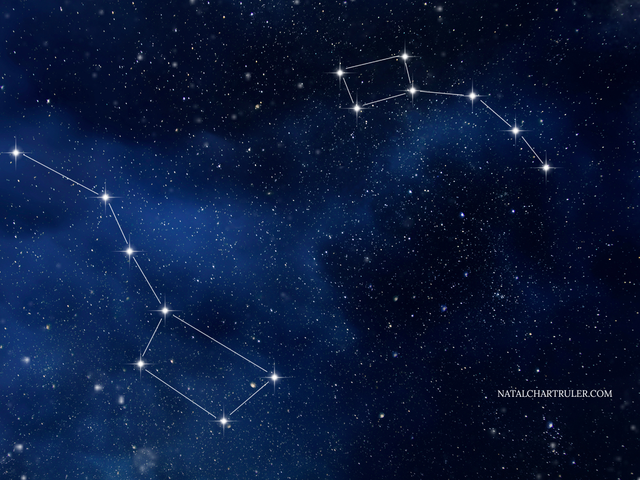
- Ursa Major — home to the Big Dipper, one of the most recognizable star patterns in the northern sky.
- Orion — one of the most visible and widely recognized constellations worldwide, visible from most inhabited latitudes.
- Cassiopeia — a distinctive W-shaped constellation named for a queen in Greek mythology.
- Crux (the Southern Cross) — visible only from southern latitudes, and important enough to appear on several national flags.
These non-zodiac constellations played a huge practical role historically — used for navigation, calendar-keeping, and orientation long before anyone assigned them personality traits.
Where Constellations Fit Into a Natal Chart Reading
When an astrologer says your Sun was "in Capricorn" at your birth, they're referring to one of the twelve tropical zodiac segments, not literally the constellation Capricorn as it currently sits in the sky. That distinction matters for understanding what a natal chart actually measures: it's a structured framework built on the ecliptic's twelve fixed segments, using the Sun's apparent yearly path as the reference, not a live astronomical survey of where each constellation happens to be positioned tonight.
That said, the constellations are where this entire framework originated, and understanding their astronomical reality — some genuinely ancient, some added centuries later, most unrelated to the zodiac altogether — gives useful context for why the zodiac wheel is built the way it is. A natal chart calculated today, whether through a free tool like the one at natalchartruler.com or by hand with printed ephemeris tables, ultimately traces back to this same ancient practice of dividing the sky into a legible, trackable structure.

Getting Oriented: Finding Constellations Yourself
If you want to connect the astrology to the actual night sky, a few starting points help:
- Start with the easiest ones. Ursa Major (the Big Dipper) and Orion are visible from most of the Northern Hemisphere for large parts of the year and are the easiest to learn to recognize first.
- Use the season to narrow things down. Different constellations are visible at different times of year, so knowing the current season narrows what you're looking for considerably.
- Remember that your zodiac sign and the visible constellation rarely match up. Due to precession, the constellation your Sun sign is named after usually isn't the one actually behind the Sun on your birthday anymore — that's expected, not a mistake.
- Use a star map or app to correlate what you're seeing with what you already know from a natal chart, if you're curious how the astronomical and astrological pictures relate.
Closing Thoughts
Constellations are where astrology's whole visual and symbolic vocabulary began — long before charts, houses, or horoscopes, people were simply looking up and organizing what they saw into shapes worth naming. Understanding the astronomical reality behind the zodiac, precession included, doesn't undercut what a natal chart offers; it just clarifies what a chart is actually built on, so the symbolism means something more concrete the next time you look at your own.