Can an employer reject you because of a criminal background check?
Finding out that a criminal record might cost you a job opportunity is incredibly stressful. If you are an applicant wondering if a company can legally turn you down based on a background check, the short answer is yes, they can—but they cannot just do it arbitrarily or without following strict legal protocols.
Federal, state, and local laws exist to protect job seekers from unfair discrimination and inaccurate data. If an employer intends to reject your application due to a criminal history, they must navigate a highly regulated legal framework.
The Legal Baseline: The FCRA and the EEOC
Employers do not have a blank check to reject applicants with a criminal history. Their actions are heavily governed by two federal entities: the Fair Credit Reporting Act (FCRA) and the Equal Employment Opportunity Commission (EEOC).
- The EEOC’s "Nature-Time-Job" Rule
The EEOC explicitly states that a blanket policy of rejecting any applicant with a criminal record is discriminatory. Instead, employers must perform an Individualized Assessment. To legally reject a candidate, the employer must prove that the conviction is directly relevant to the role by evaluating three specific criteria:
• The nature and gravity of the offense: Was it a minor, non-violent infraction or a severe felony?
• The time that has elapsed: Did the offense occur ten years ago, or six months ago?
• The nature of the job: Does the criminal history directly impact the duties of the position? (For instance, someone with a decade-old driving violation shouldn't be barred from an office desk job, but a recent financial fraud conviction is highly relevant to a banking role).
- The Mandated Two-Step Adverse Action Process
Under the FCRA, if an employer uses a third-party screening agency and sees something in your report that makes them want to reject you, they are legally barred from cutting contact immediately. They must complete a strict, multi-step process known as Adverse Action:
1.Send a Pre-Adverse Action Notice:Before the final decision.
The employer must formally notify you that something negative appeared in your background check. Along with this notice, they are legally required to send you a complete copy of the background report they pulled and a document outlining your federal rights.
2.Observe the Mandatory Waiting Period:Typically 5 business days.
The employer must pause the hiring process. This window gives you an opportunity to review the report for inaccuracies, explain the context of the record, or file an official dispute if the information is wrong or belongs to someone else.
3.Send the Final Adverse Action Notice:After the waiting period.
If you do not dispute the records, or if the employer conducts an individualized assessment and still finds you unsuited for the role, they can issue a final rejection notice. This document must include the contact information of the screening company and instructions on how to obtain a free copy of your report within 60 days.
State Laws and "Ban-the-Box"
Compounding these federal regulations are state and local "Ban-the-Box" laws. Over 35 states and hundreds of municipalities have passed ordinances that forbid employers from asking about criminal history on an initial job application. Many of these laws dictate that an employer cannot ask about or run a criminal background check until after a conditional offer of employment has been extended. If they rescind that offer, their legal justification must be ironclad.
Where Employers Stumble (and How Technology Helps)
The primary reason employers find themselves facing costly class-action lawsuits isn't because they rejected a candidate with a criminal background—it's because their screening process was sloppy. Common mistakes include:
• Using outdated databases that report expunged or sealed records.
• Mixing up candidates with similar names (e.g., attributing a record to John R. Smith instead of John P. Smith).
• Failing to track the mandatory waiting periods between pre-adverse and final adverse action notices.
To mitigate these risks, modern human resource teams rely on compliant, specialized screening platforms like Intelifi.
Intelifi's Compliance-First Solution
Intelifi addresses these specific points of friction by automating the most litigious parts of the hiring pipeline. Rather than forcing HR managers to become legal experts on 180+ localized Ban-the-Box ordinances, Intelifi’s Emerge™ platform integrates local, state, and federal compliance rules directly into its software workflow.
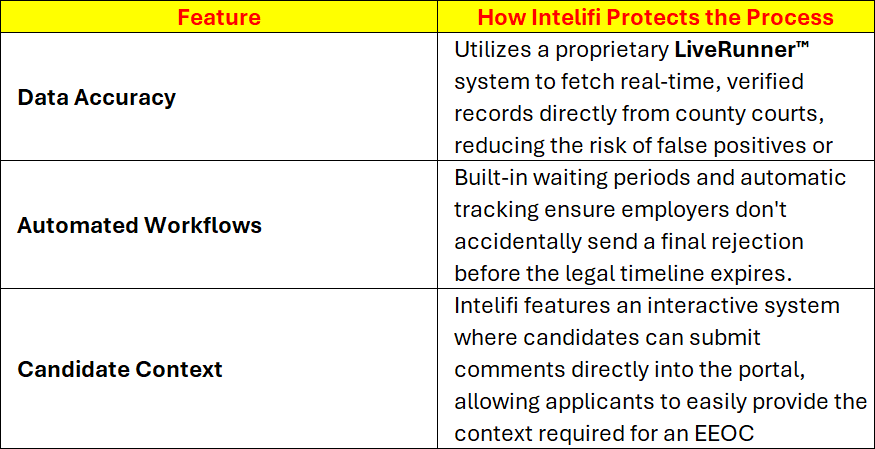
Feature How Intelifi Protects the Process
Data Accuracy Utilizes a proprietary LiveRunner™ system to fetch real-time, verified records directly from county courts, reducing the risk of false positives or reporting sealed records.
Automated Workflows Built-in waiting periods and automatic tracking ensure employers don't accidentally send a final rejection before the legal timeline expires.
Candidate Context Intelifi features an interactive system where candidates can submit comments directly into the portal, allowing applicants to easily provide the context required for an EEOC Individualized Assessment.
Ultimately, while an employer can reject you due to a criminal background check, they must do so through a transparent, highly regulated process that gives you a fair chance to view the data, dispute inaccuracies, and provide context. Utilizing an advanced system like Intelifi ensures that employers remain strictly within the boundaries of fair and legal hiring practices.