Crypto Security in 2026
Crypto Security in 2026: Why "Not Your Keys, Not Your Coins" Still Matters More Than Ever
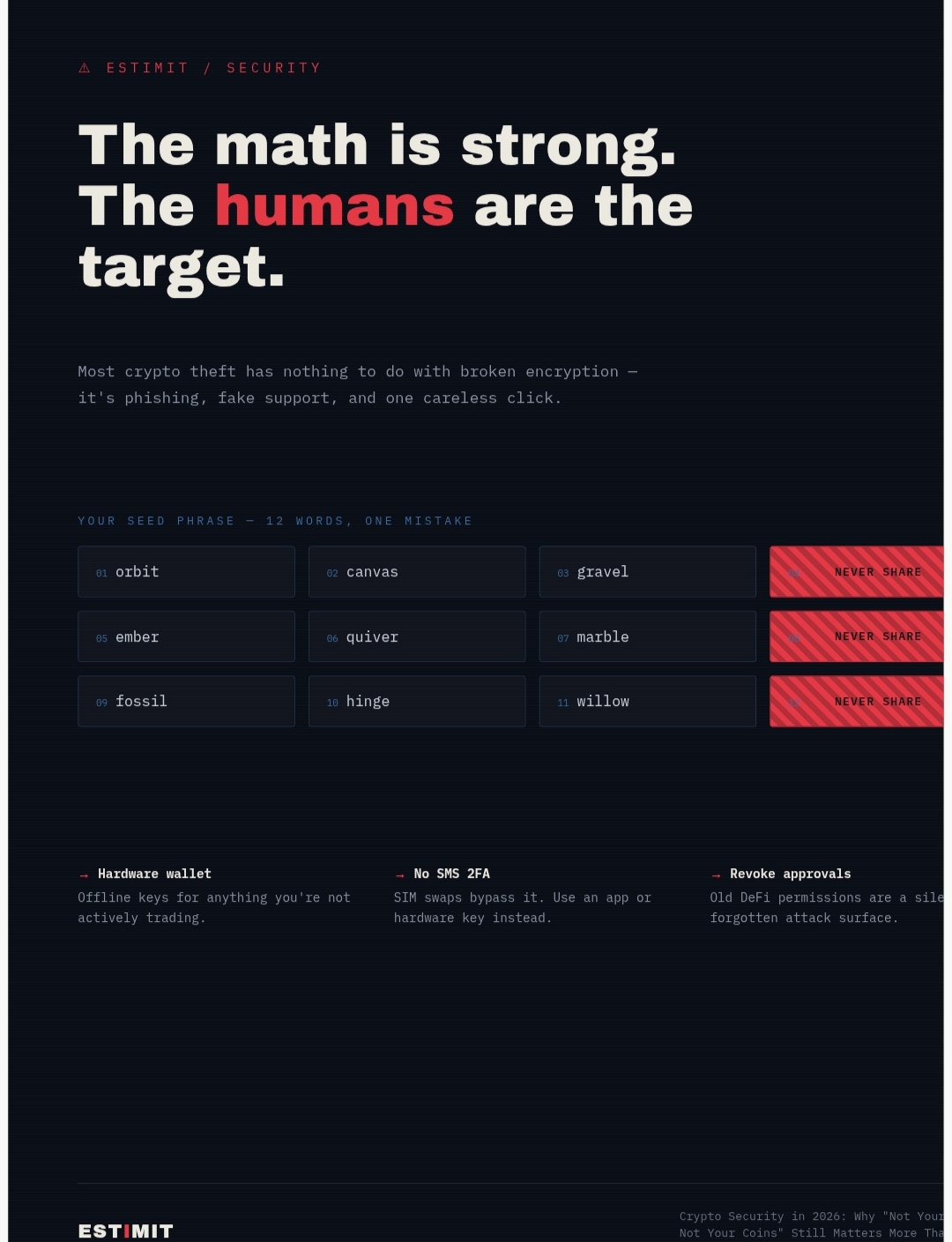
Every year, billions of dollars in crypto are stolen — not through some elaborate cryptographic break of Bitcoin or Ethereum's underlying encryption, but through much older, much simpler tricks: phishing links, fake support agents, malicious browser extensions, and people simply not understanding how their own wallets work. The technology securing crypto assets is, by most measures, remarkably strong. The weak link is almost always human.
The Custody Question Comes First
Before diving into specific threats, every crypto holder needs to answer one foundational question: who actually controls the private keys to your assets? If you're holding funds on a centralized exchange, the exchange controls the keys — you have an IOU, not direct ownership, and you're trusting that company's security practices and solvency. History has shown this trust can be misplaced, from exchange hacks to outright collapses that wiped out user balances overnight.
Self-custody, using a hardware or software wallet where you personally control the private keys, removes that counterparty risk but transfers full responsibility onto you. There's no customer support line to call if you lose your seed phrase or send funds to the wrong address. The tradeoff is real, and there's no universally correct answer — only a right answer for your own risk tolerance, technical comfort, and how much you're holding.
The Threats That Actually Cause Losses
Phishing remains king. Fake wallet-connection pop-ups, cloned websites that look identical to legitimate exchanges, and messages impersonating support staff continue to account for a large share of stolen funds. The trick is almost always urgency — a message claiming your account will be locked, or that a limited-time opportunity is about to expire, designed to make you act before you think.
Malicious approvals. Many DeFi interactions require you to "approve" a smart contract to access tokens in your wallet. Attackers exploit this by tricking users into signing approvals that grant unlimited access to their token balances, then draining the wallet at a later, less suspicious moment.
SIM swapping. If your email or exchange account is protected by SMS-based two-factor authentication, an attacker who convinces your mobile carrier to port your phone number to their device can often bypass that protection entirely and reset your account access.
Fake hardware wallets and tampered devices. Buying a hardware wallet from anywhere other than the manufacturer directly introduces the risk of receiving a pre-tampered device or a seed phrase that was generated before it ever reached you.
Social engineering through "helpful" strangers. Fraudsters lurking in crypto communities and social media replies pose as helpful support staff, offering to "fix" a problem in exchange for your seed phrase or remote access to your device. No legitimate support agent will ever ask for your seed phrase.
Practical Habits That Actually Reduce Risk
Use a hardware wallet for any holdings you're not actively trading, keeping the signing key offline and physically separate from any internet-connected device. Never type your seed phrase into a website, app, or message, under any circumstances — the only place it should ever be entered is directly into your own wallet device during setup or recovery. Revoke unused token approvals periodically using a blockchain explorer's approval-checker tool, since old approvals from long-forgotten DeFi interactions are a common attack surface. Bookmark the exact URLs of exchanges and protocols you use regularly rather than clicking links from search results or social media, where cloned phishing sites often outrank the real thing in ads. Enable app-based or hardware-key two-factor authentication instead of SMS wherever possible, since SMS is vulnerable to SIM swapping. Split large holdings across multiple wallets, so a single compromised device or leaked key doesn't expose your entire portfolio at once.
Security Isn't a One-Time Setup
The biggest mistake people make is treating wallet security as something you configure once and never revisit. New attack techniques emerge constantly, approval permissions accumulate over time, and personal circumstances change. Reviewing your setup periodically — checking connected apps, updating hardware wallet firmware, and reassessing where your assets are custodied — is as important as the initial setup itself.
Crypto's core promise is giving individuals direct control over their own money, without a bank or government standing in the middle. That control is genuinely powerful, but it comes with a responsibility that traditional finance's guardrails usually shield people from. Taking that responsibility seriously, with unglamorous, boring, repeatable habits, is what separates people who keep their crypto from the far too many who learn these lessons the hard way.