Before Adding a Virtual Card to Any Subscription: Balance, Currency, Renewal Date, Merchant Rules
Why this matters
Crypto payment problems are usually described at the headline level. Before Adding a Virtual Card to Any Subscription: Balance, Currency, Renewal Date, Merchant Rules is more useful when reduced to the sequence a user can actually check.
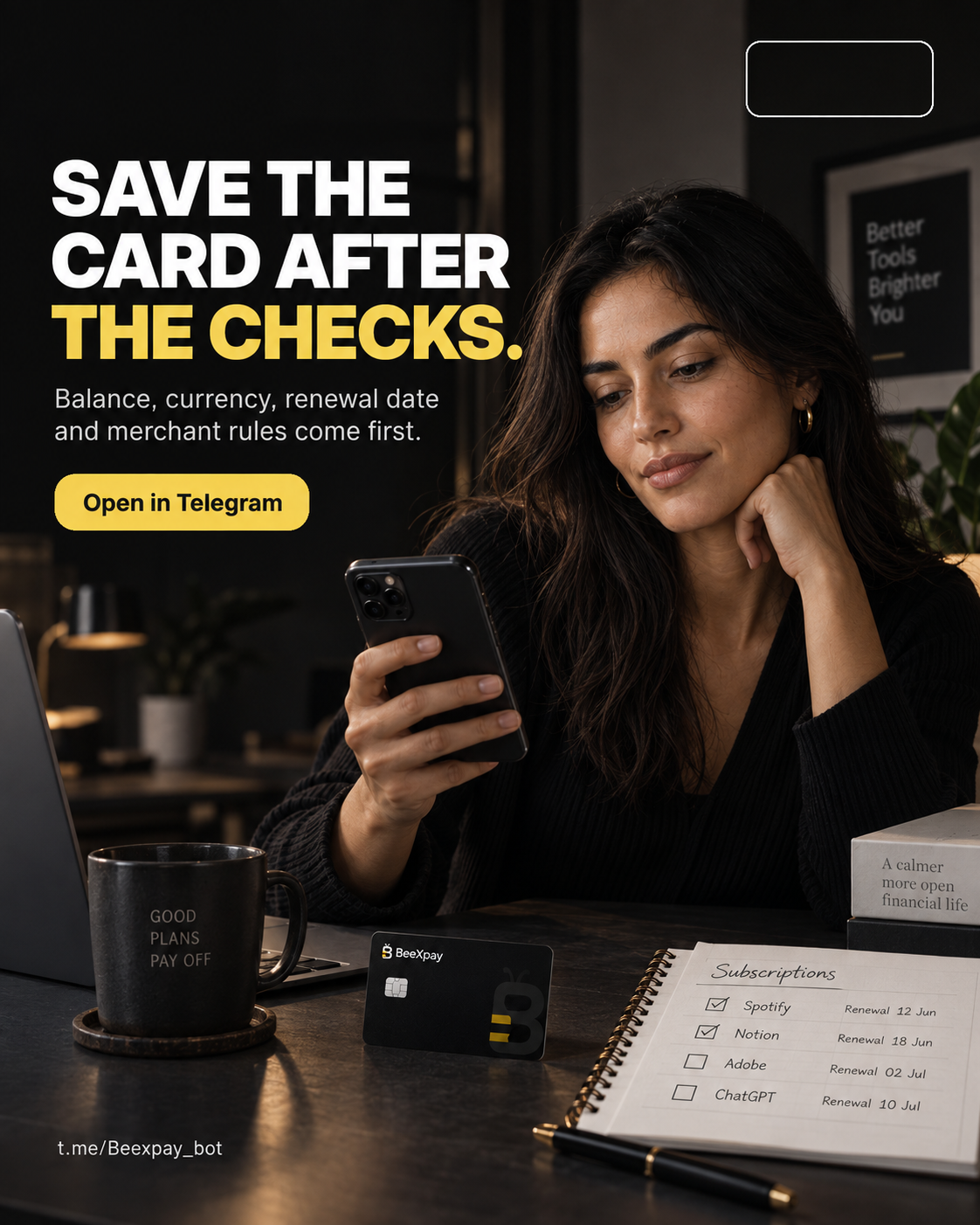
The best subscription setup is one you can ignore for a month because you prepared the balance and billing details in advance. That is why the practical question is not whether a crypto card sounds convenient, but which variables still need checking before the payment becomes irreversible.
What the documented flow tells us
Virtual cards are suited to online checkout and recurring digital services where the merchant accepts the card. Keep the renewal date visible and fund the balance before the charge. Check whether the subscription bills in USD or another currency; non-USD fees may apply. Merchant acceptance and recurring-billing policies remain outside BeeXpay's control.
These details are operational rather than promotional. They determine timing, cost, compatibility, or the amount of information a user needs to provide. In a crypto-funded payment flow, those details matter because the funding transfer itself may be irreversible even when the final card payment is not yet complete.
A simple routine
- Read the live product screen and confirm the relevant fee, currency, network or access rule.
- Check the merchant or destination requirement before funding for a time-sensitive purchase.
- Keep enough balance or time margin for the part of the flow you do not control.
- Save the transaction reference and use official support channels if something behaves differently than expected.
The boundary
Do not promise that a card will work for a named service without checking that service's current payment rules. This distinction is important because a payment service can control its own interface and terms, but not every merchant policy, blockchain condition, carrier event or external network.
A decision framework
A useful way to test this situation is to separate three questions. First, what can you verify before the crypto transfer is sent? Second, what part is controlled by the merchant, card network, blockchain, carrier or device rather than BeeXpay? Third, if the result is not what you expected, which information will support a clean support request? For this topic, the answer begins with the published conditions: Virtual cards are suited to online checkout and recurring digital services where the merchant accepts the card. The next step is to keep the external dependency visible rather than treating it as part of the same promise.
One realistic scenario
The best subscription setup is one you can ignore for a month because you prepared the balance and billing details in advance. The user does not need to understand every layer of card infrastructure to handle this well. They only need a repeatable order: verify the live requirement, leave a reasonable margin, send the correct crypto transaction, and retain the reference until the final payment or service activation is complete.
Takeaway
Store the renewal date beside the card, not just the card inside the merchant account. The points below stay within BeeXpay's published site content and Terms & Conditions, while general card-network practices are labelled as such.