How to Vet a Decentralized Exchange Before You Connect Your Wallet
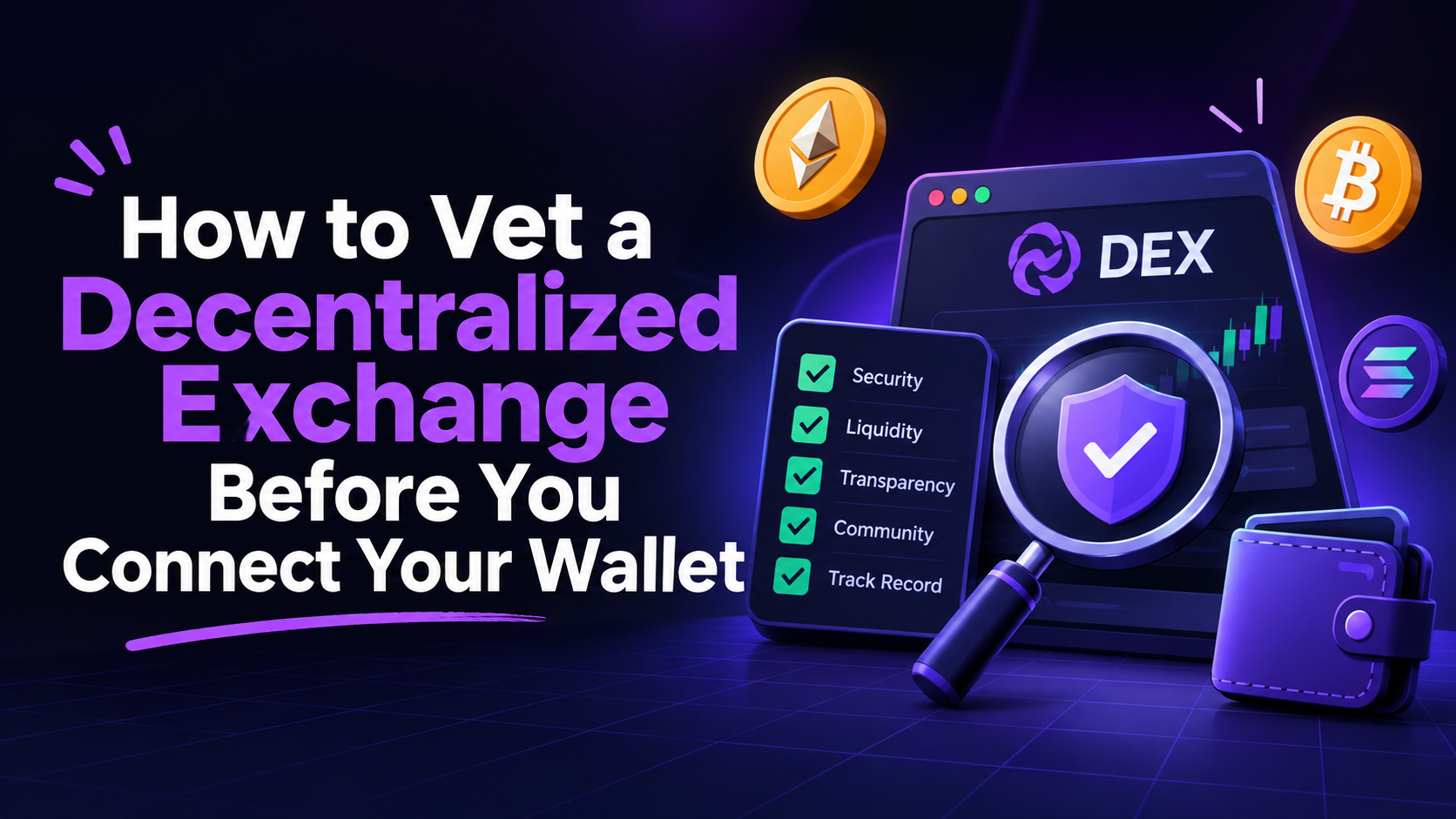
Connecting a wallet to a decentralized exchange takes seconds. Working out whether that exchange deserves your funds takes longer, and most traders skip it. There's no account manager, deposit insurance, or support desk with the power to reverse a bad transaction. If a contract fails, the loss usually lands on the people who were using it.
Vetting a DEX comes down to a handful of checks: who reviewed the code and how much of it, whether researchers are paid to find bugs, what your wallet is allowing the contract to do, and how much liquidity actually sits behind a quote. None of these checks removes risk. Together, they help filter out many obvious threats.
Audits: What They Cover and What They Miss
An audit is a paid review of a protocol's smart contracts by a security firm. It's the first thing most people check, and also one of the most misunderstood.
One of the biggest lessons from Sui has been the Cetus exploit. The concentrated liquidity DEX suffered a loss of approximately $223 million on May 22, 2025, due to an overflow-check failure during mathematical operations. Cetus confirmed that the bug was in an open-source library its contracts depended on. According to Rekt, that library wasn't included in the scope of an audit completed 41 days before the attack.
So, "audited" isn't a simple yes-or-no question. Open the report and check three things: the date, the commit or contract version reviewed, and the list of files included in the scope. If shared libraries or recently added features aren't listed, the audit says nothing about them.
The aftermath matters too. Cetus relaunched 17 days after the exploit, using recovered funds, reserves, and a loan from the Sui Foundation to refill affected pools. How a team responds after an incident tells you a lot about whether you'd want to be a user during the next one.
Do Bug Bounties Matter?
Yes, and their size tells you something. A bug bounty pays independent researchers to report vulnerabilities instead of exploiting them. If the reward for finding a critical bug is tiny compared with the funds at risk, the incentive points in the wrong direction.
PancakeSwap has run a bug bounty program for years. Its Immunefi program has been live since March 2021, with a maximum bounty of $1,000,000. Critical smart contract rewards are set at 5% of directly affected funds, up to that cap.
Smaller and newer platforms often combine a formal audit with a crowdsourced review. Dexlyn Labs, a decentralized trading platform on the Supra blockchain, took that route. Hacken completed its traditional audit, and HackenProof then opened the code to community bug hunters through its DualDefense program, focused on threats such as the theft or permanent locking of user funds. Two separate reviews don't guarantee safety, but they widen the group of people who have examined the code.
What Are You Approving in Your Wallet?
Before a DEX can move your tokens, your wallet signs an approval. Many interfaces request unlimited approvals by default so you don't have to sign again the next time you trade. That convenience remains in place even after you leave.
If the contract you approved is later exploited, or if you approved a malicious lookalike, those tokens could be drained without requiring another signature from you.
Approve specific amounts where your wallet allows it. Review and revoke old approvals regularly with a token approval checker, especially for contracts you no longer use. Bookmark the official URL of any DEX trading platform you use regularly, since phishing sites that copy popular DEX interfaces are common.
Liquidity Depth and Price Impact
A DEX can be perfectly secure and still give you a poor trade. A decentralized crypto exchange prices swaps based on the liquidity available in its pools. Thin pools translate to higher price impact, while a loose slippage setting can allow the final execution price to move further than expected.
Most interfaces show estimated price impact before you confirm a trade. Check it every time, especially when trading smaller tokens. If the number looks too high for your trade size, consider splitting the order or looking for a deeper pool. Aggregators such as Jupiter on Solana compare routes across different venues, which helps, but they can't create liquidity that isn't there.
Cross-Chain Routes Add Another Layer
Once a trade leaves one network, the bridge between blockchains becomes part of your risk picture. Bridges hold or route large sums, which also makes them attractive targets for attackers.
In the Cetus incident, more than $60 million of the stolen funds had already crossed the Wormhole bridge to the Ethereum network before the remaining funds were frozen by Sui validators.
When using cross-chain crypto exchanges, learn which bridge or messaging protocol is used to transfer tokens between different blockchains and whether it has undergone its own security audits. A cross-chain decentralized exchange is only as safe as the weakest contract in the route.
A Short Pre-Trade Checklist
- Audit reports: Recent, public, and covering the contracts you're actually using.
- Bug bounty: Active, with rewards that make sense relative to the total value at risk.
- Admin controls: Check who can upgrade contracts or pause markets, and whether changes go through a timelock.
- Approvals: Use limited amounts where possible and revoke old approvals.
- Liquidity: Check the price impact for your exact trade size.
- Cross-chain route: Identify the bridge or messaging protocol and check whether it has been reviewed.
Where Checklists Fall Short
No outside review can promise that a contract is bug-free. Cetus had undergone audits. In my view, the honest takeaway is to size positions as if any decentralized exchange platform could fail, and to treat these checks as a way to avoid obvious problems.
They won't make DeFi risk-free. But they can help keep you away from platforms that never tried to earn your trust in the first place.