Sandwich Attacks and Slippage Tolerance: How MEV Quietly Raises the Cost of DEX Trades
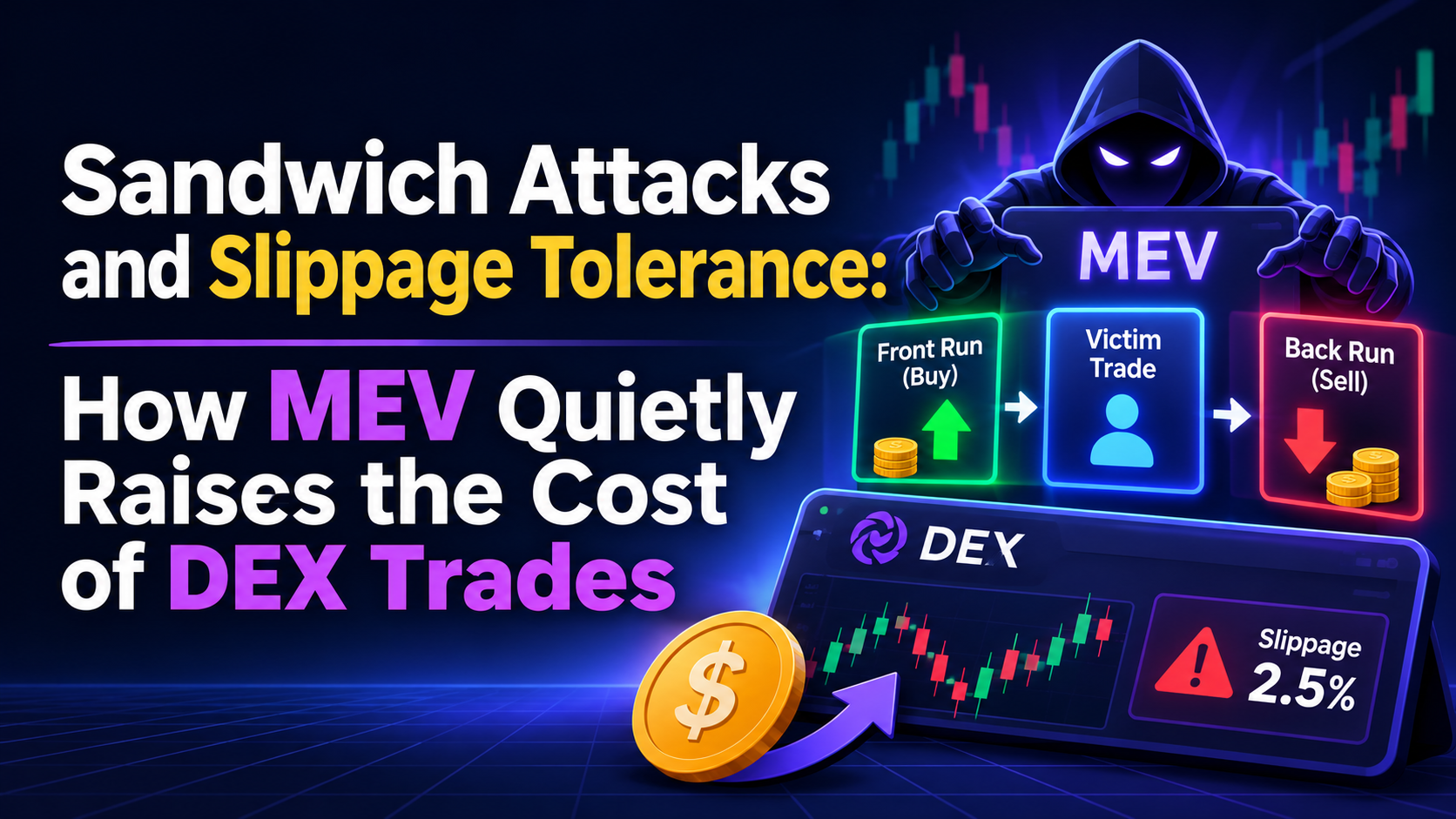
Every swap on a public blockchain is visible before it settles. That visibility is a feature of open ledgers, but it's also an opening for one of the most common hidden costs on any decentralized exchange platform: the sandwich attack. A bot spots your pending trade, buys just ahead of it, lets your order push the price higher, and sells immediately afterward. You get a worse fill, while the bot keeps the difference.
This cost is part of a larger category called MEV (maximal extractable value). It never appears on the fee line, which is why traders often underestimate it. One setting that plays a major role in how much value a bot can extract is slippage tolerance, yet many traders never adjust it.
What Is a Sandwich Attack?
A sandwich attack is a pair of trades placed on either side of your swap to profit from the price movement your transaction causes. It works on automated market maker pools because their prices move predictably with every trade.
Here's how the sequence works. You submit a swap to buy a token with 2% slippage tolerance. A bot spots your transaction before it's confirmed. It buys first, which raises the pool price. Your trade then executes at that higher price, still within your 2% limit, and pushes the price higher again. The bot sells into that price movement.
Your order doesn't fail, so nothing necessarily looks wrong. You simply pay more than you needed to.
Why Slippage Tolerance Is the Real Exposure
Slippage tolerance is the maximum price change you'll accept between receiving a quote and executing a trade. It exists because pool prices can move between the moment you click and the moment your transaction lands on-chain.
The catch is that a bot may be able to extract value up to the price gap you allow. Set a 5% tolerance on a liquid pair that only needs 0.3%, and you've allowed your trade to execute at a much worse price. Set it too tightly, however, and trades involving volatile tokens may fail to execute.
In my view, fixed slippage defaults are one of the weakest parts of many swap interfaces. A single number can't suit both a stablecoin pair and a newly launched memecoin. Tools that adjust tolerance for each trade are a real improvement, although they also require users to trust the estimator behind them.
How Different Platforms Handle MEV
MEV defenses generally fall into a few groups: hiding orders from public view, controlling how transactions reach validators, settling orders in batches, and setting slippage more precisely. Several large venues now combine more than one approach.
Private Transaction Routing on BNB Chain
PancakeSwap's main defense is keeping swaps out of the public mempool. Its MEV Guard on BNB Chain, built with 48 Club, is designed to protect swaps from front-running and sandwich attacks. For Binance Wallet and Trust Wallet users, it switches on automatically once connected. MetaMask users can add it through a one-click setup.
The chain itself has also taken action. In March 2025, the BNB Chain community launched the Goodwill Alliance to curb sandwich attacks. BNB Chain later reported a 95% drop in these attacks. That figure comes from BNB Chain itself, so it's worth treating it as the network's own measurement.
Controlled Execution and Adaptive Slippage on Solana
Jupiter works on two fronts. Jupiter argues that some providers increase sandwich risk by selling order flow to external MEV searchers. It says its Ultra V3 engine never hands trades to an external provider for execution.
It also uses a Real-Time Slippage Estimator that sets slippage based on volume, historical volatility, and transaction patterns.
Jupiter is candid about the limitations, which is worth noting. Its own launch material acknowledges that the risk isn't zero because validators still pass transactions to upcoming leaders.
Batch Settlement
A different approach skips the race altogether. CoW Protocol collects orders over a short window and settles them together at a single clearing price, with solvers competing to fill the batch.
If every order in a batch receives the same clearing price, there's no opportunity for a bot to profit by inserting a trade ahead of an individual order within that batch. The trade-off is that users depend on solver competition to get a good execution price.
Cross-Chain Trades Have Two Exposure Points
When you swap tokens across blockchains, MEV risk doesn't disappear. It can appear on multiple legs of the route. A cross-chain crypto exchange may route your funds through a bridge between blockchains and then execute a swap on the destination chain. Each leg can be observed and priced independently on its own network.
That matters on newer chains too. Dexlyn Labs is a cross-chain decentralized exchange operating on Supra. DeFiLlama describes it as an AMM covering token trading, liquidity pools, and cross-chain bridging.
On any decentralized trading platform built around AMM pools, the same principle applies: the slippage tolerance you set determines how much price movement you're willing to accept on each swap leg.
How Traders Can Reduce MEV Losses
- Set slippage per trade: Keep it low on liquid pairs and increase it only when volatile tokens repeatedly fail to execute.
- Use private routing where available: A protected RPC can help keep your order out of the public mempool.
- Split large orders: Smaller swaps may move pools less and leave less room for a profitable sandwich attack.
- Check the executed price: Compare your actual fill against the original quote after each trade on a decentralized crypto exchange. Repeated gaps can be a warning sign.
What Protection Can't Do
No setup removes MEV entirely. Private routing still relies on the party operating the relay, while batch auctions depend on solvers behaving properly. Arbitrage, a related form of MEV, helps keep pool prices aligned with other markets and isn't necessarily harmful to traders.
The goal isn't to eliminate every form of MEV. It's to make sure your own order isn't the easiest one for someone else to profit from.
What This Means for DeFi Traders
The swap screen on any DEX trading platform shows fees, routes, and price impact. It rarely shows what a sandwich attack could cost you. Slippage tolerance is one of the controls that directly limits the price movement you're willing to accept, so it deserves more attention than the default value usually gets.