Why Concentrated Liquidity Changes the Way DEX Liquidity Providers Trade
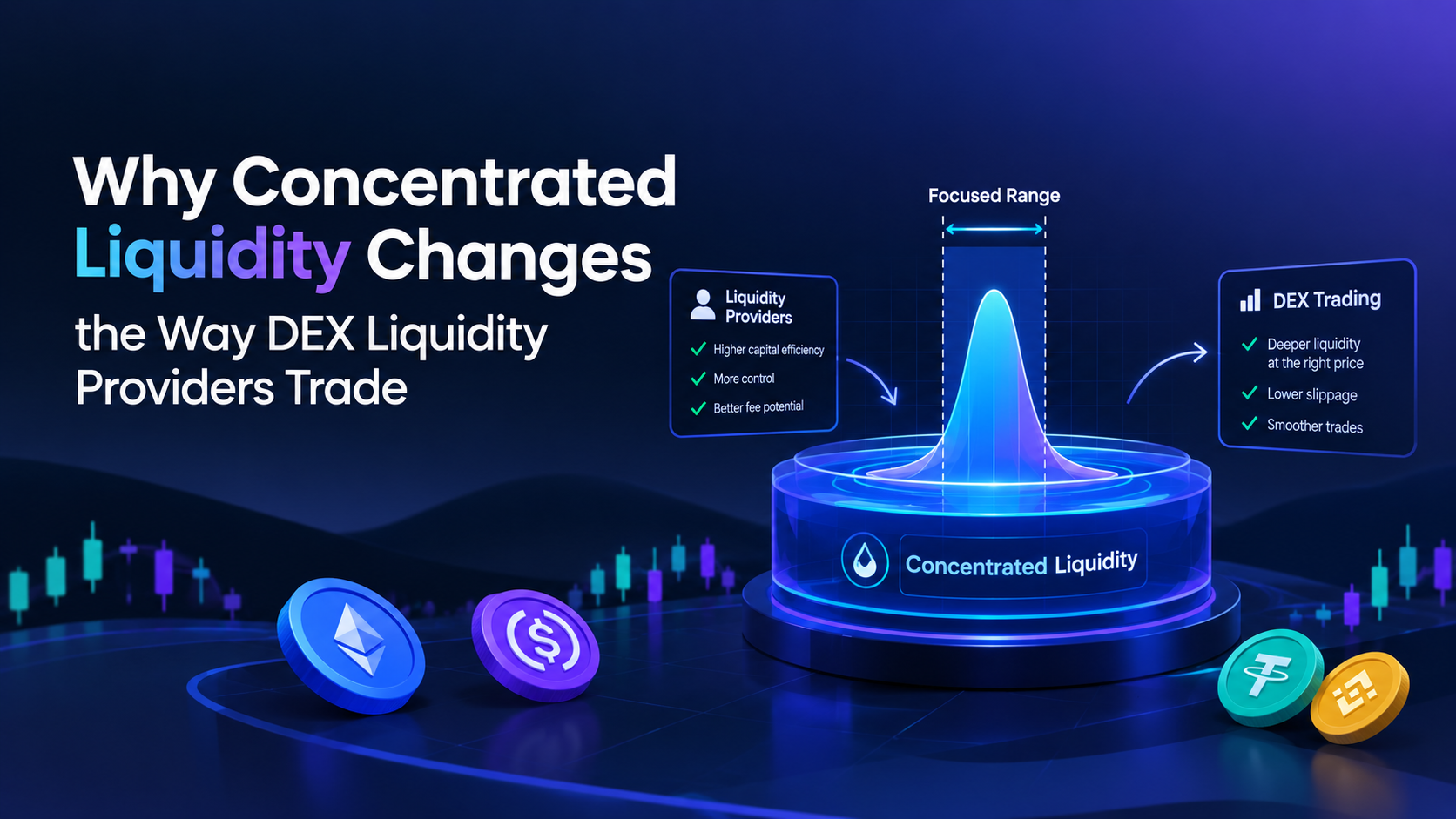
Liquidity providers on a decentralized exchange used to have a relatively simple job: deposit two tokens into a pool and collect a share of trading fees. Concentrated liquidity changes that model. Instead of spreading capital across the entire possible price curve, an LP selects a price range where the capital will be active.
That design can give traders deeper liquidity around active prices while giving LPs more control over where their capital is deployed. It also creates new risks. A position can move out of range, stop earning swap fees, and become heavily exposed to one side of the pair.
For anyone using a decentralized exchange platform, understanding that tradeoff matters more than simply looking at an advertised APR.
**What Is Concentrated Liquidity?
Concentrated liquidity is an AMM design in which liquidity providers select a specific price range for their position instead of supplying capital across the entire price curve.
Suppose ETH trades around $3,000 and an LP creates an ETH/USDC position covering $2,700 to $3,300. The position is active while the market remains inside that range. Trades consume liquidity within the active price intervals, and the LP earns a share of the applicable swap fees.
If ETH moves above $3,300, the position can become inactive. The LP may be left holding mostly one asset and stops
earning fees from swaps until the market returns to the selected range.
PancakeSwap's documentation describes the same mechanism for its V3 pools: LPs choose their price range, and positions outside the active range no longer participate in trades or earn trading fees.
Why Do DEXs Use Concentrated Liquidity?
Traditional constant-product AMMs distribute liquidity across a very wide price curve. Much of that capital may sit far away from the price where most trading currently occurs.
Concentrated liquidity places more capital around selected prices. For traders, this can mean more available liquidity around an active market price and potentially lower price impact for a given pool.
For LPs, the tradeoff is management.
A narrow range can collect fees from a large share of trades while the market stays inside it. A wider range can remain active through larger price movements, but the same amount of capital is spread across more prices.
That makes range selection a trading decision rather than a passive deposit.
How Does a Concentrated Liquidity Position Work?
A concentrated liquidity position has several moving parts:
- Lower price: The point where the position begins becoming active.
- Upper price: The point where the position stops being active.
- Ticks: Discrete price intervals used by the AMM to track changes in liquidity.
- Fee tier: The swap fee charged by the pool.
- Active liquidity: Capital currently available around the market price.
Orca's Whirlpools, for example, use tick spacing to define price intervals when creating concentrated liquidity pools.
The token mix also changes as price moves. If the market rises through a position, the position gradually holds more of one token. If the price falls, the balance shifts toward the other.
Once price crosses the selected range completely, the position can become one-sided.
That is a major difference from a simple liquidity deposit.
Does a Narrower Range Always Mean Higher Returns?
No.
A narrower range increases the concentration of capital while the position is active, but it also gives the LP less room for price movement.
Imagine two LPs providing the same ETH/USDC pair. One chooses a range of $2,900 to $3,100. Another chooses $2,500 to $3,500.
If ETH remains close to $3,000, the narrower position may capture a larger share of trading activity relative to its active liquidity. If ETH quickly moves to $3,400, the narrower position is outside its range while the wider position remains active.
PancakeSwap also notes that LP fee returns depend on factors such as trading volume, fee tier, deposited liquidity, selected range, and the amount of active liquidity competing within that range.
So a higher displayed APR at one moment should not be treated as a guaranteed return.
What Risks Should LPs Watch?
Concentrated liquidity adds several risks that matter when using a decentralized crypto exchange or other AMM-based dex trading platform.
Range risk: Price can leave the selected range, making the position inactive.
Impermanent loss: The token mix changes as price moves. A volatile pair can produce a large difference between holding the tokens directly and holding them through an LP position.
Rebalancing costs: An LP may need to close one position and create another when market conditions change. Each adjustment can involve network fees and trading costs.
Fee competition: If many LPs concentrate liquidity around the same price, each position receives a smaller share of fees generated within that area.
Smart-contract risk: The LP's capital remains subject to the AMM's contracts and the blockchain on which they operate.
Orca's position simulator reflects this tradeoff by showing projected PnL, token mix, impermanent loss, and estimated yield as price moves through a selected range.
How Different DEX Platforms Use the Model
Concentrated liquidity is not implemented identically across every protocol.
PancakeSwap V3 uses non-fungible liquidity positions with customizable ranges and fee tiers. Its newer Infinity architecture also includes a concentrated-liquidity AMM called CLAMM alongside other pool designs.
Orca uses its Whirlpools architecture on Solana, where pool creation includes parameters such as token mints, tick spacing, and initial price.
Dexlyn Labs uses concentrated liquidity within its DEX on Supra. Its documentation describes custom price ranges, liquidity positions, ticks, and range orders. A range order can use a single-sided liquidity position to behave somewhat like a limit order as price moves through the selected range.
These are different implementations of the same broad idea: put liquidity where trading is expected to happen rather than distributing it uniformly across every possible price.
What Should Traders and LPs Check Before Using a DEX?
A decentralized trading platform can make liquidity provision look simple from the front end, but the underlying position deserves closer inspection.
Before supplying capital, check:
- Current trading volume and active liquidity
- Pool fee tier
- Historical price movement
- Width of the proposed range
- Expected network transaction costs
- Impermanent-loss exposure
- How often the position may need rebalancing
- Smart-contract and protocol security information
For traders, the same mechanics matter from the opposite side. Concentrated liquidity can improve available liquidity around active prices, but a thin or poorly positioned pool can still produce high price impact.
The result is a DEX model where liquidity provision looks less like depositing money into a passive pool and more like managing a defined market position.
Why Range Selection Matters
Concentrated liquidity gives LPs greater control over where their capital works, but that control comes with more decisions.
A tight range may suit an asset pair that trades inside a predictable band. A volatile pair may require a wider range or more frequent management. Neither approach works equally well under every market condition.
That is the real design tradeoff behind concentrated liquidity. It shifts its thinking from "How much liquidity did I deposit?" to "Where is my liquidity active, and what is happening when price leaves that area?
That is an important point that any prospective decentralized exchange (DEX) user should consider when weighing against other metrics, such as the fees, the annual percentage rate (APR), and the token bonuses.