DeFi Explained
DeFi Explained: How Code Is Quietly Replacing Bankers
Imagine a bank that never closes, never asks for your ID, never has a loan officer who can reject your application on a bad day, and whose entire rulebook is published in public for anyone to audit. That, in essence, is the promise of decentralized finance — DeFi for short. It's one of the most consequential and least understood corners of the crypto industry, and it's already moving hundreds of billions of dollars without a single traditional financial institution in the loop.
The Core Idea
Traditional finance runs on intermediaries. Want to take out a loan? A bank evaluates your creditworthiness. Want to trade a stock? A broker routes your order through an exchange. Want to earn interest on your savings? A bank pools deposits and decides what rate to pay you. In every case, a trusted institution sits between you and the outcome you want, and that institution takes a cut, sets the terms, and can freeze you out entirely.
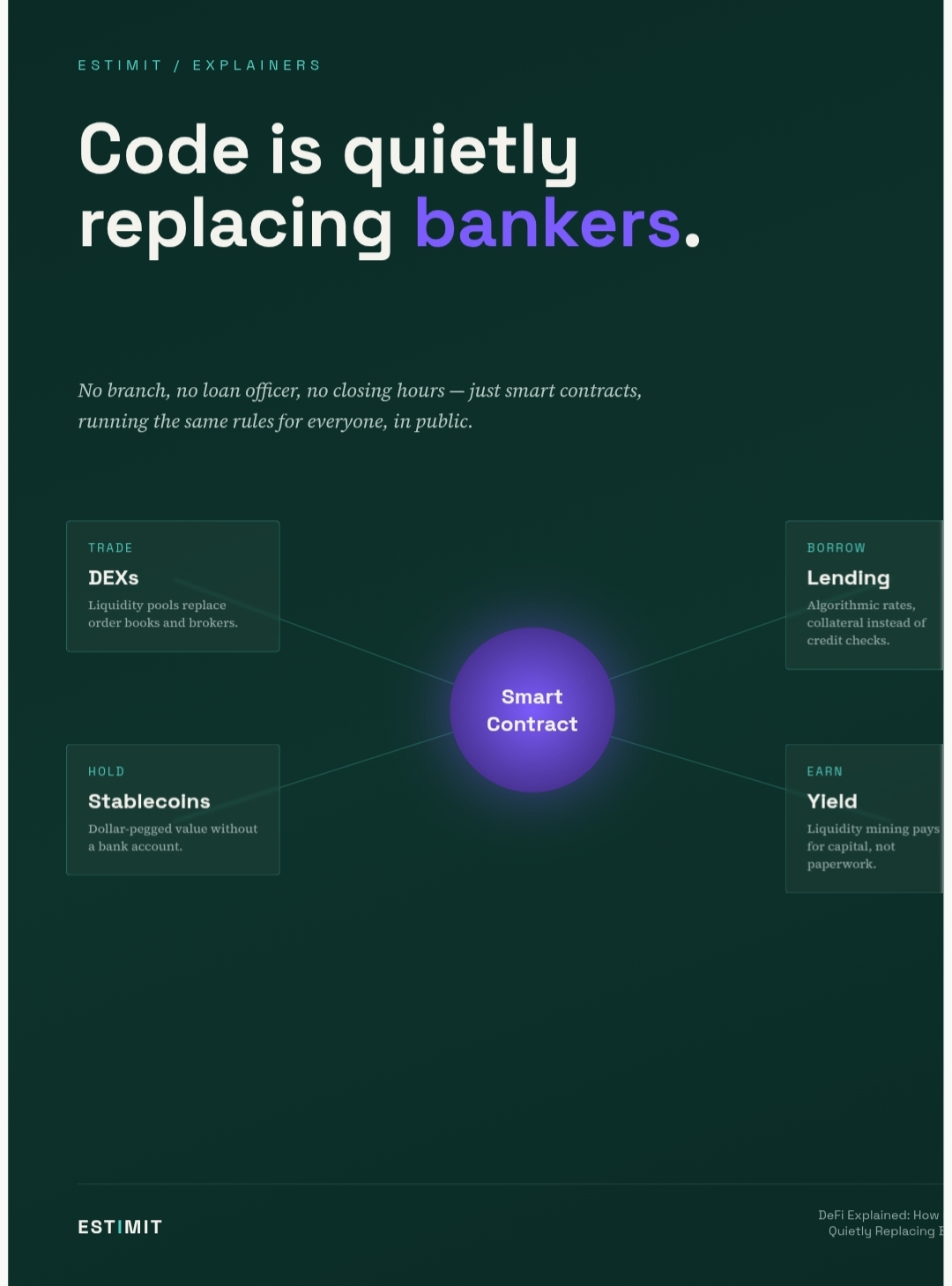
DeFi replaces those institutions with smart contracts — self-executing code deployed on a blockchain, most commonly Ethereum. A smart contract doesn't sleep, doesn't discriminate, and doesn't have a manager who can override it on a whim. If the code says you get your collateral back when you repay a loan, that's what happens, automatically, every time.
The Building Blocks
Decentralized exchanges (DEXs) like Uniswap let people trade tokens directly from their own wallets, using liquidity pools instead of a traditional order book matched by a company. Anyone can supply tokens to these pools and earn a share of trading fees in return, effectively becoming a market maker without needing a trading license.
Lending protocols such as Aave or Compound let users deposit crypto as collateral and borrow against it, or lend out their holdings to earn interest paid by borrowers. Interest rates adjust algorithmically based on supply and demand within each pool, updating in real time rather than being set by a committee.
Stablecoins provide the price stability that volatile crypto assets lack, pegging their value to something like the US dollar. They've become the connective tissue of DeFi, used as the base currency for trading, lending, and saving without needing to touch a traditional bank account.
Yield farming and liquidity mining let users chase the best returns by moving capital between protocols, often earning additional governance tokens as an incentive for providing liquidity where it's needed most.
Why This Matters Beyond Crypto Twitter
The appeal isn't purely ideological. In countries with unstable currencies or limited banking infrastructure, DeFi protocols offer access to dollar-denominated savings and credit that would otherwise be unavailable. Someone with a smartphone and an internet connection can access financial tools that used to require a bank branch, a credit history, and government-issued documentation.
There's also a transparency argument that's hard to dismiss: every transaction, every interest rate change, every liquidation on a major DeFi protocol is visible on-chain, forever. Compare that to traditional finance, where the inner workings of risk models and lending decisions are proprietary black boxes.
The Risks Nobody Should Skip
None of this comes without serious downsides. Smart contract bugs have led to hundreds of millions of dollars in losses through exploits that traditional finance's slower, more regulated processes would likely have caught. There's no customer service line to call if you send funds to the wrong address or fall victim to a malicious contract. Regulatory uncertainty looms over the entire sector, with governments still figuring out how — or whether — to treat these protocols like the financial institutions they're functionally replacing.
Liquidation risk is also real and unforgiving: borrow against volatile collateral, and a sharp price drop can wipe out your position automatically, with no human on the other end willing to offer you extra time.
Where This Is Heading
DeFi is still early, messy, and occasionally chaotic, but the underlying shift it represents — financial infrastructure that's programmable, transparent, and accessible without gatekeepers — isn't going away. Traditional finance is already borrowing ideas from it, from tokenized real-world assets to blockchain-based settlement systems. Whether DeFi eventually merges with the traditional system or continues evolving as a parallel track, it's forcing an honest conversation about who financial infrastructure should really serve.