Einige Fragen Kunst betreffend | A few questions concerning art
Einige Fragen, Kunst betreffend
Wieder mal ein Göttertreffen. Es wurde Zeit. Anberaumt vom Küchentisch.
So sitzen sie also erneut beisammen und sinnieren. Wie bisher sind jedoch längst nicht alle Götter dabei, die in der menschlichen Welt eigentlich bekannt sind, sei es hier oder da oder insgesamt, und ganz genau genommen ist kein einziger der weltbekannten Götter dabei. Es sind auch nur drei, nämlich eine tätowierte Göttin der Fragen, der Zweifel und der Sehnsucht nach Antworten; ein angealterter Gott der Kunst, des Rausches und der unvermeidlichen Scheiterns; ein allmählich zu mollig werdender Gott der Überheblichkeit, der Besserwisserei und der viel zu großen Schuhe. Die Namen sind unverändert Vivienne, Wolf und ich, und wir sitzen am ewig gleichen Küchentisch in der Nähe vom Nirvana, nein, Walhalla. So heißt eine Kneipe wenige Straßen-Ecken entfernt, und einer von uns hat dort infolge mehrerer Vorkommnisse ein lebenslanges Hausverbot, aber das ist eine andere Geschichte, zumal das Hausverbot seit der Bestattung erloschen sein dürfte, aber auch das ist eine andere Geschichte.
Diesmal stelle ich mir vor, wie wir über ein Thema sprechen, das uns alle interessiert, nämlich: Wer hat eigentlich Kunst erfunden? Und wann und wozu? Den ersten Beitrag lege ich Wolf in den Mund, dem weitest gefächerten Künstler unter uns, tätig als Maler, Skulpteur (das ist ein Skulpturenerschaffer, und dieses Wort gibt es tatsächlich, da habe ich extra nachgeschaut) und Schauspieler, ferner als Regisseur und Drehbuchautor. Wolf sagt also: „Das ist doch klar, wer die Kunst erfunden hat, das waren die ersten Künstler, und –“ (Vivienne und ich wollen gerade lachen wie über einen Scherz) „– und das meine ich ernst! Die Künstler machen die Kunst; und nicht umgekehrt!“ Wir halten inne.
Vivienne schaut mich nach zwei Sekunden an und meint fast bedauernd: „Mir scheint, er hat recht. Egal, wann es geschehen sein mag, ob in den Höhlen von Lascaux oder anderswo und ob früher oder später – es waren Menschen mit einer bestimmten Absicht. Selbst wenn diese Absichten ganz zu Anfang beschwörender, magischer, ritueller Art gewesen sein sollten, was ja gar nicht erwiesen ist, selbst dann würde es eine fortschreitende Loslösung davon gegeben haben, und zwar durch die Künstler, die Schaffenden.“
Während Wolf einen befriedigten Zug aus seiner Bierflasche nimmt, versuche ich einzuwenden: „Aber! Wir wollen doch nicht außer Acht lassen, dass das Wort Künstler vom Wort Kunst abgeleitet ist und nicht umgekehrt. Und das dürfte bedeuten, dass wir ‚Kunst‘ schlecht über ‚Künstler‘ definieren oder auch nur beschreiben können. Mit dem Wort ‚Kunst‘ abstrahieren wir ja erst einmal von den sie erschaffenden Menschen, oder nicht?“
„Aber! Sprachlogik hilft uns hier nicht wirklich weiter“, antwortet Vivienne, indem sie mich imitiert. „Mit der Aussage ‚Künstler machen die Kunst‘ ist darauf hingewiesen, dass eine bestimmte Absicht dazu gehört, weil ein Kunstwerk nicht zufällig entsteht und auch nicht dadurch zustande kommt, dass irgendwer von einem Werk behauptet, es sei Kunst.“ Wolf nickt. „Künstler und ihre jeweiligen kommunikativen Absichten sind entscheidend, um Kunst in die Welt zu bringen.“ Wolf nickt wieder.
„Wenn ich etwas erschaffe mit der Intention eines Künstlers, ist eine wichtige Bedingung erfüllt, wobei wir uns eine solche Intention gleich noch etwas genauer anschauen sollten. Doch diese allein reicht meiner Meinung nach nicht aus. Es muss auch jemand da sein, der sich auf das als Kunstwerk Geschaffene einlassen will und kann. Der Betrachter oder Hörer gehört mit dazu, Kunst ist ein soziales Phänomen, keine individuelle Setzung“, werfe ich wortreich ein, geradezu eloquent. Ich lehne mich befriedigt zurück.
„Ästhetische Theorie als Teil der Kommunikationstheorie?“, fragt Vivienne, und diesmal bin ich der, der nickt. „Wenn das Kunstschöne oder das Künstlerische sich von Naturschönheit und Natur unterscheiden will, dann geht es nur über diese Brücke“, setze ich nach. „Andernfalls formt der Mensch den Stein nicht anders als eine Welle es tut, nämlich plan-, ziel- und absichtslos.“ Wolf blinzelt schalkhaft.
„Aber dein Beethoven“ – dabei schaut er mich an, den Beethoven-Fan – „Beethoven war doch der Ansicht, die Kunst würde sich selbst äußern durch den Künstler, der ihrem Geist dient. Wo sind denn da der Plan, das Ziel, die Absicht?“
„Vielleicht hatte er Kant gelesen“, räume ich ein, „und bezog sich auf Kants Vorstellung von Natur. In dieser Vorstellung ist der Mensch durch und durch Teil der Natur, somit auch alles, was der Mensch hervorbringt, einschließlich der Kunst. So, wie wir einen Ameisenbau oder ein Vogelnest als Teil der Natur betrachten. Das künstlerische Genie gestaltet aus dieser Natur heraus, indem es nicht Regeln folgt, sondern Regeln erschafft, denen andere Künstler folgen können. Wiederum frei, wenn sie talentiert genug sind.“
Vivienne möchte noch bei der Intention, der Absicht der künstlerisch Schaffenden bleiben: „Haben Künstlerinnen und Künstler also eine Botschaft? Oder ‚passiert‘ ihnen das Kunstwerk einfach, weil sie nicht anders können?“ – „Das Werk ‚passiert‘, aber es ist kein Zufall, sondern es sieht gerne so aus, als hätte es Freiheit und Notwendigkeit miteinander in Ausgleich gebracht“, wage ich hinzu zu fügen. „Und erst an dieser Stelle beginnt seine Botschaft, nicht schon vorher, sonst hätte diese ja einfach ausgesagt werden können und keine künstlerischen Mittel benötigt, sei es in der Musik oder Malerei, bei Skulptur oder Dichtung.“
Wolf ist das zu viel intellektuelles Gequatsche. „Hier, schaut mal. Das ist mein Aquarell mit dem Titel ‚Bauer der Provence‘. Es zeigt Auguste, von dem ich euch ja schon erzählt habe. Ich habe einerseits so gemalt, dass man ihn wiedererkennt, andererseits vieles nur angedeutet, um Leichtigkeit zu erreichen. Aber als das Bild schon fertig war, da musste ich es auf kontrollierte Weise zerstören. Da habe ich ohne Pinsel hier mit der Fingerspitze einen farbigen Fleck aufgesetzt, und dabei ging ich das Risiko ein, das Bild wirklich zu entwerten, es kaputt zu machen. Aber ich musste das tun, um ihm die harmlose Regelhaftigkeit wieder auszutreiben, die bis hierhin die Komposition und Ausführung zwar nicht diktiert, aber doch geleitet hat.“
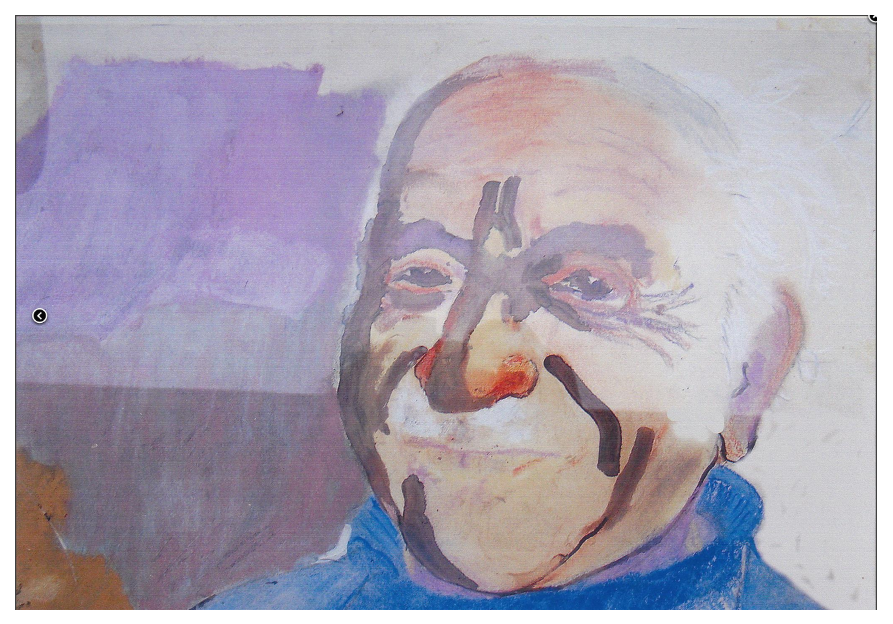
artwork: Wolfgang Kroke, 'Auguste'
A few questions concerning art
Another gathering of the gods. It was about time. Arranged from the kitchen table.
So here they are once again, sitting together and pondering. As before, however, by no means all the gods who are actually known in the human world are present – be it here, there or in general – and, strictly speaking, not a single one of the world-famous gods is present. There are only three of them: a tattooed goddess of questions, doubt and the longing for answers; an ageing god of art, ecstasy and inevitable failure; and a god of arrogance, know-it-all behaviour and shoes that are far too big, who is gradually getting a bit too chubby. Our names remain the same: Vivienne, Wolf and me, and we’re sitting at the same old kitchen table near Nirvana – no, Valhalla. That’s the name of a pub a few street corners away, and one of us has been banned from it for life following several incidents, but that’s another story, especially as the ban is likely to have been lifted since the funeral – though that, too, is another story.
This time, I’m imagining us discussing a topic that interests us all, namely: Who actually invented art? And when, and why? I’ll have Wolf make the first contribution – he’s the most versatile artist amongst us, working as a painter, sculptor (that’s someone who creates sculptures, and that word really does exist; I looked it up just to be sure) and actor, as well as a director and screenwriter. So Wolf says: “It’s obvious who invented art – it was the first artists, and –” (Vivienne and I are just about to laugh as if at a joke) “– and I mean that seriously! Artists make art; not the other way round!” We pause.
After two seconds, Vivienne looks at me and says, almost regretfully: “It seems to me he’s right. No matter when it may have happened – whether in the caves of Lascaux or elsewhere, and whether earlier or later – it was people with a specific intention. Even if those intentions were of a more evocative, magical or ritualistic nature at the very beginning – which hasn’t actually been proven – even then there would have been a gradual distancing from that, brought about by the artists, the creators.”
Whilst Wolf takes a satisfied swig from his beer bottle, I try to object: “But! We mustn’t forget that the word ‘artist’ is derived from the word ‘art’, and not the other way round. And that would suggest that we can hardly define or even describe ‘art’ in terms of ‘artists’. After all, with the word ‘art’, we’re abstracting away from the people who create it in the first place, aren’t we?”
“But! Linguistic logic doesn’t really help us here,” replies Vivienne, mimicking me. “The statement ‘artists make art’ points out that a specific intention is involved, because a work of art does not come about by chance, nor does it come into being simply because someone claims a work is art.” Wolf nods. “Artists and their respective communicative intentions are crucial to bringing art into the world.” Wolf nods again.
“If I create something with the intention of an artist, an important condition is fulfilled, although we should take a closer look at such an intention in a moment. Yet, in my opinion, this alone is not enough. There must also be someone who is willing and able to engage with what has been created as a work of art. The viewer or listener is part of the equation; art is a social phenomenon, not an individual construct,” I interject at length, almost eloquently. I lean back, satisfied.
“Aesthetic theory as part of communication theory?” asks Vivienne, and this time I’m the one who nods. “If artistic beauty or the arts want to distinguish themselves from natural beauty and nature, then this is the only way to do so,” I add. “Otherwise, humans shape stone no differently than a wave does – that is, without plan, aim or intention. ” Wolf winks mischievously.
“But your Beethoven” – as he says this, he looks at me, the Beethoven fan – “Beethoven was, after all, of the view that art expresses itself through the artist, who serves its spirit. Where, then, are the plan, the aim, the intention?”
“Perhaps he’d read Kant,” I concede, “and was referring to Kant’s conception of nature. In this conception, humankind is, through and through, part of nature; therefore, so too is everything humankind produces, including art. Just as we regard an anthill or a bird’s nest as part of nature. The artistic genius creates from within this nature, not by following rules, but by creating rules that other artists can follow – freely, provided they are talented enough.”
Vivienne would like to stay with the subject of the artist’s intention: “So do artists have a message? Or does the artwork simply ‘happen’ to them because they cannot help themselves?” – “The work ‘happens’, but it is no accident; rather, it often appears as though it has struck a balance between freedom and necessity,” I venture to add. “And it is only at this point that its message begins, not before; otherwise, it could simply have been stated and would not have required artistic means, be it in music or painting, sculpture or poetry.”
Wolf finds this all too much intellectual drivel. “Here, have a look. This is my watercolour entitled ‘Farmer of Provence’. It depicts Auguste, whom I’ve already told you about. On the one hand, I painted it in such a way that he is recognisable; on the other, I merely hinted at many details to achieve a sense of lightness. But once the painting was finished, I had to destroy it in a controlled manner. So, without a brush, I applied a splash of colour here with my fingertip, thereby taking the risk of truly devaluing the painting, of ruining it. But I had to do this to drive out that harmless regularity which, up to this point, had not dictated the composition and execution, but had nevertheless guided them.”
[translated with DeepL]
Lo que aprendí de tu texto es que incluso los dioses de la cocina reconocen que el artista es quien crea el arte, no al revés; la frase de Wolf, “Los artistas hacen el arte; y no al contrario”, lo dice sin vueltas. La elección de Vivienne como la diosa de la duda y la sed de respuestas me parece clave. ¿Qué te llevó a asociar a Wolf con el fracaso inevitable y la embriaguez creativa?
Wolf era artista y sabía lo que era el fracaso, ya que una obra nunca sale tal y como el creador desea. Pero, aun así, la creación genera una euforia creativa. (Además, era un apasionado de la cerveza.)
Wolf was an artist himself and knew all about failing, as a work never turns out quite as the artist would like. But the act of creating nevertheless induces a creative fever. (He was also quite fond of drinking beer.)
Wolf war selbst Künstler und kannte das Scheitern, da ein Werk nie so gelingt, wie der Schaffende es wünscht. Aber das Schaffen erzeugt dennoch einen kreativen Rausch. (Außerdem war er dem Biertrinken ergeben.)