Why Stablecoin Liquidity Is Becoming the Backbone of DEX Trading
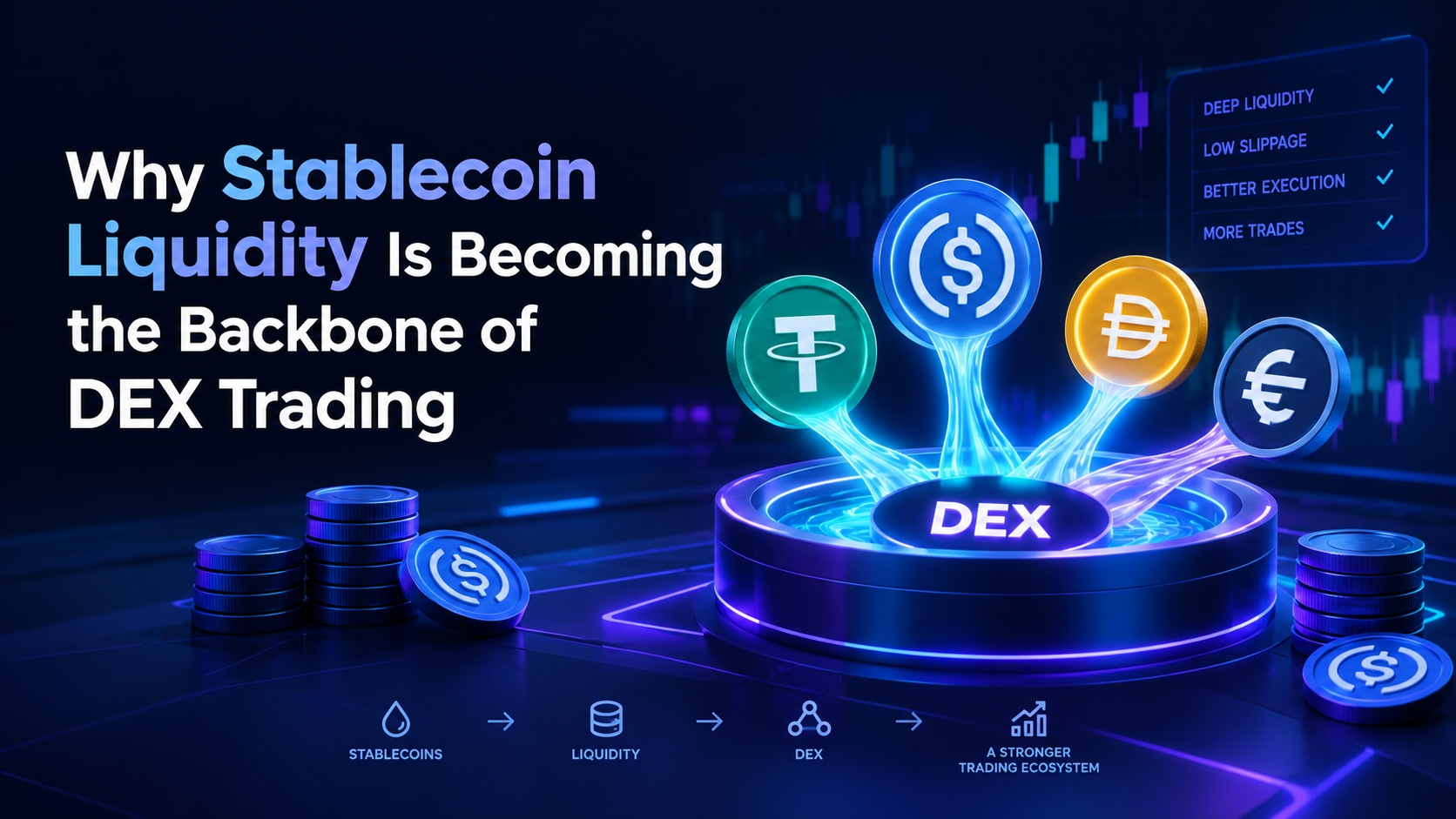
People always begin talking about decentralized exchanges when discussing token listing, trading volume, or total value locked.
However, one aspect of DEX activity that's not always given due credit is stablecoin liquidity.
Stablecoins provide the trading pairs that connect volatile crypto assets with relatively stable units of account. They are used for entering positions, exiting trades, moving capital between markets, providing liquidity, and settling transactions.
Recent data shows just how important they have become. A 2026 report covering five DEXs found that stablecoins were involved in 76.8% of trading volume and 75.5% of swaps during the period studied. The report also found that USDC and USDT accounted for most of that activity.
That makes stablecoin liquidity much more than a convenient feature. It is a major part of how decentralized markets function.
Why Stablecoins Matter to DEXs
A trader needs a reliable way to move between volatile assets and something that behaves more like cash.
Consider an ETH trader who wants to reduce exposure.
One option is to sell ETH directly into a stablecoin pair such as ETH/USDC.
The stablecoin then becomes the trader's settlement asset.
The same process works in the opposite direction. Someone holding USDC can use it to purchase ETH, SOL,
BTC related assets, or thousands of other tokens depending on the available markets.
This creates a large amount of trading activity around stablecoin pairs.
For a decentralized exchange platform , deep stablecoin liquidity can therefore influence several parts of the trading experience:
  Price impact
   - Available trading routes
   - Slippage
   - Arbitrage activity
   - Capital efficiency
   - Market depth
   - Cross chain settlement
A DEX with strong stablecoin markets can often provide better starting and ending points for more complicated trades.
Not All Stablecoin Liquidity Is Equal
A large stablecoin balance inside a liquidity pool does not automatically mean that the market has excellent execution.
The pool's design matters.
A constant product pool, for example, distributes liquidity according to a mathematical curve. Concentrated liquidity allows providers to position capital around specific price ranges.
Stablecoin pairs create another interesting situation because their prices are expected to remain close to a particular value.
A pool designed specifically for correlated assets can use a different pricing model from a standard volatile asset pool.
This is why DEX developers need to think about the relationship between the assets being traded rather than treating every pair in exactly the same way.
Why Stablecoin Pairs Can Have Lower Price Impact
Imagine a trader swapping USDC for USDT.
If both assets remain close to their intended value, the pool does not need to account for the same degree of price volatility found in an ETH/USDC market.
This allows certain stablecoin focused automated market makers to concentrate liquidity more efficiently around the expected trading range.
The result can be lower slippage for large trades when the pool has enough reserves.
But there is a catch.
Stablecoins can lose their pegs.
When that happens, a pricing model designed around closely correlated assets can behave very differently from normal market conditions.
Liquidity providers therefore need to consider both normal trading conditions and stress scenarios.
Stablecoin Depegs Test DEX Infrastructure
A stablecoin trading at $1 is not guaranteed to remain there.
A loss of confidence, problems with reserves, market panic, or issues involving collateral can cause the token to trade below or above its intended value.
This creates unusual conditions for decentralized exchanges.
Let’s assume that a stablecoin drops from $1 to $0.90.
Arbitrage traders may immediately attempt to purchase the discounted asset. Liquidity providers may withdraw capital or rebalance positions. Traders may move toward another stablecoin.
The DEX must continue calculating prices while the assumptions behind its pool design are changing.
Recent academic research has also examined the need for real time protection and anomaly detection in
DeFi stablecoin systems, particularly around oracle manipulation and other attack patterns.
This is why stablecoin liquidity should not be evaluated only during calm market conditions.
Stablecoins Are Becoming More Important for Cross Chain Trading
Stablecoins also play an important role in cross chain markets.
A trader may hold USDC on one blockchain and want another asset on a different chain.
Instead of transferring the original volatile asset, a route can use a stablecoin as an intermediate asset.
A simplified route could look like:
ETH → USDC → bridge → USDC → SOL
The actual route may be more complicated, but the principle is important.
Stablecoins can act as a common settlement asset between otherwise separate markets.
This gives a cross chain crypto exchange more options when searching for an efficient route.
The bridge between blockchains is only one component. The system also needs sufficient stablecoin liquidity on the destination chain.
If that liquidity is shallow, the cross chain route can still produce poor execution even when the bridge itself is fast.
Stablecoin Liquidity and Smart Routing
This is where smart routing becomes useful.
A modern DEX trading platform can compare multiple pools before executing a swap.
For example, a router might compare:
USDC → ETH
against:
USDC → USDT → ETH
The second route contains an additional swap, but it could provide better overall execution if the direct USDC/ETH market has insufficient liquidity.
A more advanced router can also consider different DEXs, fee tiers, gas costs, and cross chain routes.
The trader does not necessarily need to know which pool is being used.
The routing system handles that calculation.
Stablecoin Liquidity Is Becoming More Institutional
Stablecoins are also moving beyond their traditional role in crypto trading.
Recent industry and institutional reports point to growing use of stablecoins for payments, settlement, treasury management, and tokenized financial products. Circle, for example, describes USDC as infrastructure for trading, collateral movement, and cross chain transfers, while its USYC product connects stablecoin liquidity with tokenized money market exposure.
That creates a wider opportunity for DEX infrastructure.
If more tokenized assets begin trading on-chain, they will need markets where users can buy and sell them.
Stablecoins are natural candidates for those markets because they provide a familiar unit for pricing.
BNB Chain's 2026 research also points to a shift in tokenized assets from simply being issued on-chain toward being integrated with existing liquidity and funding systems.
What Traders Should Check
Before using a stablecoin pool or a decentralized trading platform, traders should look at more than the advertised fee.
Pay attention to:
-Pool liquidity: If your trade size can fit in the pool or not.
-Stablecoin quality: learn what makes up a good cryptocurrency and what it means to be redeemed.
-Peg stability: A small price difference can become significant during stressed markets.
-Price impact: A low fee does not guarantee a good final price.
-Routing: Compare the complete route rather than one trading pair.
-Cross chain costs: Include bridge fees and destination transaction costs.
-Smart contract risk: Consider every protocol involved in the transaction.
These factors can have a larger effect on the final result than a headline trading fee.
The Next DEX Battle May Be About Stablecoin Depth
Stablecoins are no longer simply an alternative to holding dollars inside a crypto wallet.
They are becoming a major source of trading liquidity and settlement capital.
That matters for every decentralized crypto exchange competing for traders.
Strong stablecoin markets can support lower slippage, more efficient routing, easier cross chain execution, and deeper markets for other digital assets.
For users who want to swap tokens across blockchains , stablecoins can also provide an important link between otherwise fragmented markets.
The interesting question is no longer whether stablecoins will play a role in DEX trading.
They already do.
The bigger question is whether DEXs can build liquidity systems that remain efficient when stablecoins trade normally, when markets become volatile, and when billions of dollars move between chains.
That is where stablecoin infrastructure will have to prove its value.