CereBree: A Comprehensive Guide to the AI Operating System for Human, Healthcare, and Enterprise Intelligence
Introducing CereBree the Future of Onchain AI
CereBree is an onchain AI ecosystem for enterprise workflows, healthcare systems, and human intelligence. It combines artificial intelligence, blockchain infrastructure, and lifecycle intelligence to create interconnected products designed around people and organizations rather than isolated tasks. Traditional software generally focuses on completing specific functions. A customer relationship management system manages customers. A human resources platform manages workforce information. A hospital system manages clinical records. An education platform delivers courses. A wellness application tracks individual habits. CereBree takes a different approach by creating a shared ecosystem where multiple AI-native platforms can operate through a common intelligence layer. Cognie provides the connective tissue between these environments, while onchain infrastructure creates the foundation for secure and coordinated ecosystem activity. The result is intended to be more than a collection of independent applications. CereBree is positioning itself as a system capable of connecting different forms of intelligence across the lifecycle of an individual, an organization, or a healthcare environment.
CereBree is a human-centered, agentic AI platform designed to help individuals and organizations grow and make better decisions. According to the company's official materials, its broader vision is to unify information from work, learning, wellbeing, and other areas to provide personalized and real-time guidance. The platform is built around a simple observation: AI is most useful when it understands context rather than simply answering isolated questions. Traditional enterprise software often divides information into separate systems. A CRM may contain customer relationships, an HR platform may contain workforce information, an IT service system may track support issues, and healthcare systems may contain clinical and operational information. When these systems cannot communicate effectively, decision-makers are forced to assemble the complete picture themselves.
The Way CereBree Connects Learning, Work, Health, and Well-Being
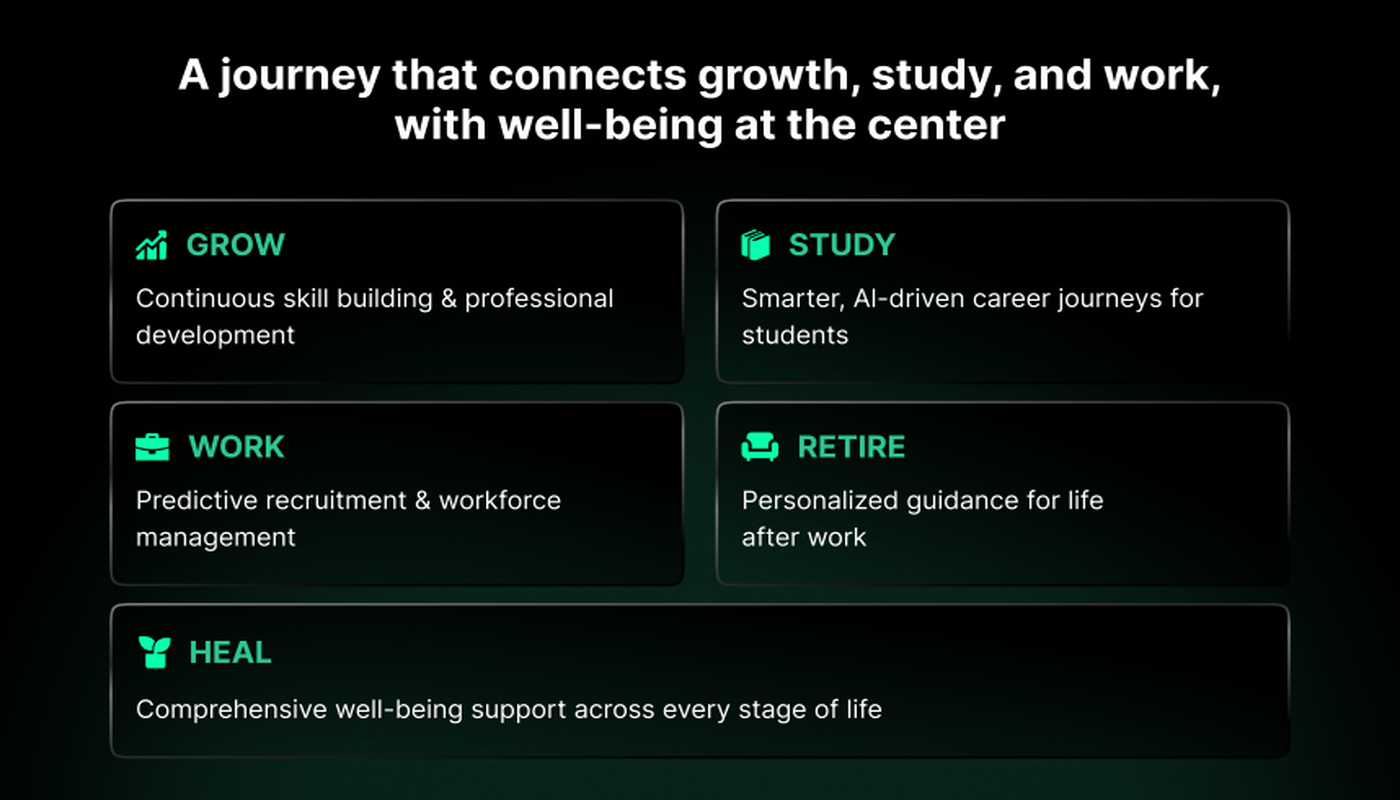
One of CereBree’s most distinctive ideas is that learning, work, health, and well-being should not be viewed as completely separate parts of life. Instead, these areas are deeply connected and continuously influence one another. CereBree’s lifecycle intelligence approach is built around recognizing these relationships and creating a more connected understanding of how different aspects of a person’s life evolve together. Consider someone learning a new technology skill. That learning can create new career opportunities, which may lead to changes in income, responsibilities, workload, and daily routines. Those changes can then influence physical health, mental well-being, personal priorities, and the amount of time available for continued learning. In the same way, health challenges can affect a person’s ability to work, study, maintain productivity, or pursue long-term goals. Rather than treating these experiences as isolated data points, CereBree aims to understand the connections between them.
This creates a continuous cycle in which progress in one area can influence outcomes in another. Learning can shape career development, career development can affect lifestyle, lifestyle can influence well-being, and well-being can determine how effectively someone can continue learning and working. By recognizing these relationships, CereBree seeks to move beyond fragmented experiences toward a more holistic model of lifecycle intelligence. The long-term vision is an ecosystem that can evolve alongside an individual through different stages of life. A person might use CereBree as a student while developing new skills, continue using the ecosystem when transitioning into a career, and later rely on intelligent tools for professional development, wellness goals, and future planning. Instead of forcing people to manage these areas through disconnected systems, CereBree aims to create a continuous intelligence layer that understands how learning, work, health, and well-being influence one another over time.
Ultimately, CereBree’s approach is based on a simple principle: human growth should not be fragmented. When intelligence can understand the connections between what people learn, how they work, how they feel, and how they live, technology can become more useful throughout the entire journey of personal and professional development.
Understanding the CereBree’s Core Products and Services
CereBree is designed as a broad AI ecosystem rather than a single-purpose application. Its platform connects healthcare, enterprise operations, workforce intelligence, personal development, and AI-driven assistance through a unified intelligence layer. The company’s website currently highlights several products and services that work across these areas, with Cognie serving as a central AI intelligence component.
Cognie: The AI Intelligence Companion
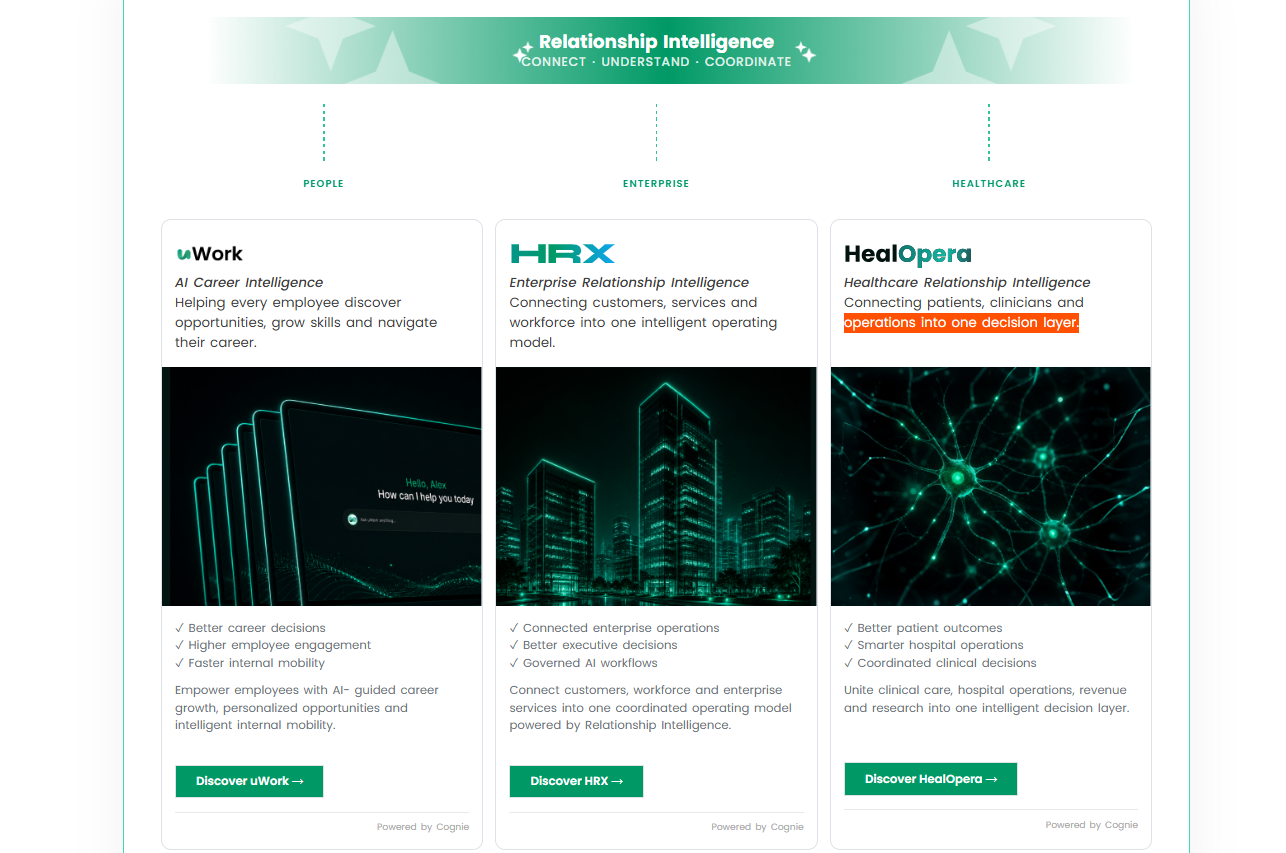
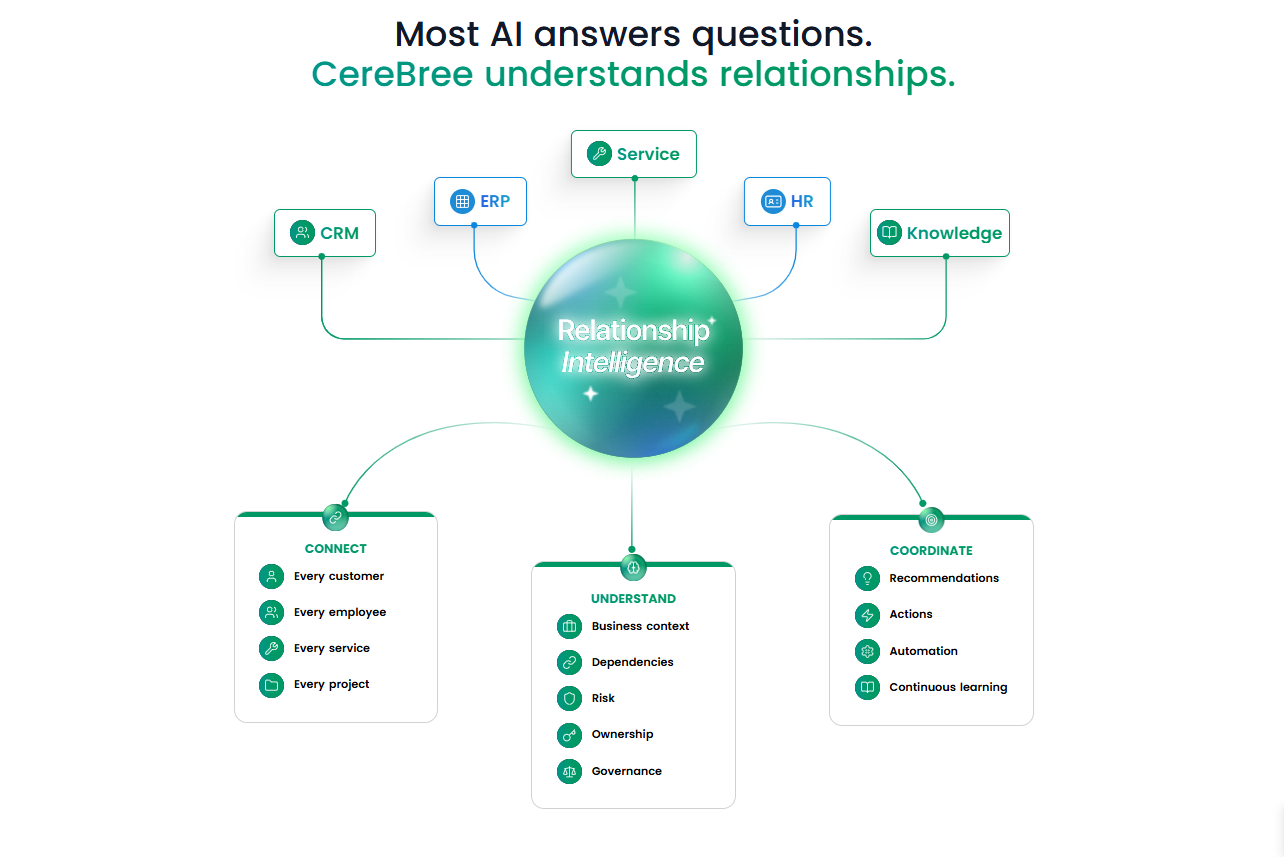
Cognie is positioned as CereBree’s AI intelligence companion and is designed to help users ask questions, solve problems, identify opportunities, and make better decisions using connected business context. Rather than treating information from CRM, ERP, service, HR, and knowledge systems as isolated data sources, CereBree uses Cognie to connect these signals and provide context-aware responses. The platform is intended to move beyond basic question-and-answer AI toward decision support. CereBree describes this approach through three stages: connecting business signals, understanding relationships and dependencies, and coordinating recommendations, actions, automation, and continuous learning. This makes Cognie an important intelligence layer across the wider ecosystem.
uWork: AI-Powered Career Intelligence
uWork focuses on employee and career development. CereBree describes it as an AI career-intelligence solution that helps employees discover opportunities, develop relevant skills, and navigate career pathways. The platform is designed to support better career decisions, stronger employee engagement, and faster internal mobility. This approach connects personal development with organizational workforce needs. Instead of treating career development as a standalone training activity, uWork can help align employee skills and aspirations with available opportunities inside an organization.
HRX: Enterprise Relationship Intelligence
HRX is CereBree’s enterprise relationship-intelligence offering. It connects customers, employees, services, and other enterprise information into a coordinated operating model. According to CereBree, HRX is designed to support connected enterprise operations, better executive decisions, and governed AI workflows. The broader concept behind HRX is Relationship Intelligence. By understanding relationships between customers, employees, projects, services, ownership, risks, and dependencies, organizations can move from fragmented dashboards toward more coordinated decision-making.
HealOpera: Healthcare Operations Intelligence
HealOpera extends CereBree’s intelligence architecture into healthcare. It is presented as a hospital operating workflow layer that connects clinical care, hospital operations, revenue, patients, and research within a unified infrastructure. CereBree specifically describes HealOpera as an infrastructure layer rather than an EMR replacement or isolated point solution. Its goal is to help healthcare organizations coordinate complex workflows while providing a shared decision layer for patients, clinicians, and hospital operations. CereBree highlights potential benefits including improved patient outcomes, smarter hospital operations, and coordinated clinical decisions.
CereAura: Autism Care and Support
CereAura is focused on autism care and neurodevelopmental support. CereBree describes the product as an AI-powered platform intended to help parents, caregivers, and practitioners identify early signals, monitor developmental progress, and support personalized intervention pathways. The broader objective is to connect home, therapy, and clinical care so that developmental information can be used more consistently throughout a child’s support journey.
CereOnco: Intelligent Cancer-Care Support
CereOnco focuses on cancer-related healthcare and is presented as an intelligent care layer for cancer journeys. CereBree describes its broader health ecosystem as supporting early understanding, personalized care, and continuous assistance. On the CereBree platform, CereOnco is positioned alongside CereAura and HealOpera as part of the company’s HealthTech AI strategy. The objective is to apply AI and connected intelligence to complex healthcare experiences while helping patients and healthcare stakeholders navigate information and decisions more effectively.
CereForge: Technology and AI Infrastructure
CereForge is listed by CereBree as one of its core technology products alongside uWork, HRX, and HealOpera. Within the wider CereBree ecosystem, technology infrastructure is important because the company aims to connect intelligence across different environments rather than build isolated applications. This infrastructure-oriented approach supports CereBree’s vision of creating an intelligence layer that can operate across people, healthcare, and enterprise environments.
Personal Development and Learning Intelligence
CereBree also extends beyond enterprise and healthcare through personal-development services. Its platform describes learning intelligence as supporting skill development and progression, while career acceleration is intended to connect users with opportunities and growth pathways. Neural mentorship is another component designed around learning and development. The CereBree whitepaper similarly describes a broader lifecycle model connecting growth, study, work, retirement, and well-being. Its study-oriented services are designed to use job-market demand to inform course recommendations and track actual skill levels rather than simply measuring course completion.
CRX: The Ecosystem Utility Layer
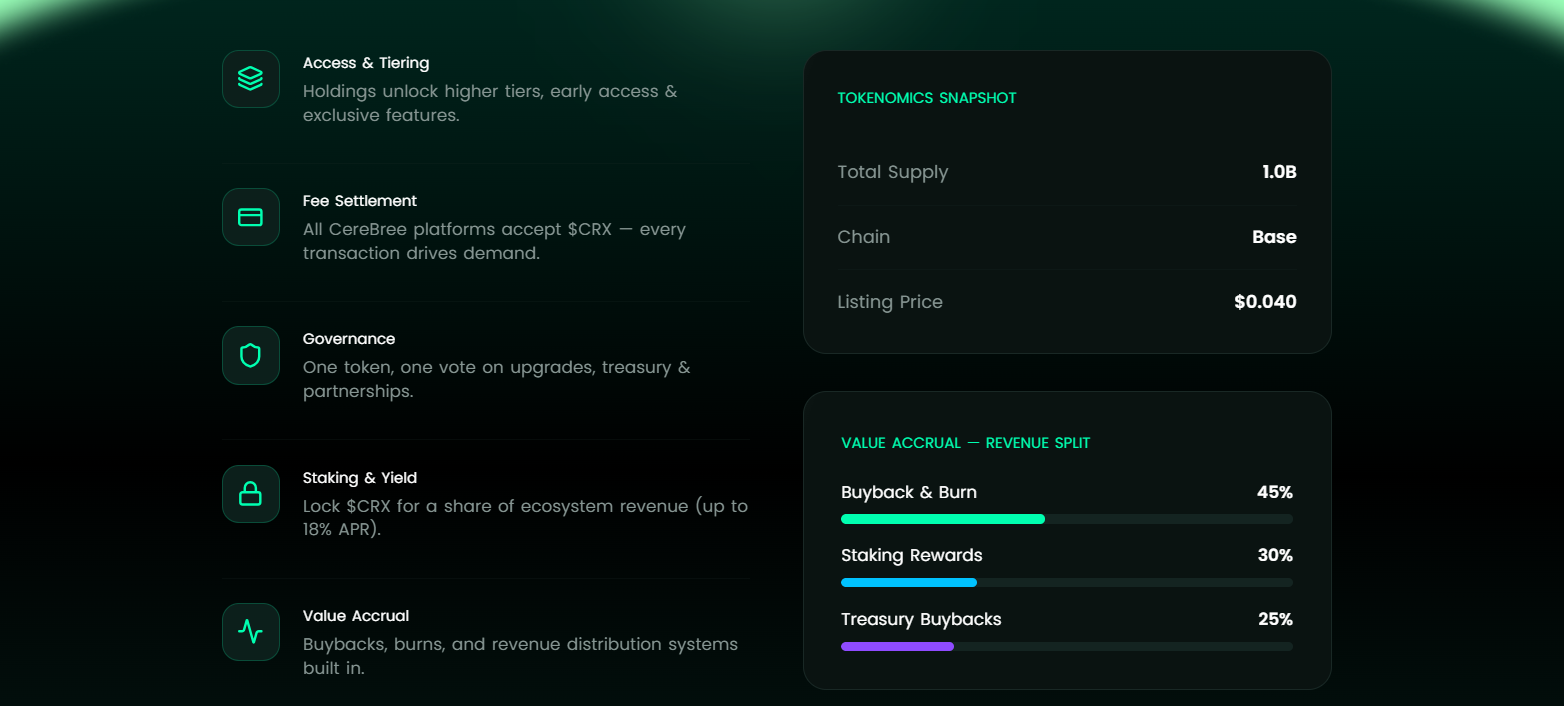
Another important component is CRX, which CereBree presents as the utility and economic layer of its ecosystem. The website states that CRX is intended to support platform access, tiering, fee settlement, governance, staking, and ecosystem participation. According to the current website, holding CRX can provide access to higher tiers, early access, and selected features. The token is also described as being accepted for transactions across CereBree platforms, while governance functionality is designed around voting on upgrades, treasury matters, and partnerships.
The Potential Benefits of CereBree
If CereBree’s architecture can be successfully implemented and scaled, its relationship-intelligence approach could offer several potential advantages for organizations and individuals. One of the most important benefits is reduced data fragmentation. By connecting information from multiple systems, CereBree could reduce the need for employees to manually collect, compare, and interpret information spread across different applications. Bringing these data points into a connected context may make it easier to understand situations that cannot be fully explained by a single system.
Another potential benefit is better contextual decision-making. Instead of depending solely on isolated dashboards or individual reports, decision-makers could potentially see relationships between customers, employees, services, projects, operational risks, and other relevant factors. This broader context could help organizations understand not only what is happening, but also how different events and entities may be influencing one another.
CereBree’s approach could also contribute to more personalized AI experiences. AI systems that operate with access to relevant organizational or personal context may be able to provide responses that are more closely aligned with an individual's circumstances. Rather than delivering generic recommendations, context-aware AI could potentially consider relationships, history, preferences, responsibilities, and other connected information when generating insights or suggestions.
Workflow automation represents another potential advantage. Traditional AI systems often focus on analyzing information or generating responses, but relationship intelligence could provide a foundation for connecting recommendations with real-world actions. This could allow AI to move beyond simply identifying problems and potentially help coordinate tasks, follow-ups, processes, and other workflow activities across connected systems.
CereBree also presents a broader vision of cross-domain intelligence. Instead of limiting its technology to a single enterprise application or industry, the platform's vision encompasses areas such as enterprise operations, healthcare, learning, workforce management, career development, and personal growth. A common intelligence layer could potentially allow similar relationship-based capabilities to be applied across multiple domains while maintaining the context specific to each use case.
At the center of this approach is the idea of human-centered AI. CereBree emphasizes using artificial intelligence to support human development rather than simply replacing human activity. Its broader mission focuses on creating intelligent systems that can assist people across areas such as healthcare, work, learning, and human development. This positions AI as a tool for enhancing human capabilities, decision-making, and growth.
CereBree’s Technology Architecture
CereBree’s technology architecture can be understood as a series of interconnected layers designed to transform fragmented information into actionable intelligence. At the foundation is connected information, which provides the underlying data and relationships required for the rest of the architecture to function effectively. Instead of treating every piece of information as an independent record, the approach seeks to establish connections between relevant entities, events, and activities. Above this foundation sits the Relationship Intelligence layer. This component is intended to identify and understand connections, dependencies, ownership structures, interactions, and potential risks. By interpreting relationships between different data points, this layer can provide the contextual foundation needed for more meaningful analysis and decision-making.
The next layer is Cognie, which provides AI-driven interaction and reasoning. With relationship intelligence supplying contextual information, Cognie can serve as an interface through which users interact with the underlying intelligence. The objective is to make complex organizational or personal information easier to understand and use through AI-powered interaction. On top of these intelligence capabilities are specialized applications designed for different domains. These can include enterprise operations, healthcare, workforce management, career development, learning, and personal growth. Each application can potentially use the same underlying intelligence infrastructure while addressing the specific requirements of its particular environment.
Finally, blockchain and CRX are positioned as an economic and governance layer within the broader CereBree ecosystem. This layer is intended to provide mechanisms for participation, coordination, and value exchange around the intelligence infrastructure. The significance of this architecture is that CereBree is not positioning its vision around building completely independent AI products for every individual use case. Instead, the broader objective is to develop one underlying intelligence layer capable of supporting multiple domains. If successful, this model could allow relationship intelligence and contextual AI capabilities to be reused across different applications while maintaining a common technological foundation.
Why the CereBree Ecosystem Matters
The broader challenge CereBree aims to address is the fragmentation of information, systems, and decision-making. Organizations often possess vast amounts of data across separate platforms, yet converting that information into coordinated and actionable decisions can remain difficult. Individuals face a similar problem as they rely on different services for healthcare, education, careers, finance, and personal development, with limited connection between these experiences. CereBree’s approach is based on the idea that AI can deliver greater value when it understands relationships, dependencies, and context instead of simply processing isolated pieces of information. Its Enterprise Decision Layer is therefore designed to connect business signals, identify relationships and risks, and help coordinate more informed decisions across different functions.
This same philosophy extends into CereBree’s healthcare solutions, where connected intelligence can bring patients, clinicians, clinical information, and hospital operations into a more unified environment. Rather than viewing healthcare activities as separate processes, the ecosystem aims to provide greater context around patient needs and operational decisions. On the PeopleTech side, the approach is applied to learning, career development, workforce capabilities, and personal growth. By connecting these areas, CereBree seeks to create an ecosystem where AI can better understand the broader journey of people and organizations and provide more relevant intelligence throughout that journey.
$CRX Tokenomics
$CRX is CereBree’s utility and governance token, designed to serve as the economic layer connecting participants across the ecosystem through access, incentives, payments, rewards, and decentralized decision-making. Importantly, $CRX is not the product—the CereBree platforms are the product. The token exists to align incentives across a multi-sided ecosystem involving individuals, enterprises, healthcare providers, developers, and other participants. In enterprise environments, the platforms remain the primary focus, while $CRX provides the broader ecosystem with a natively decentralized mechanism for participation and value distribution.
Token Details
- Token: $CRX
- Total Supply: 1 billion
- Blockchain: Base
- Listing Price: $0.040
- Buyback & Burn: 45%
- Staking Rewards: 30%
- Treasury Buybacks: 25%
The Utility of $CRX
$CRX is built around five core functions that support participation throughout the CereBree ecosystem.
1. Access and Tiering
Holding $CRX provides access to different ecosystem tiers. Token holdings can determine eligibility for early access, priority support, exclusive features, and other benefits. As participation increases, higher token tiers can unlock additional opportunities across the ecosystem, creating a structured relationship between token ownership and ecosystem access.
2. Fee Settlement
$CRX can be used across CereBree platforms for one-time payments, subscriptions, and credits. By connecting token utility to actual platform activity, the model is designed to align token demand with ecosystem usage. As more participants use CereBree products and services, more transactions can flow through the $CRX economic layer.
3. Governance
$CRX also functions as the governance mechanism for the ecosystem. Through a one-token, one-vote model, holders can participate in decisions concerning platform upgrades, treasury allocation, feature priorities, partnerships, and other ecosystem developments. This gives token holders a role in shaping how CereBree evolves while supporting decentralized coordination across the community.
4. Staking and Yield
$CRX holders can lock their tokens to participate in ecosystem revenue distribution.
Three staking options are available:
- 30-day lock: 8% APR
- 90-day lock: 12% APR
- 180-day lock: 18% APR
The structure rewards longer-term commitments with higher potential yields, encouraging participants to align their interests with the long-term development of the ecosystem.
5. Rewards
CereBree also uses $CRX to incentivize meaningful ecosystem participation. Participants can earn tokens through activities such as referrals, content creation, bug bounties, and early-adoption programs. This creates additional ways for users and contributors to participate beyond simply holding the token.
$CRX Value Accrual
A core component of the $CRX economic model is the redistribution of platform revenue throughout the ecosystem. According to the tokenomics structure, 100% of $CRX platform revenue is allocated back into the ecosystem through buybacks, burns, staking rewards, and treasury activities.
45% — Buyback and Burn
The largest allocation, 45%, is dedicated to buybacks and burns. CereBree uses this allocation to purchase $CRX from the open market and permanently remove the purchased tokens from circulation. The intended result is a reduction in token supply as platform activity increases. This creates a deflationary mechanism that connects ecosystem usage with the circulating supply of $CRX.
30% — Staking Rewards
30% of the allocation is dedicated to staking rewards. Rewards are distributed proportionally among eligible stakers across the available lock periods. The different lock durations are designed to provide a range of participation options, with longer commitments offering higher stated APRs. This mechanism encourages users to maintain longer-term positions within the ecosystem while receiving a share of the designated staking allocation.
25% — Treasury Buybacks
The remaining 25% is directed toward treasury buybacks.
These funds can support ecosystem development, new AI models, infrastructure, operational requirements, and other strategic initiatives. Treasury decisions are governed by token holders, creating a connection between capital deployment and community governance.
Final Thoughts
CereBree is developing a broad ecosystem around the concept of context-aware, human-centered intelligence. Its architecture combines an AI intelligence layer centered around Cognie with specialized products covering enterprise relationship intelligence, healthcare, education, career development, and broader human lifecycle needs. The ecosystem's core components include Cognie, HRX, uWork, HealOpera, CereAura, CereOnco, CereCulum AI, and the CRX utility layer. Each serves a different purpose, but the underlying objective is consistent: connect fragmented information, understand relationships, and turn that context into more useful decisions and actions.
As CereBree develops, its ability to successfully connect these domains, deliver practical AI applications, protect sensitive information, and demonstrate measurable real-world outcomes will be central to determining the long-term value of its ecosystem. Its current architecture presents an ambitious attempt to move AI beyond isolated chatbots and toward a more integrated intelligence layer for people, healthcare systems, and enterprises.
Stay connected with the latest updates
- Website: https://cerebree.com/
- Whitepaper: https://cerebree.gitbook.io/docs
- X (Twitter): https://x.com/CereBree
- Telegram: https://t.me/CereBree
- Linkedin: https://www.linkedin.com/company/cerebreeofficial/
Author
Bitcointalk username: AvalonDarcy1
Bitcointalk link: https://bitcointalk.org/index.php?action=profile;u=3696366
Wallet Address: 0x45dC2154516494e8351121f5b55611Aca4533866