Digital Twin Services: Benefits, Applications, and Implementation Challenges
India's digital twin market reached USD 1,147.5 million in 2025 and is projected to touch USD 18,016.9 million by 2034, growing at a CAGR of 35.79% during 2026-2034, according to IMARC Group. Globally, the market was valued at USD 29.3 billion in 2025, with North America holding more than 34.6% share.
Demand is clear, but readiness is uneven. Rockwell Automation's 2026 State of Smart Manufacturing study found that 97% of Indian manufacturers call digital transformation essential to staying competitive, yet 60% name capturing, interpreting, and using data as their top internal obstacle, against 37% globally. ABI Research's 2026 survey of manufacturing decision makers adds that cost is the leading inhibitor to adopting or expanding digital twins.
Choosing the right digital twin services therefore comes down to three questions: what value the twin must deliver, what it will cost, and what will slow the rollout. This article answers each with current figures and practical benchmarks.
What Are Digital Twin Services?
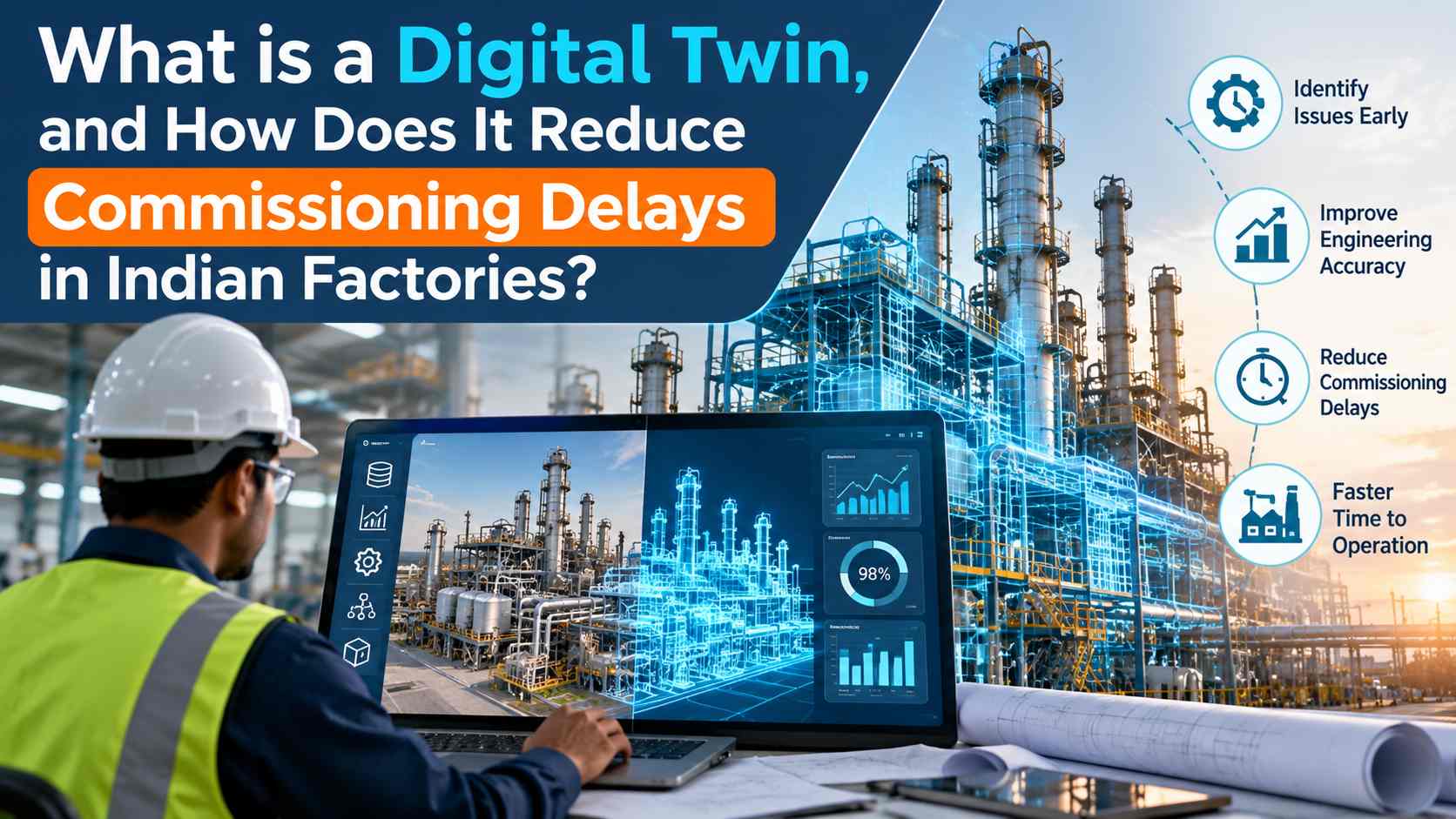
Digital twin services cover the design, build, integration, and upkeep of a virtual replica of a facility, asset, or process that stays linked to real-world data. A 3D model shows geometry at a point in time, while a digital twin adds a two-way data connection so the model reflects live conditions and supports decisions. Services are typically delivered at six scales:
- Component twin: bearings, valves, and sensors
- Asset twin: pumps, compressors, motors, and reactors
- System twin: a process unit such as a distillation train or packaging line
- Facility twin: an entire plant or site
- Product twin: a manufactured product tracked across its lifecycle
- Process twin: production and business processes in one connected view
What Are the Benefits of Digital Twin Services?
Benefits accrue in three phases: design, construction, and operations. Benchmarks from industrial projects include:
- Lower rework cost: construction rework from design errors typically consumes 5-15% of total construction cost on complex projects, and integrated clash detection delivers construction cost savings of 5-10%
- Faster, cheaper delivery: BIM-based delivery has been shown to speed up projects by 20-50%, reduce rework by up to 40%, and lower construction costs by 10-20%
- Schedule reliability: 4D construction sequencing typically shortens schedules by 5-15%
- Leaner site labour: model-based construction delivery routinely cuts field labour hours by 10-20%
- Lower operating cost: live twin data linkage typically reduces operations and maintenance cost by 5-20%
- Faster onboarding: training simulators on facility twins reduce operator onboarding time by 30-50%
- Payback: well-designed twins typically recover investment in 12-36 months
Where Are Digital Twin Services Applied?
Applications span the full lifecycle, and value is highest where the operating phase is long. Facilities typically operate for 25-40 years, against a 2-4 year construction cycle, so operational use cases dominate lifetime returns.
- Design coordination: clash detection across piping, structural, electrical, HVAC, and instrumentation models before construction begins
- Construction sequencing: time-phased simulation to confirm equipment access, crane positions, and installation order
- Brownfield expansion: laser scanning to capture as-existing geometry and check new work against live installations
- Predictive maintenance: condition data linked to asset twins for failure prediction
- Turnaround planning: 4D visualisation of work sequence, scaffolding, and access, typically shortening turnaround duration by 5-15%
- Regulatory drawings: Factory Act, fire NOC, and licensing layouts extracted directly from the coordinated model
- Sustainability reporting: energy and emission data tracked for BRSR Core and CPCB monitoring obligations
Sector priorities differ. Semiconductor fabs use facility twins for cleanroom and tool coordination, pharmaceutical plants use batch twins for genealogy and Schedule M compliance, chemical and petrochemical plants link twins to process safety studies, data centres optimise cooling and power, and steel and cement plants focus on critical-equipment reliability.
How Much Do Digital Twin Services Cost and How Long Do They Take?
Cost and duration depend on scope, data readiness, and integration needs. Reference ranges for Indian industrial projects:
- Digital twin implementation: INR 30 lakh for a basic asset twin to INR 30 crore for a full facility twin
- BIM implementation: INR 50 lakh to INR 15 crore for industrial projects
- 3D modelling for medium plants: INR 25 lakh to INR 3 crore
- Laser scanning for brownfield sites: INR 5-50 lakh per site, depending on scale and access
- Timelines: asset twins in 6-12 months, system twins in 12-18 months, and facility twins with full operational integration in 18-36 months
ABI Research's 2026 analysis notes that a factory twin with a narrow scope can cost below six figures in US dollars, but projects quickly turn into large integration and data infrastructure efforts that raise prices. A tightly defined first use case keeps spend controlled.
What Are the Main Implementation Challenges?
- Weak data foundation: inconsistent master data, tag names, and timestamps produce twins that mislead. MarketsandMarkets' August 2026 analysis ranks data integration complexity as the highest adoption barrier.
- Cost and unclear returns: twins launched without a quantified baseline, target improvement, and payback period rarely prove their value.
- Legacy and brownfield sites: older plants need sensor retrofits and must reconcile legacy operational systems with modern IT platforms.
- Confusing a 3D model with a twin: a static model labelled as a twin disappoints sponsors who expected operational insight.
- Vendor lock-in: single-vendor stacks limit flexibility, so open standards such as IFC, ISO 19650, and OPC UA protect long-term options.
- Handover discontinuity: digital content is often lost between engineering, construction, and operations unless ownership continues across phases.
- Skills and adoption: operators and maintenance teams must trust and use the twin for it to influence decisions.
How Should Manufacturers Implement a Digital Twin?
- Define the decision: pick one use case, such as clash-free construction or predictive maintenance on critical assets, with a measurable target.
- Mature the 3D foundation: build disciplined models with clash detection before adding live data.
- Fix the data layer: standardise tags, master data, time synchronisation, and connectivity.
- Start at asset level: connect critical equipment first, then expand to systems and the full facility.
- Maintain continuity: update the as-built model at handover and link equipment data to maintenance systems.
How IMARC Engineering's Expertise Can Help in Digital Twin Services
IMARC Engineering supports manufacturers from concept through handover. Key strengths include:
- Integrated BIM models: architectural, structural, civil, HVAC, electrical, plumbing, piping, and equipment data in one federated environment
- Process-aware modelling: GMP zones, hazardous area classifications, and equipment envelopes embedded as model data
- Clash detection: severity-classified clash reports with resolution tracking before tender release
- Sequencing simulation: schedule-linked 3D simulations that expose installation and access conflicts early
- Regulatory drawings: submissions generated directly from the model so they stay consistent after design changes
- Lifecycle support: as-built twins configured for maintenance system integration and future expansion planning
Consult With Our Team: https://www.imarcengineering.com/contact?service=3d-modelling-and-simulation
Conclusion
Digital twin services deliver their strongest returns when scope, data, and ownership are defined early. Manufacturers that start with a focused use case, build disciplined 3D and data foundations, and maintain model continuity from design to operations convert digital investment into measurable savings. In a market growing this quickly, the advantage will favour sponsors that treat the twin as a living operational asset rather than a one-time engineering deliverable.
Contact Us:
IMARC Engineering
Phone: +91-120-433-0800
Email: sales@imarcengineering.com
India: C-130, Sector 2, Noida, Uttar Pradesh 201301
LinkedIn: https://www.linkedin.com/showcase/imarc-engineering/