Akai MPC-5000 Wave File Sample Set
Over 150 studio quality wave file samples.
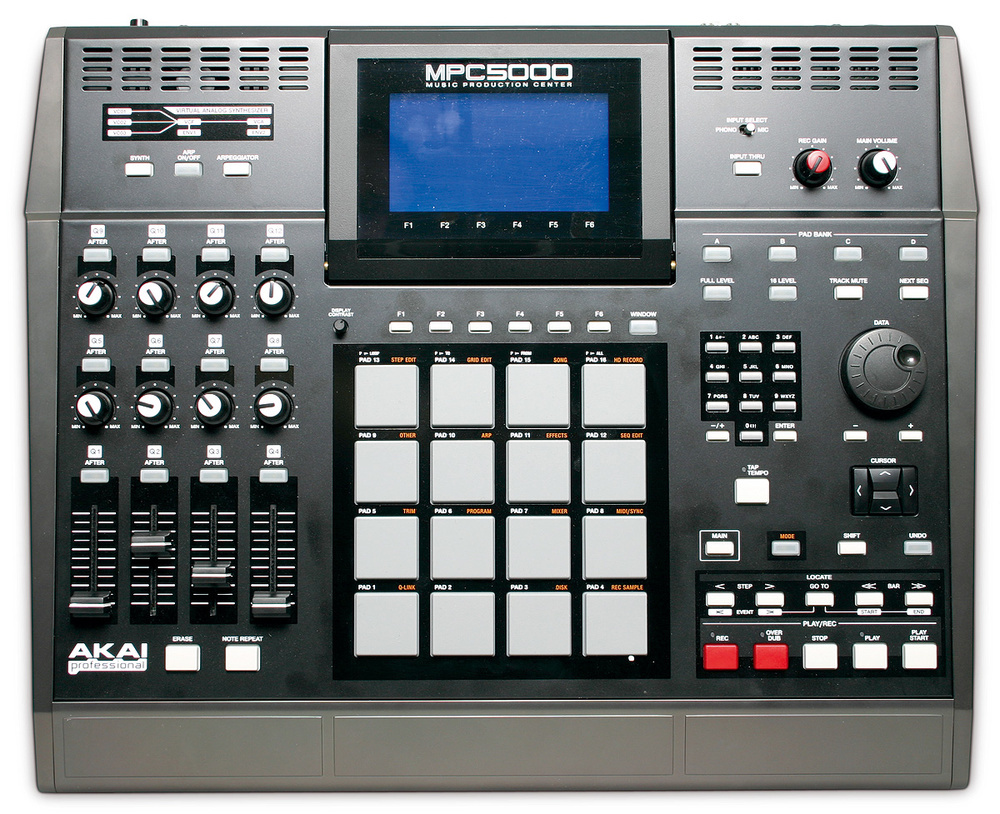
Released in 2008, the Akai MPC5000 was designed to be the definitive "studio in a box," marking the final flagship entry in the standalone MPC hardware line before the brand shifted toward software-integrated controllers. While earlier models like the 3000 were praised for their simplicity and "swing," the 5000 was a maximalist attempt to integrate every facet of modern production into a single chassis. It arrived as a hulking, 18-pound workstation that combined traditional sampling and sequencing with several firsts for the series, most notably an 8-track streaming hard disk recorder and a built-in 20-voice virtual analog (VA) synthesizer.
The inclusion of a 3-oscillator VA synth was a significant departure from the MPC’s pure sampler heritage. It allowed producers to design basslines, leads, and pads from scratch without needing external sound modules, effectively bridging the gap between a beat machine and a traditional synthesizer workstation. Complementing this was a robust sequencing engine with a high-resolution 960 PPQ timing and a larger, hinged 240x128 LCD screen that provided a much clearer view of waveforms and MIDI data compared to the cramped displays of the MPC2500 or 1000.
Under the hood, the MPC5000 offered a 64-voice sampler with 64MB of RAM, expandable to 192MB, and came standard with an 80GB internal hard drive. It also featured an updated "Chop Shop 2.0" for stereo sample slicing and a "Continuous Sample Track" feature, which allowed long loops to stay in perfect sync regardless of where the sequence was started. On the hardware side, it was incredibly well-connected, boasting ten analog outputs, eight ADAT optical outputs, and a turntable preamp—making it easy for producers to sample directly from vinyl without an external mixer.
Despite its impressive specifications, the MPC5000 had a polarized reception upon release. Early users and high-profile producers like Just Blaze criticized its initial operating system for being unstable, and some felt it lacked the surgical sample-editing depth of its predecessor, the MPC4000. However, subsequent firmware updates (most notably OS 2.0) resolved many of these bugs and refined the workflow. Today, the MPC5000 is remembered as a powerful "beast" of a machine, favored by those who want a fully self-contained hardware experience that avoids the distractions of a computer screen while providing the sonic flexibility of a synthesizer and a multi-track recorder.