How Egg Traceability Software Strengthens Food Safety and Supply Chain Management
How Egg Traceability Software Strengthens Food Safety and Supply Chain Management
Introduction:
Egg traceability has become an essential part of modern food supply chain management as businesses face increasing expectations for food safety, transparency, accountability, and operational efficiency. Eggs can pass through farms, collection centers, grading facilities, packing operations, warehouses, distributors, retailers, and foodservice businesses before reaching consumers, creating multiple points where accurate tracking is required. Traditional paper records, spreadsheets, and disconnected systems can make it difficult to identify the origin and movement of specific egg batches when a quality or food safety issue occurs. Egg traceability software provides a centralized digital approach that connects supply chain data, improves product visibility, supports faster investigations, and helps businesses maintain reliable records throughout the egg journey.
What Is Egg Traceability Software?
Egg traceability software is a digital platform that enables businesses to record, manage, and track egg-related information across the supply chain. Instead of depending on manual documents and separate spreadsheets, businesses can connect farm information, production activities, collection records, lot numbers, grading, packing, processing, inventory, shipments, and customer information within a centralized system. By assigning digital identities to lots or batches, the system creates a traceable history that allows businesses to determine where eggs originated, what activities they passed through, and where finished products were distributed. This digital approach improves data accuracy, reduces administrative work, and makes important traceability information easier to access when required.
The Egg Supply Chain: From Farm to Consumer
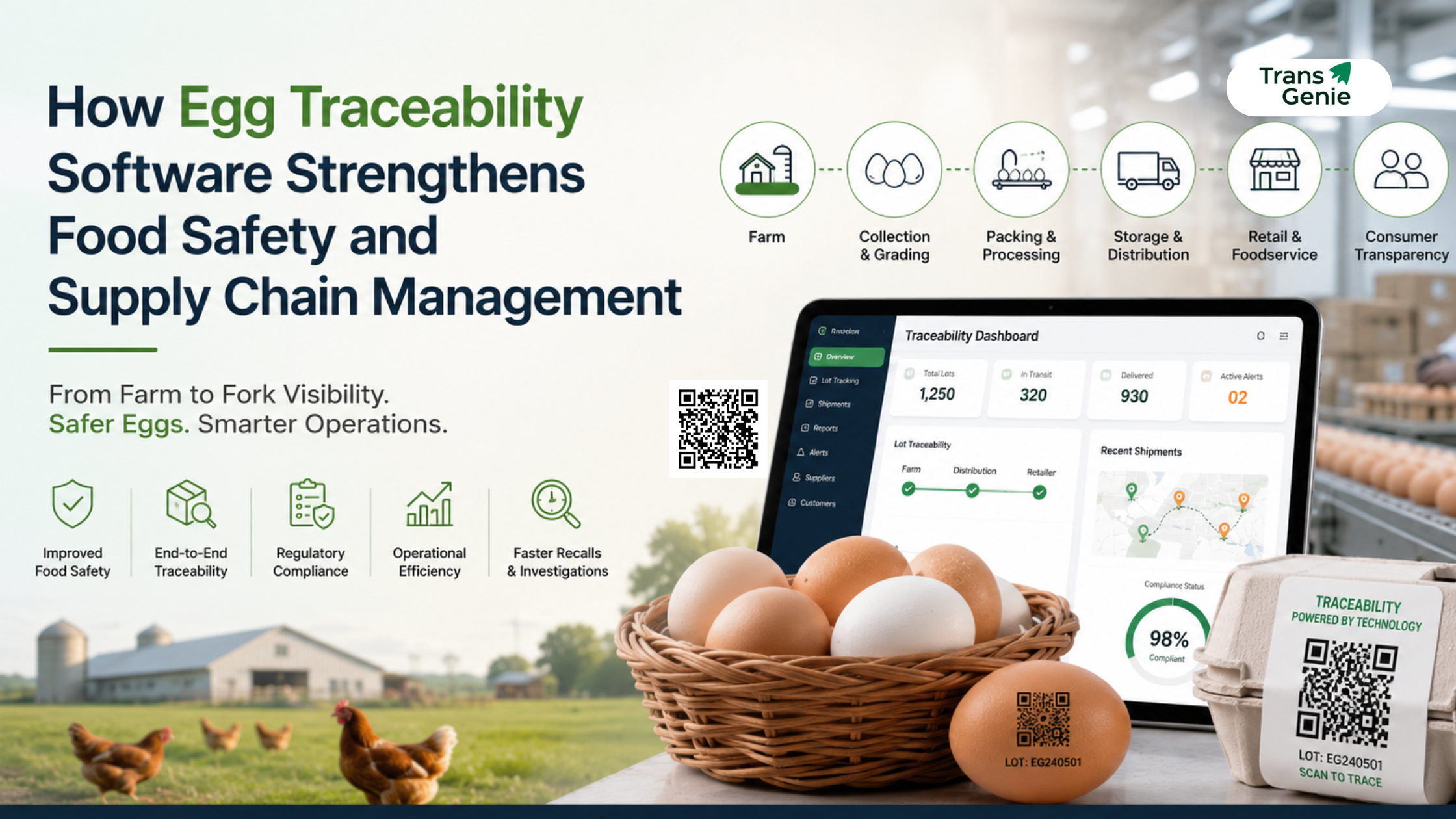
The egg supply chain involves several interconnected stages, and maintaining visibility across each one is critical for effective traceability. At the farm and poultry operations stage, businesses can record production information, supplier details, collection dates, and quantities to establish product origin. During egg collection and grading, records can be linked to specific lots as eggs are collected, inspected, sorted, and graded. At the packing and processing stage, traceability software can connect incoming egg lots with packaged or processed products. During storage and distribution, inventory movements, warehouse activities, shipments, and destinations can be recorded digitally. At the retail and foodservice level, businesses can maintain visibility into where products were delivered, while consumer-facing QR codes can potentially provide additional product information and transparency. Connecting these stages creates a continuous traceability chain from farm to consumer.
How Egg Traceability Software Improves Food Safety
Food safety depends on the ability to quickly identify where a product came from and what happened to it throughout the supply chain. Egg traceability software helps businesses record production, handling, processing, storage, and distribution information against specific lots or batches. If a potential contamination or quality issue is identified, businesses can use these connected records to investigate the affected products and identify relevant suppliers, facilities, processing activities, and distribution locations. Centralized digital records also reduce dependence on fragmented documentation and help establish a consistent source of information for food safety teams. By improving visibility and accountability, traceability software gives businesses stronger tools for managing food safety risks and responding to incidents.
Lot and Batch Tracking for Eggs
Lot and batch tracking is one of the most important capabilities of an egg traceability system because it allows businesses to associate products with their production and supply chain history. A unique lot or batch identifier can be linked to information such as farm origin, collection date, facility, processing activity, packaging details, inventory movements, and shipment records. When a food safety issue occurs, teams can use these relationships to determine which products may be affected and where those products were distributed. Accurate lot-level tracking also helps prevent businesses from unnecessarily holding or recalling unaffected products, allowing them to respond with greater precision.
Faster Egg Recalls With Digital Traceability
When a recall is required, time is critical. Businesses using paper records or disconnected spreadsheets may need to manually search through multiple systems to identify affected products and their destinations. Digital egg traceability software can centralize these relationships, allowing users to trace a product backward to its source and forward through processing, inventory, and distribution channels. This makes it easier to identify affected lots, customers, warehouses, and shipment destinations during an investigation. Faster access to accurate information can help businesses coordinate recall activities more efficiently, reduce unnecessary product withdrawals, and limit the potential impact of a food safety incident.
Improving Supply Chain Visibility and Operational Efficiency
Beyond food safety, egg traceability software can improve everyday supply chain operations by connecting information across departments and business partners. Digital data capture reduces repetitive paperwork and minimizes the risk of errors caused by manual entry or duplicate records. Businesses can gain better visibility into inventory, product movements, suppliers, shipments, and customer deliveries while reducing the time employees spend searching for information. When traceability data is connected with inventory, ERP, or other business systems, organizations can create a more efficient flow of information from production through distribution. This helps supply chain teams make faster, more informed operational decisions.
Compliance and Regulatory Readiness
Food businesses need reliable records to demonstrate how products move through their supply chains and to support food safety programs, audits, and regulatory requirements. Digital traceability systems can organize important product, supplier, lot, shipment, and processing information in a centralized environment, making records easier to retrieve when needed. For businesses subject to applicable requirements such as the FDA Food Traceability Rule (FSMA 204), traceability software can help structure relevant Critical Tracking Events (CTEs) and Key Data Elements (KDEs) and support readiness for required recordkeeping processes. Regulatory applicability depends on the product, business, and jurisdiction, so companies should align their system with the requirements that apply to their operations.
QR Codes, Barcodes, and Digital Egg Traceability
QR codes and barcodes provide a practical way to connect physical egg products with digital traceability records. By assigning a code to a lot, batch, case, pallet, or product package, businesses can scan products as they move through different supply chain stages and automatically associate movement data with the relevant traceability record. This reduces reliance on manual data entry and can improve the speed and accuracy of product identification. Depending on the implementation, QR codes can also support consumer-facing transparency by providing access to information about product origin, handling, or other relevant details. Together, digital identification and traceability software create a more connected approach to egg supply chain management.
Key Features to Look for in Egg Traceability Software
Businesses evaluating egg traceability software should look for capabilities that support their entire supply chain rather than focusing on simple inventory tracking alone. Important features can include farm-to-consumer traceability, lot and batch tracking, QR and barcode support, supplier management, digital recordkeeping, recall management, compliance reporting, ERP and inventory integration, real-time dashboards, analytics, and role-based access controls. The system should also make traceability information easy for authorized teams to search, review, and export when required. A scalable platform should support the organization's current operations while allowing additional suppliers, facilities, products, and distribution channels to be added as the business grows.
Business Benefits of Digital Egg Traceability
Implementing digital egg traceability can deliver benefits that extend beyond compliance. Better product visibility can strengthen food safety management, while faster lot identification can improve recall response. Automated data capture can reduce manual work and tracking errors, and centralized records can make audits and investigations easier to manage. Supply chain teams can also gain greater visibility into inventory and product movement, while stronger supplier accountability can improve coordination across business partners. For organizations selling into markets where customers increasingly expect transparency and documented supply chain controls, digital traceability can also help strengthen confidence and trust.
Common Egg Traceability Challenges and How Software Solves Them
Egg businesses can face several traceability challenges when information is managed manually or across disconnected systems. Paper-based records can be replaced with centralized digital documentation, while difficult batch identification can be addressed through automated lot and batch tracking. Slow recall investigations can be improved through connected product and shipment records, and data silos can be reduced by integrating information across supply chain functions. Automated data capture can also help reduce errors caused by repetitive manual entry, while centralized reporting makes it easier to prepare records for audits and internal investigations. The goal is to create a traceability process that is accurate, accessible, and practical for everyday operations.
How to Implement an Egg Traceability System
Successful implementation begins with mapping the existing egg supply chain and identifying every stage where traceability information is created or exchanged. Businesses should determine which data needs to be captured, define relevant Critical Tracking Events (CTEs) and Key Data Elements (KDEs) where applicable, establish consistent lot and batch identification procedures, and determine how scanning technologies will be used. The traceability platform should then be connected with relevant ERP, inventory, warehouse, or production systems where integration is beneficial. Employees and supply chain partners should receive appropriate training, and organizations should regularly test their traceability and recall workflows to confirm that products can be traced accurately in both directions.
The Future of Egg Traceability
The future of egg traceability is moving toward more connected and intelligent supply chain systems. AI-powered analytics can help businesses identify patterns and potential operational risks, while IoT technologies can support real-time monitoring of relevant environmental and logistics conditions. Cloud-based platforms can make traceability information accessible across multiple facilities and supply chain partners, while digital identification technologies can improve product-level visibility. As consumers and business customers demand greater transparency, egg producers, processors, distributors, and retailers are likely to place greater emphasis on real-time data, predictive analytics, automation, and connected food ecosystems.
Why Choose TransGenie for Egg Traceability?
TransGenie provides a digital approach to managing traceability across the egg supply chain, helping businesses connect product, lot, supplier, inventory, and distribution information in a centralized environment. With capabilities such as end-to-end traceability, farm-to-consumer visibility, lot and batch management, QR and barcode-based tracking, recall-ready records, compliance-focused reporting, supply chain analytics, and business-system integration, organizations can build a more structured traceability process. By replacing fragmented tracking methods with connected digital records, TransGenie can help egg businesses improve visibility, strengthen operational control, and prepare for evolving traceability expectations.
Conclusion
Egg traceability is no longer simply about maintaining records; it is about creating reliable visibility across the entire journey of a product. Egg traceability software helps businesses connect farm information, production activities, lots, processing, inventory, shipments, and customers while making critical information easier to access when food safety or operational issues arise. From improving food safety and accelerating recalls to reducing manual work, supporting regulatory readiness, and strengthening supply chain visibility, digital traceability provides a foundation for more efficient and accountable egg operations. As the food industry continues moving toward connected and data-driven supply chains, businesses that invest in modern traceability systems can be better positioned to manage risk, meet customer expectations, and build long-term supply chain resilience.