The Future of Electrical Safety Testing - Automation & Smart
Introduction
As electrical appliances become more sophisticated and electric vehicles (EVs) continue to transform the automotive industry, the demand for reliable electrical safety testing is growing. Manufacturers must ensure that their products meet applicable safety requirements while maintaining production efficiency, consistent quality, and accurate test records.
Traditional electrical safety testing remains essential, but advances in automation, digital connectivity, and intelligent test equipment are changing how manufacturers approach the testing process.
Modern electrical safety testers can combine multiple test functions, automate measurement sequences, record results, and communicate with production systems. At the same time, the development of EVs, high-voltage components, and charging infrastructure is creating new testing requirements.
In this article, we explore the key trends shaping the future of electrical safety testing and how manufacturers can prepare for the next generation of testing technology.
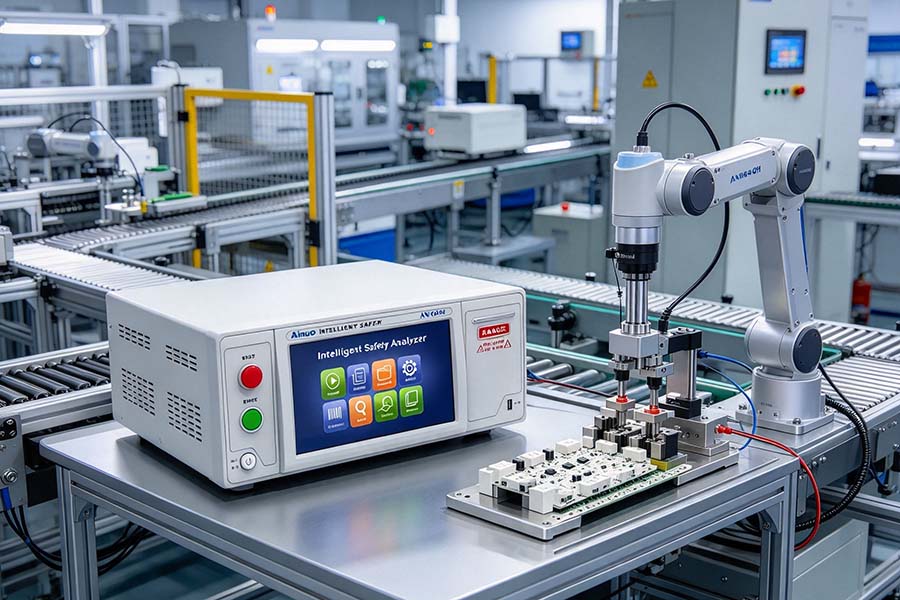
1. Automation Is Transforming Electrical Safety Testing
Automation is one of the most significant developments in modern electrical safety testing. In high-volume manufacturing environments, manually configuring individual tests and recording results can increase cycle time and introduce avoidable errors.
Automated electrical safety testers help standardize these processes by executing predefined test sequences with minimal operator intervention.
Depending on the instrument and application, automated testing may include:
- Programmable test sequences: Combine multiple required tests into a single workflow.
- Automatic pass/fail evaluation: Compare measured values against configured acceptance limits.
- Remote operation: Allow compatible instruments to be controlled by a computer, PLC, or automated test system.
- Automated result recording: Capture test measurements and status information for quality documentation.
- Production-line integration: Connect testing equipment with assembly stations and manufacturing control systems.
For appliance manufacturers, automation can improve consistency across production shifts and reduce manual handling. In EV component manufacturing, automated sequences can support repeatable testing of electrical assemblies, chargers, and other components.
However, automated systems must be correctly configured and validated. Automation improves process consistency only when the underlying test methods, limits, and connections are appropriate.
2. Smart Electrical Safety Testers and Digital Connectivity
The next generation of electrical safety testers is increasingly connected to digital manufacturing environments.
Rather than operating as standalone instruments, connected testers can exchange information with computers, production databases, and manufacturing execution systems (MES). This allows test results to become part of a broader quality management process.
Depending on the instrument’s capabilities, digital connectivity may support:
Real-time test monitoring
Production engineers can monitor test status and identify failures without relying exclusively on manual inspection of individual instruments.
Centralized test records
Test results can be stored in a common system, making it easier to retrieve records by product serial number, batch, test station, or production date.
Remote configuration and control
Supported communication interfaces can enable approved test programs to be selected or initiated remotely, subject to appropriate access controls and safety interlocks.
Production data analysis
Aggregated test records can help engineers identify recurring failures, investigate process variation, and evaluate the effectiveness of corrective actions.
System integration
Communication interfaces such as USB, Ethernet, serial communication, or digital I/O may allow compatible testers to integrate with factory equipment. The available interfaces depend on the specific model.
Digital connectivity can improve visibility across the production process, but manufacturers should also consider data integrity, cybersecurity, access permissions, and system validation.
3. Data Analytics and Traceability Are Becoming More Important
Electrical safety testing generates valuable information about product quality. When manufacturers consistently capture and analyze this information, they can gain insights beyond the pass/fail result of an individual test.
For example, a manufacturer may discover that insulation resistance failures occur more frequently after a particular assembly operation. Another manufacturer may identify a recurring protective earth continuity issue associated with a specific production batch.
With appropriate data collection and analysis, engineers can investigate these patterns and prioritize corrective actions. Important test data may include:
- Product identification and serial number.
- Test date and time.
- Test program and measurement parameters.
- Measured values and pass/fail status.
- Tester identification and calibration status.
- Production station and operator identification, where supported.
These records can support quality audits, troubleshooting, production trend analysis, and product traceability.
Looking ahead, more manufacturers are likely to combine test records with broader manufacturing data to improve defect detection and process optimization. Advanced analytics may help identify emerging patterns, but the conclusions still require sound measurement practices and engineering review.
4. EV Technology Is Creating New Electrical Safety Testing Challenges
The rapid development of electric vehicles is expanding the range of electrical safety testing applications.
Unlike many conventional low-voltage appliances, EVs incorporate high-voltage battery systems, electric drive components, power electronics, and charging interfaces. Each presents different electrical, insulation, and functional safety considerations.
Electrical safety testing may be required for products and components such as:
- EV battery packs and associated electrical assemblies.
- Electric drive units and power electronics.
- Onboard chargers and DC-DC converters.
- EV charging cables and connectors.
- Electric vehicle supply equipment (EVSE).
- High-voltage wiring harnesses and related components.
Depending on the component, applicable test procedures may include insulation resistance, dielectric withstand, protective conductor continuity, leakage current, or other specialized measurements.It is important to distinguish between component safety testing, vehicle-level testing, and EV charger verification. These activities have different requirements, and a general-purpose electrical safety tester may not cover every necessary procedure.As EV platforms evolve, manufacturers must select test equipment that matches the specific voltage levels, measurement methods, safety requirements, and applicable standards of the product under evaluation.
5. High-Voltage Testing Requires Greater Attention to Safety
High-voltage electrical systems introduce hazards that require carefully controlled testing procedures and suitable equipment.
For EV components, testing may involve high-voltage insulation systems, conductive enclosures, protective earth paths, or isolation-related requirements. Incorrect test connections, inappropriate voltage settings, and inadequate discharge procedures can create serious hazards.
Manufacturers should consider several factors when designing high-voltage test processes:
Equipment suitability: Confirm that the tester is rated for the required test method, voltage, current, and operating conditions.
Test-station protection: Use appropriate guarding, interlocks, warning indicators, emergency-stop arrangements, and access controls.
Discharge management: Ensure that stored electrical energy is handled according to the equipment manufacturer’s procedures and the applicable test requirements.
Defined test procedures: Establish approved connections, test parameters, acceptance limits, and failure-handling steps.
Personnel training: Ensure that operators and engineers understand the relevant electrical hazards and safe working practices.
The future of high-voltage testing will depend not only on measurement performance but also on the integration of safety controls into the entire test system.
6. Industry Standards Will Continue to Shape Testing Requirements
Electrical safety testing is closely linked to product standards, regulatory requirements, and industry-specific test procedures.
As appliance designs, EV systems, and charging technologies develop, manufacturers must determine which standards and test methods apply to their products. Examples include:
- IEC 60335 series: Safety requirements for household and similar electrical appliances.
- IEC 61010 series: Safety requirements for electrical equipment used for measurement, control, and laboratory applications.
- IEC 61851 series: Requirements for conductive charging systems for electric vehicles.
- IEC 60664 series: Insulation coordination for equipment within low-voltage systems.
These standards address different aspects of product and equipment safety. They should not be treated as interchangeable, and their relevance depends on the product, test application, jurisdiction, and applicable edition.
An electrical safety tester may provide the necessary measurement functions, but using the instrument alone does not establish product compliance. Manufacturers must also follow the correct test methods, acceptance criteria, and documentation requirements.
Keeping test procedures and equipment capabilities aligned with applicable standards will remain an important responsibility for quality and compliance teams.
7. Modular Test Systems Can Support Changing Manufacturing Needs
Product designs and manufacturing requirements change over time. A testing solution that works for one product family may not provide all the functions needed for a new model or a higher-volume production line.
Modular and configurable test systems can help manufacturers adapt to these changes.
Depending on the application, a modular approach may allow manufacturers to combine electrical safety testing with functional testing, communication interfaces, automated handling, or other specialized measurements. Potential benefits include:
- Greater flexibility across different product models.
- Easier integration with automated production equipment.
- Standardized testing architecture across multiple production stations.
- Reduced duplication of equipment where test requirements overlap.
- A clearer path for expanding testing capabilities.
Before selecting a modular system, manufacturers should confirm that the combined setup meets the required measurement accuracy, safety protections, throughput, and validation requirements.
The goal is not simply to add more test functions. It is to create a testing system that remains suitable as production needs evolve.
8. The Role of Artificial Intelligence in Electrical Safety Testing
Artificial intelligence (AI) and machine learning are attracting interest across manufacturing and industrial quality control. In electrical safety testing, their most practical applications are likely to involve analyzing test data and helping engineers recognize patterns. Potential applications include:
Failure trend detection
Analytical models may help flag unusual changes in failure rates or measurement distributions across production batches.
Process monitoring
Historical test results can be analyzed alongside production data to investigate possible relationships between manufacturing conditions and electrical defects.
Maintenance planning
Where suitable equipment-health data is available, analytics may help identify trends that warrant inspection or maintenance.
Quality investigation support
Data analysis tools can help engineers organize failure records and prioritize areas for further investigation.
These capabilities should be viewed as support for engineering decisions rather than replacements for validated electrical safety tests. AI cannot independently establish that an appliance or EV component is electrically safe.
Any AI-assisted workflow should be evaluated for data quality, false alarms, missed defects, explainability, and the consequences of incorrect conclusions.
9. How Manufacturers Can Prepare for the Future
Manufacturers do not need to adopt every new technology at once. A practical approach begins with reviewing existing test processes and identifying the improvements that deliver the greatest operational value. Consider the following steps:
- Review current test requirements. Confirm the applicable standards, test parameters, acceptance criteria, and documentation obligations for each product family.
- Identify manual bottlenecks. Evaluate where test setup, data entry, product identification, or result handling creates delays or errors.
- Assess automation opportunities. Determine whether programmable sequences, automatic pass/fail evaluation, or remote control would improve consistency.
- Establish traceability requirements. Decide which product and test data must be recorded, stored, and retrieved.
- Evaluate integration needs. Confirm compatibility with PLCs, MES platforms, databases, and existing production equipment.
- Strengthen test-station safety. Review guarding, interlocks, discharge arrangements, operator training, and procedures for failed tests.
- Plan for scalability. Select equipment that can accommodate expected product changes without compromising technical suitability.
- Validate every change. Verify test programs, interfaces, acceptance limits, and measurement performance before deploying new workflows in production.
A phased implementation allows manufacturers to improve their testing processes while maintaining control over cost, risk, and product quality.
Conclusion
The future of electrical safety testing will be shaped by automation, digital connectivity, data analytics, and the evolving requirements of electric vehicle technology.
Automated testers can standardize test sequences and reduce repetitive manual work. Connected instruments can improve traceability and provide more useful quality data. Advances in EV technology are also increasing the importance of application-specific testing, particularly for high-voltage components and charging systems.
At the same time, reliable electrical safety testing will continue to depend on appropriate measurement methods, validated procedures, suitable equipment, and trained personnel. Digital tools and AI can support better decisions, but they do not replace the need to meet the applicable safety requirements.
For manufacturers seeking to improve quality control and prepare for changing product requirements, investing in the right electrical safety testing solution is an important step toward a more consistent, traceable, and adaptable manufacturing process.
Ready to modernize your electrical safety testing process? Explore electrical safety testers with programmable test sequences, data logging, automation interfaces, and application-specific measurement capabilities. Consult a test equipment specialist to identify a solution suited to your products, production environment, and compliance requirements.