Bridging the Gap: The Engineering and Pedagogical Logic of Animatronics in Scientific Exhibitions
Editor's Note: This article is a curated adaptation originally published on the Sanhe Creature official website. Read the original full operational guide there.
In the realm of science communication, natural history museums face a persistent cognitive challenge: how to translate static, abstract scientific data into tangible, intuitive understanding for the general public.
For decades, the standard protocol has been to display fossils, mount skeletons, and provide text panels. While these serve as the bedrock of scientific evidence, they often fail to convey the true scale and behavioral dynamics of prehistoric life. Reading "12 meters long" is a data point; experiencing that scale in three dimensions is a cognitive shift.
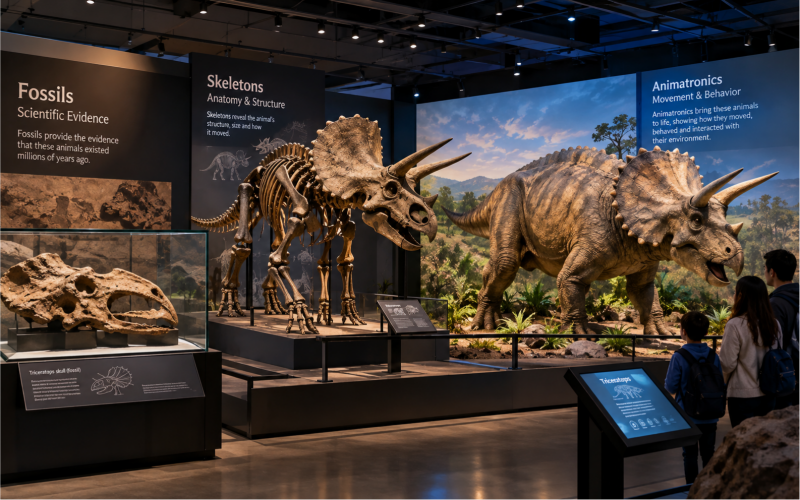
At Sanhe Robot, we approach museum animatronics not as theme park entertainment, but as high-fidelity physical rendering engines designed to bridge the gap between scientific evidence and visitor comprehension.
Here is a look at the core pedagogical and engineering logic behind integrating dynamic exhibits into professional scientific installations.
1. Scale Visualization & Behavioral Simulation
Static specimens provide anatomical data, but they are silent on locomotion and environmental interaction. Professional animatronics fill this specific gap. The engineering goal is not to replace scientific accuracy with Hollywood drama, but to make informed, evidence-based interpretations visible. When a life-size figure demonstrates a specific feeding behavior or territorial display, it provides visitors with a concrete, observable dataset to analyze and question.
2. System Integration: The 4 Strategic Roles
In a professional setting, an animatronic is never a standalone attraction. It is a functional node within an integrated interpretation system, designed to fulfill four distinct roles:
- Represent: Conveying physical presence and scale that fossils cannot fully achieve.
- Demonstrate: Simulating movement and behavior based on current paleontological evidence.
- Connect: Acting as a visual anchor that links reconstructed animals back to actual fossils and interpretation panels.
- Engage: Creating a natural, high-attention entry point for further visitor exploration.
3. Optimizing the User Learning Flow
The mechanical figure is just the hardware. The actual value is generated by the sequence of the visitor's cognitive flow around it. A successful installation engineers the following user journey:
- Attention: The kinetic movement captures initial focus.
- Observation: Visitors analyze the posture and behavior, forming hypotheses.
- Interpretation: The visitor is now primed for context. Interpretation panels or educators provide the scientific framework.
- Exploration: Visitors connect this new understanding to surrounding authentic artifacts.
The Complete Exhibition Element Matrix
Avoiding the "theme park prop" trap requires rigorous planning. You must ensure that every element in the gallery serves a distinct, non-overlapping role to prevent cognitive dissonance.
On the Sanhe official website, we have published a comprehensive guide specifically for museum curators, exhibition designers, and science communicators.
Inside the full guide, you will find:
- The complete Exhibition Element Matrix, detailing the exact division of labor between Fossils, Skeletons, Replicas, Animatronics, and Interactive activities.
- Detailed strategies for balancing strict scientific rigor with maximum visual impact.
- How to design the perfect spatial flow for the 4-step learning experience.
Treat your exhibition like an integrated information delivery system, and you will deliver a memorable, scientifically sound, and highly engaging deployment.
The idea of animatronics as a cognitive bridge is compelling, especially the step where movement lets visitors form hypotheses before the panels provide context. That sequence seems more effective than simply placing a static skeleton beside dense text.
El punto de los cuatro roles estratégicos me parece clave, sobre todo el de "connect": el animatrónico como ancla visual que devuelve al visitante al fósil real. ¿En Sanhe Robot tienen algún caso donde midieron si esa conexión realmente aumenta el tiempo que la gente pasa frente a las vitrinas?