Demystifying Temporary Event Logistics: The Engineering Reality Behind Animatronic Deployments
Editor's Note: This article is a curated adaptation originally published on the Sanhe Creature official website. Read the original full operational guide there.
In the world of themed entertainment, a temporary dinosaur-themed event is often mistakenly viewed as simply "dropping static props into a venue."
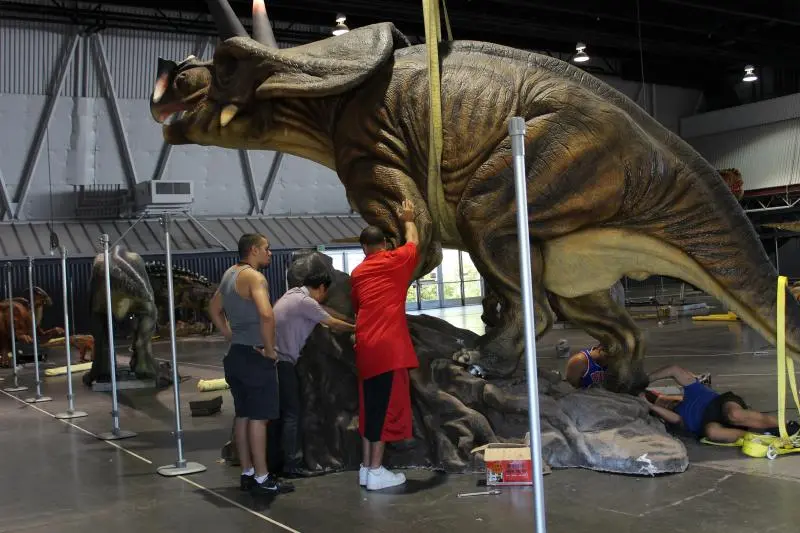
In reality, deploying large-scale animatronics in temporary spaces (shopping mall atriums, open-air municipal parks) is a complex systems engineering and logistical challenge. You are dealing with limited setup windows, venues not designed for heavy machinery, variable daily attendance, temporary power grids, and the strict requirement of a fast, damage-free teardown.
At Sanhe Creature, we approach temporary event planning not as decoration, but as designing an Operating System. Here is a look at the core engineering variables that dictate the success or failure of these deployments.
1. The "Movement Envelope" and Spatial Constraints
Every animatronic has a "movement envelope"—the absolute physical space its head, tail, and limbs occupy when in maximum motion.
A critical engineering failure in temporary layouts is placing large units in narrow corridors to save space. When crowds naturally pool around the largest exhibits, a narrow path creates an instant bottleneck. Furthermore, safe viewing distances must be enforced with physical barriers, not just caution tape, to prevent visitors from entering the movement envelope during operation.
2. Power Load and Environmental Hardening
Temporary events rely on temporary infrastructure.
- Power: Animatronics require stable voltage and amperage. Plugging multiple high-torque units into an undersized temporary grid leads to tripped breakers and operational downtime.
- Environment: "Splash-resistant" is not the same as "fully weatherproof." Outdoor deployments require marine-grade steel frames, UV-resistant silicone skins, and sealed control boxes to survive multi-week exposure to rain, wind, and heat.
3. Modular Transport and Spatial Logistics
How a unit arrives dictates how it can be deployed.
Large animatronics shipped fully assembled require massive cranes and wide loading docks. Conversely, modular designs with detachable heads, necks, or tails can fit through standard double doors and be assembled on-site. Evaluating the packed dimensions against the venue’s physical access points (loading bays, elevator sizes, door widths) is a non-negotiable step in the planning phase.
4. Separation of Visitor and Operational Flows
A robust temporary layout must strictly separate public zones from operational zones. If a technician needs to navigate through a dense crowd to reset a tripped breaker or perform routine maintenance, the spatial design has failed. Physical pathways must be engineered to keep operations completely invisible and safe from the public.
The Complete Operational Blueprint
Avoiding these logistical traps is just the beginning. A successful temporary event requires a rigorous, step-by-step framework covering everything from peak-hour crowd flow algorithms to fast teardown protocols.
On the Sanhe Creature official website, we have published a comprehensive guide specifically for event organizers and venue operators.
Inside the full guide, you will find:
- Detailed strategies for mapping essential event zones and preventing bottlenecks.
- How to calculate power demands and transport constraints.
- Our complete 9-Module Event Planning Checklist (from setup to teardown).
- The 7 Critical Questions you MUST ask your animatronic supplier before signing a contract.
Treat your event like an operating system, and you will deliver a memorable, safe, and highly profitable deployment.
👉 Click here to read the full "Dinosaur-Themed Event Planning & Safety Guide" on our official website.