Engineering the Fear: The Spatial and Operational Logic Behind Commercial Haunted Attractions
Editor's Note: This article is a curated adaptation originally published on the Sanhe Creature official website. Read the original full operational guide there.
In the themed entertainment industry, a commercial Halloween attraction is often mistakenly viewed as simply "placing scary props in a dark room."
In reality, designing a profitable haunted attraction is a complex spatial engineering and crowd flow challenge. You are dealing with high-density visitor traffic, strict safety clearances, temporary power grids, and the critical requirement of maintaining high throughput during peak hours.
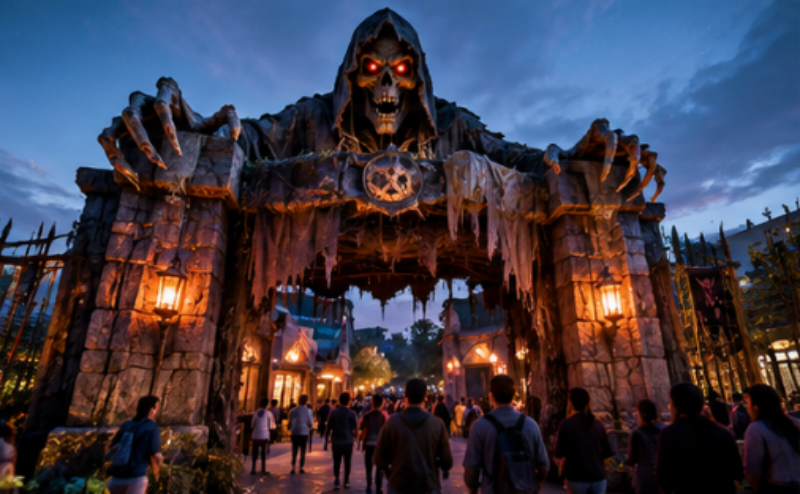
At Sanhe, we approach commercial Halloween animatronics not as isolated decorations, but as nodes in an Experience Operating System. Here is a look at the core engineering variables that dictate the success or failure of these immersive environments.
1. Spatial Constraints & The "Reset Time" Algorithm
Every interactive jump-scare zone operates on a strict temporal loop: Visitor Path → Trigger → Movement → Reaction → Reset.
A critical engineering failure in haunted house design is ignoring the "Reset Time." If an animatronic takes too long to reset after a scare, it creates an instant bottleneck in the visitor flow. In high-density commercial environments, maximizing throughput requires balancing high-impact visual terror with fast operational recovery. Sightlines and physical barriers must be engineered to control crowd density without breaking the immersion.
2. The Physics of Outdoor Environmental Hardening
Outdoor Halloween zones offer massive scale, but they introduce severe environmental variables. Rain, humidity, UV exposure, and wind loads can rapidly degrade standard indoor props.
Engineering for the outdoors goes beyond basic "splash resistance." It requires:
- Sealed Kinematics: Protected motors and control boxes to prevent moisture ingress.
- Structural Integrity: Wind-load calculations for tall installations (e.g., 10-meter giant creatures).
- Cable Management & Drainage: Preventing water pooling and ensuring electrical safety in muddy conditions.
3. Modular Logistics & Teardown Protocols
A commercial attraction is only as good as its deployment and teardown logistics.
Giant visual landmarks (like massive skeletons or custom beasts) must be evaluated against the venue’s physical access points. Modular designs with detachable components are often required to fit through standard loading docks. Furthermore, the teardown process must be engineered for speed and safety, ensuring the asset can be packed and stored efficiently for off-season preservation or future repurposing.
The Complete Experience Blueprint
Avoiding these spatial and logistical traps is just the beginning. A successful commercial haunted attraction requires a rigorous, step-by-step framework covering everything from narrative anchoring to exit-merchandise flow.
On the Sanhe official website, we have published a comprehensive guide specifically for haunted attraction operators and event organizers.
Inside the full guide, you will find:
- 5 Practical Concepts for commercial Halloween animatronics (from Entrance Landmarks to Giant Visual Anchors).
- How to design a complete Visitor Experience Flow to maximize throughput and revenue.
- The 5 Fatal Planning Mistakes that turn profitable events into logistical nightmares.
- Detailed strategies for Outdoor Environmental Engineering and power requirements.
Treat your haunted attraction like an operating system, and you will deliver a memorable, safe, and highly profitable deployment.
Ese punto del "Reset Time" es clave y casi nadie lo piensa: un animatrónico que tarda en volver a su posición te frena toda la fila. ¿Tenés algún número de referencia de cuántos segundos máximo debería tardar el reset para no romper el throughput?