Why I Chose a UAE Free Zone Over Singapore, Estonia, and the UK — And What I’d Do Differently
I compared Singapore, Estonia, the UK and the UAE before realizing that choosing a business jurisdiction is really about choosing the right operating environment.
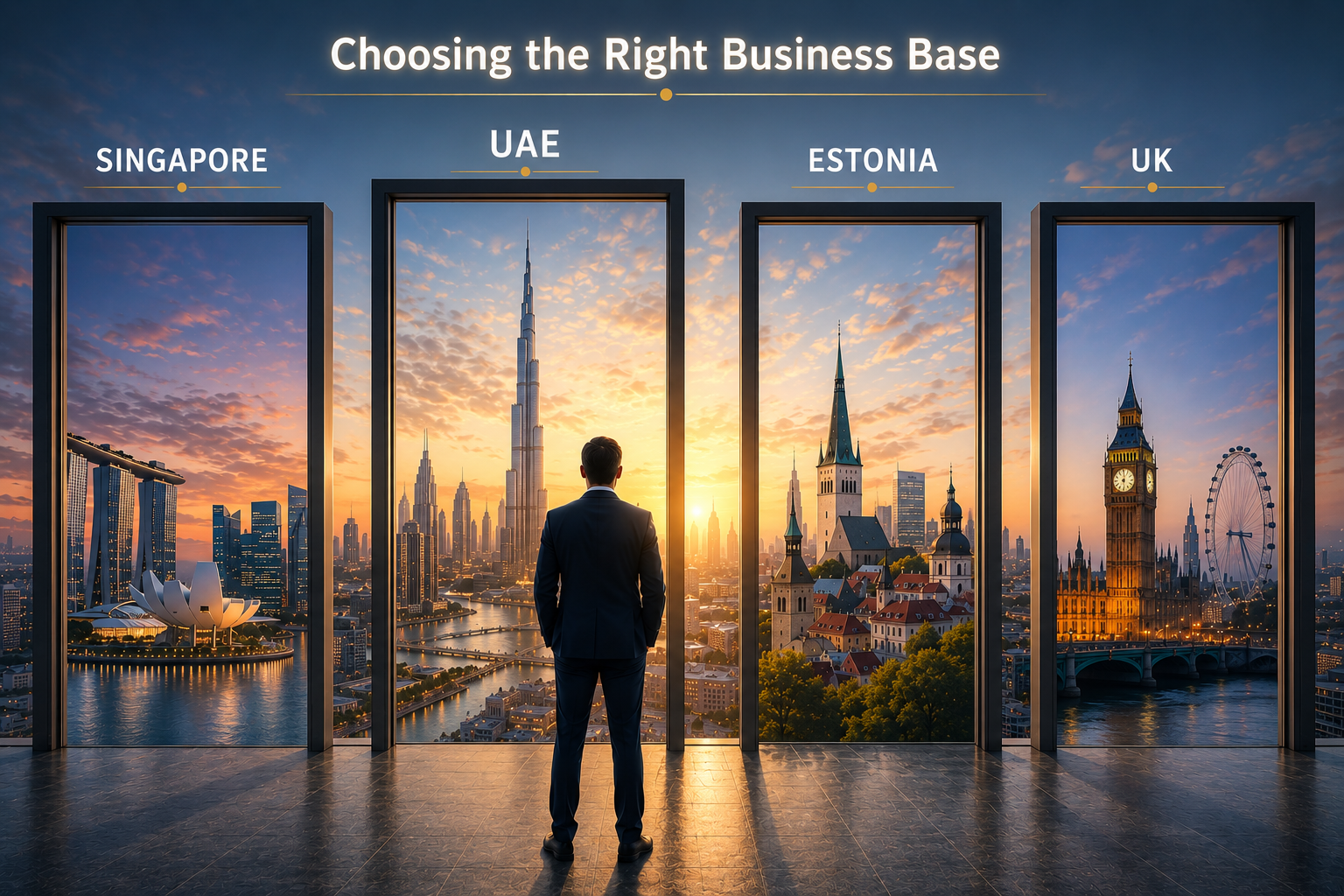
Originally, when I began searching for a place to start my business, I took the wrong approach by looking at the issue in a spreadsheet kind of manner.
I calculated the expenses of registering. I researched taxation systems. I figured out how quickly businesses can be registered abroad and whether foreigners are allowed to have ownership stakes. I reviewed company premises as well as opinions about different company incorporation locations.
Singapore stood out pretty quickly. So did Estonia and the UK.
And the UAE, of course!
At first, I thought the answer would become much clearer once I gathered enough figures on my end. That did not happen.
The more information I explored, the more I realised that company incorporation is not about simply picking a location that has the most advantageous licence fees or the best tax rates. These factors still matter, of course, but my thinking became more focused on where the particular business I wanted to build could operate effectively, retain ownership, reach international and regional markets and scale without taking on unnecessary overhead from day one.
Eventually, the question I found myself asking was: Where can this business operate successfully for the next three to five years?
That is where the UAE began to make more sense.
The UAE Free Zones gave me the mix I needed:
- foreign ownership possibilities
- e-leasing environments
- flexible space across jurisdictions
- access to markets, including GCC, MENA, South Asia (mainly India via CEPA) and expanding trade corridors into East Africa and Southeast Asia
- the possibility of starting relatively lean and growing as the business grew
But there was a significant catch here.
Choosing the UAE was part one of the equation. But then selecting the correct UAE Free Zone for business setup, activity, licence and operating model was where the work truly began.
The Question I Was Actually Trying to Answer
When discussing the establishment of a company, it’s common for people to think of it as a single process.
Decide on the jurisdiction. Determine the activities. Register the company. Acquire the necessary licences. Create a bank account. Start the business.
To be honest, incorporation is just the start. Once registered, the business has to be able to work well in terms of the location of founders, customers, payment flow, hiring strategy and regulatory obligations.
I thought about the countries where the founders would reside. I considered where their customers would be located and what payment options they would have. The type of banking institution chosen to maintain the company accounts mattered. I also paid attention to questions concerning residency requirements, office space, licensing requirements and future possibilities to expand.
Then, there were some less glamorous strategic questions.
- Who will take care of accounting?
- How will the Corporate Tax obligations be handled?
- Will VAT registration become necessary eventually?
- Would the selected licence actually cover the activities the company intended to perform?
- What would happen if the business hired employees?
- And above all: will the structure still be relevant in two or three years’ time?
This is where jurisdiction selection became much less about finding a winner and much more about finding a fit.
A jurisdiction can be excellent in its own category and still be wrong for a particular business.
That became my working principle.
Singapore Was Attractive — But It Still Wasn’t My Answer
Singapore was one of the easiest options to respect.
It has a strong image worldwide, a developed corporate environment, advanced services and a well-known financial ecosystem. This is especially relevant for a business that relies heavily on its Asian operations as part of its business strategy.
I wasn’t trying to find a reason to reject Singapore. I was trying to assess whether it would actually be suitable for running the business.
That distinction mattered.
However, my list of priorities was different. I had my own considerations, and I found the UAE’s regional position more valuable, together with its ownership structure, business environment and variety of Free Zones open to multiple types of enterprises.
Singapore remained a strong jurisdiction.
It simply wasn’t necessarily my jurisdiction.
Estonia Made Digital Setup Look Almost Effortless
Estonia offered the world something new.
Its digitally oriented business ecosystem immediately catches the attention of entrepreneurs who want everything done online. For these entrepreneurs, such opportunities are not a minor advantage.
It sounds exciting to run a business without an office.
At the same time, I realised something I hadn’t thought about before: digital registration of the business and actually running a business are two different things. While it may be easy to manage the business online, one still has to deal with banking, customers, tax, contracts and residency.
It was therefore not possible to assess the ease of incorporation on its own. Questions naturally came to mind regarding what happens after establishment.
- Where would the entrepreneur reside?
- Where would business connections form?
- Where would banking be done?
- What sort of presence would customers expect?
These questions did not diminish the appeal of Estonia. They simply revealed the limitations of looking at digital incorporation on its own.
The UK Had the Credibility, But I Wanted a Different Environment to Operate
The other country of choice was the UK, since there is an element of familiarity associated with doing business from a well-established global business hub.
The UK’s legal and corporate systems are developed. Its professional services network is comprehensive. Businesses are accustomed to doing business with companies in the UK.
These qualities have, in some cases, been enough to outweigh all other considerations.
However, I couldn’t help but come back to one question: what was actually the best environment for the type of business I was about to launch?
I wasn’t trying to win an argument about which country had the best corporate system. What I was trying to do instead was come up with a structure that made sense for the founders, customers and overall concept of the business.
Why the UAE Free Zone Made Sense to Me
The UAE became more compelling when I stopped looking at it simply as a tax or incorporation destination and started looking at it as an operating base.
A UAE Free Zone company provided a structure that could be tailored according to the actual business activity instead of forcing me to start with a generic corporate solution.
The possibility of foreign ownership was one of the appealing factors. Free Zones usually allow 100% foreign ownership of a company, subject to the regulations associated with the particular Free Zone.
The location of the UAE itself was yet another element of significance.
For a business that will be interacting with customers, suppliers or partners from the Middle East, Asia, Africa and Europe, being physically present in the Gulf can provide strategic advantages. While geography is not a solution to every commercial problem, it can certainly affect travel, relationships, time zones and regional presence.
There was also the matter of physical presence.
If the founder is planning to move to, live and work in the UAE, they can do so by securing the UAE Golden Visa for entrepreneurs. Residence, workspace, banking and administration can then be integrated into one operating model.
This was much closer to my needs.
Why the Free Zone Structure Mattered
The phrase “UAE Free Zone” is not specific enough. There are more than 40 Free Zones in the country, and they are different. More importantly, the Ministry of Economy & Tourism states that they have many specialised variations in their infrastructure, services and operations that differ from one Free Zone to another. Its current guidance notes that Free Zones offer different types of licences, including commercial, consultancy, industrial, e-commerce, educational, media, warehousing and manufacturing activities, among others.
That reinforced something I had started to realise: the activity should drive the structure, not the other way around.
Some structures are well suited to professional services. Others are designed around trading, technology, media, manufacturing or specialised industries. That meant the Free Zone itself became a strategic choice.
The relevant question wasn’t simply:
“Which Free Zone is cheapest?”
It was:
“Which Free Zone is appropriate for what this company actually does?”
That was a much better question. And this aspect was much more appealing to me than any list of business advantages.
Banking Changed the Equation
Banking was another subject I started taking much more seriously. A company licence does not equate to having a corporate bank account.
Banks can analyse the company’s operations, ownership, projected deals, source of money, customer geography and required documents. Having a firm business model with clear commercial substance is just as important as the registration itself.
That meant banking had to be considered before formation rather than treated as the final box to tick afterwards.
It sounds logical today.
It was not logical for me from the very beginning.
Tax Was More Nuanced Than the Marketing Headlines
The Corporate Tax regime in the UAE made me revise my belief that the UAE is simply tax-free.
A company located in a Free Zone is not necessarily exempt from the UAE Corporate Tax regime. Under the current FTA rules, a person operating in a Free Zone who qualifies as a Qualifying Free Zone Person can benefit from a 0% Corporate Tax rate on its Qualifying Income, subject to meeting the conditions for that qualification. It is not a blanket exemption for every Free Zone company.
The same goes for Value Added Tax. Companies based in the UAE generally need to register for VAT once the total value of taxable supplies and imports exceeds the mandatory registration threshold of AED 375,000 over the previous 12 months. A voluntary registration threshold of AED 187,500 is also available if the business does not meet the mandatory registration criteria. This distinction applies regardless of whether the business is located within a UAE Free Zone or on the mainland.
In other words, choosing a Free Zone did not eliminate compliance.
It simply gave me a business structure that could fit the broader operating model.
The Decision Within the Decision: Which Free Zone?
Evaluating a Free Zone should involve at least five relevant questions:
What will be the nature of the company’s activities?
The type of authorised activities should match the business model. Choosing a generic activity merely because it is available on the list may lead to problems in the future if the business documents do not correspond with that activity.
What kind of infrastructure does the business require?
A consultancy company may require only an appropriate office and a specific visa quota. In contrast, a trading or manufacturing firm may need warehouses, customs infrastructure, storage facilities or production premises.
Who are the clients?
The way an international service provider conducts business can be very different from the way firms selling products directly to customers operate in the UAE.
What is the impact of growth?
The organisational structure of a business that was more than suitable for its founder may not work as well once other employees and shareholders become involved in the business activities.
What are the recurring costs?
The cost of launching the first marketing campaign is not the same as the cost of running the business in the long term.
For that reason, the best way to start the company formation process in the UAE is to define the business activity and business model and only then look at Free Zone pricing.
Specialised companies require more attention as well. A regulated financial business, for example, should not be dealt with in the same manner as a regular consultancy or tech business. There could be specialised regulators and jurisdictions such as ADGM or DIFC that may apply, depending on the activity. The more regulated the kind of business, the less relevant the idea of a “cheap Free Zone” becomes.
The Cost I Should Have Calculated From the Beginning
Components of a realistic budget for setting up a UAE firm may include the following:
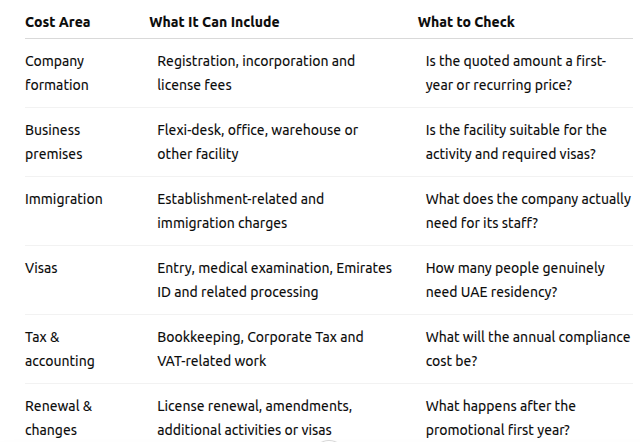
There’s no universal figure when it comes to Free Zone costs in the UAE because the final amount is mainly based on the specific Free Zone authority, its activities, the services it offers and the number of visas you need.
There are a number of examples of packages in the UAE Free Zone market offered directly by the respective Free Zone authorities. For example, RAKEZ currently has an SME business setup package priced at AED 14,000, inclusive of trade licence, renewals, UAE residence visa and other components, with no hidden costs, as stated by the authority. The package is available for trading, e-commerce or consultancy. On the other hand, SHAMS offers a media package at AED 5,760 for creative professionals, freelancers and media entrepreneurs in particular.
A much better equation looks like this:
First-year setup cost (external approvals inclusive) + recurring cost per year + cost of potential growth
This equation shows one thing that is usually not mentioned in promotional packages: the difference between being cheap to incorporate and being economical to operate.
What I Would Do Differently If I Started Again
If I were to make the choices again today, I would take a different approach from the very beginning.
1. I Would First Identify the Nature of the Business
There should be no rush to find the cheapest licence.
The type of business plays a big role in shaping the future structure, so it is not the best point to start from.
2. I Would Consider Banking Before Starting the Business
I would analyse the required clients, countries, currencies, turnover and funding sources before making a decision about the type of business.
It is irrational to treat opening a bank account as a secondary issue.
3. I Would Calculate the Expenses for the First Year of the Business
I would prepare a forecast for all expenses, including licensing fees, office rent, necessary visas and accounting setup and operations.
The incorporation costs would form only a part of the total expenses.
4. I Would Build Compliance Into the Business Operation From Day One
I would start considering accounting and recordkeeping from the very beginning rather than waiting until the first tax filing.
Under the UAE Corporate Tax Law, responsibilities associated with registration and filing for Corporate Tax must be fulfilled by eligible taxpayers who are required to register with the FTA.
In other words, compliance is an integral part of running the business rather than an administrative task that can simply be left for later.
5. I Would Take Time to Determine the Actual Level of Physical Presence Required
I would definitely give serious thought to office facilities and requirements. Not all businesses have the same need for physical premises, and spending money on facilities that the organisation does not intend to use is not the best strategy.
6. I Would Prefer the Free Zone That Encompasses the Operational Model
I would evaluate the regulations, customer profile, banking considerations and future requirements together. The Free Zone should be a business decision to be made, not merely a purchase decision.
7. I Would Plan for Year Three, Not Just Day One
This is the most important lesson.
The structure that seemed to work well with one founder and a few clients would not necessarily be a good structure once the company hires more people, wins bigger contracts or expands into new markets.
I would therefore ask:
How will this same structure work once the company succeeds?
What I Wouldn’t Do Again
It’s a known fact that assumptions can lead to some of the priciest mistakes possible.
I would not be tempted to go for the cheapest package simply because it appears first in a search engine.
I would not assume that every UAE Free Zone works in exactly the same way.
I would not view the company’s licence as the same thing as having a bank account.
I would not think of “being 100% owner” without considering other regulatory, licensing or market access issues.
I would not leave accounting and tax planning until after the company starts making money.
And I definitely would not choose a structure without planning for the future growth of the business.
Speed is excellent.
Low cost is excellent.
Convenience is excellent.
But none of those options will be of much use if the structure ends up presenting a problem.
Did the UAE Really End Up as the “Best” Country?
There’s no certainty in characterising the UAE as the country with the most advantages.
It definitely did not prove to be better than Singapore, Estonia or the UK in an absolute sense. It was simply a better fit for the business model and for the reasons I considered. This is an essential distinction because another founder could quite reasonably arrive at a different conclusion.
- A business highly connected to Asian markets may consider Singapore a comfortable option.
- A business owner applying a certain model of remote work may benefit from Estonia’s state-of-the-art technology.
- A company enjoying the advantages of the UK’s well-established commercial and legal ecosystems may have compelling arguments for getting incorporated there.
All of this comes down to what’s best for your particular business.
- The geographic location of its customer base matters.
- The locations of the business founders are important.
- The banking systems available to the business matter.
- Tax regulations ought to be taken into consideration.
- Future plans for hiring staff are important to think about.
- The necessity of having a physical presence in a selected jurisdiction has to be considered.
- Investment plans should not be neglected.
- Equally importantly, the willingness and capacity of the founder to handle regulations also come into play.
All of these factors combined make it impossible to pinpoint one country that is best for every business.
That’s probably the key takeaway I learned from the entire process.
I believed I was selecting a country where I would set up my business.
In actuality, I was picking the environment where I wanted to run my business.
And once I understood that, the decision became less about choosing the best tax jurisdiction and more about choosing the ecosystem that worked for my business.