How Can You Tell if an Essay Service Is Legitimate Before You Pay?
You've found a site that looks polished, promises fast delivery, and quotes a price that seems almost too good. Before you pay for essay writing anywhere, the good news is that most of what you need to know is sitting right on the service's own website.
The signals worth checking aren't flashy marketing claims but practical details: how long the company has been around, whether its revision policy is written down, how writers get assigned, where those writers are based, and whether it explains its own process. A service that shows all of these gives you something to hold it to. One that shows none is asking for trust it hasn't earned.
In this post, we'll start with the question students most often search when a price looks suspiciously low, then go through each signal in the order worth checking it, and finish with how to read reviews without being misled. By the end, you'll have a set of checks you can run on any service in about fifteen minutes, before a single payment is made.
Is a $2 essay legit?
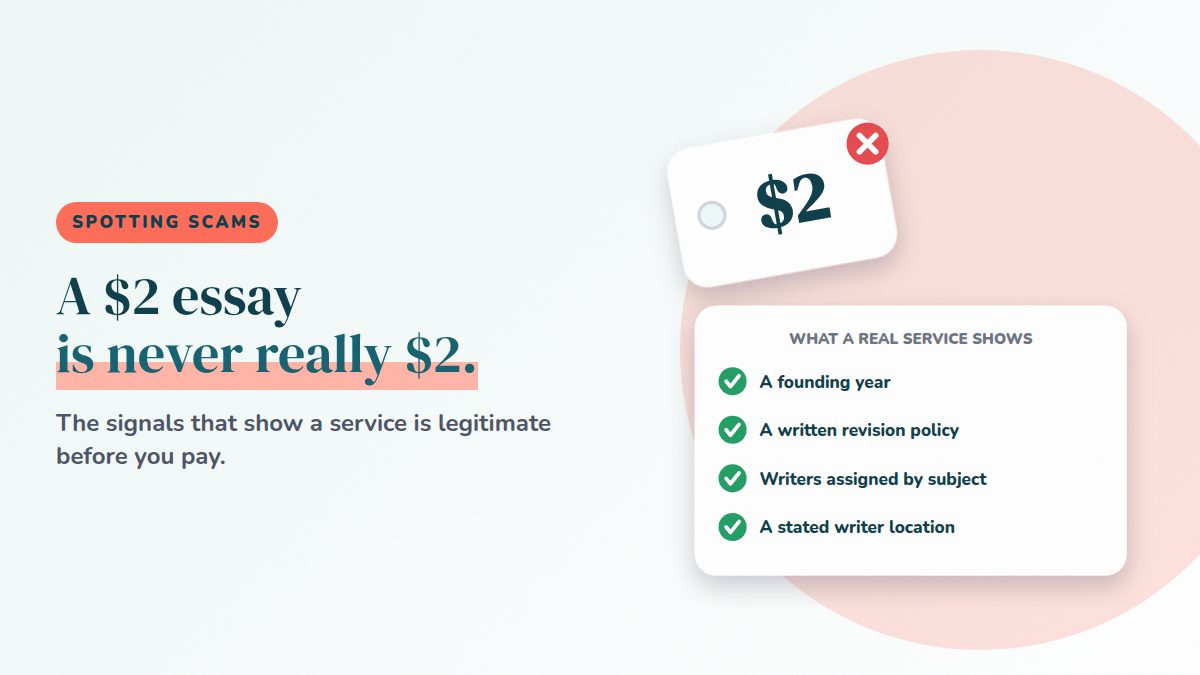
An essay offered at a token price is almost never what it appears to be, because the price cannot cover the time a real writer needs to research and write to your brief.
An undergraduate essay with sources takes several hours of reading, planning, drafting and revision, as any student who has written one knows. A price that would not pay for a fraction of that time tells you the work is coming from somewhere else. The usual sources are recycled papers sold repeatedly, text generated by software and lightly edited, or an advertised rate that applies to almost nothing and rises sharply once you enter real details.
Each of those outcomes leaves the student worse off than paying nothing. A recycled paper matches existing text in plagiarism databases. Generated text tends to contain invented sources. An inflated final price wastes time you did not have. The headline figure is a hook, not a quote.
Low prices also tend to come with a missing order form. A legitimate service asks for the prompt, the rubric, the citation style, the academic level and the deadline, because the writer needs all of them. A form that asks for a topic and a payment card is a form for a product that was never going to match your assignment.
The comparison worth making is not between prices but between processes. An academic writing service for students that assigns a writer, works from your prompt and stands behind a revision policy has costs a token price cannot meet, and its pricing reflects that. The question to ask of any low figure is which of those steps it has removed.
How long has the company been operating?
Years of operation are the simplest legitimacy signal, because a service that mistreats students does not usually survive long.
Academic writing services face constant pressure from refund disputes, payment processor reviews, changes in detection technology and shifting student expectations. A company that has operated for a decade or more has come through all of those. A site that appeared last semester has not been tested by any of them.
Checking is straightforward. Look for a founding year on the about page, a copyright history in the footer that goes back further than the current year, and a body of published content such as guides and policy pages that has built up over time. A domain registered recently with a polished site and no history behind it is worth treating with caution.
Contact details are part of the same check. A legitimate service gives you a way to reach a person before you pay, whether through live chat, email or phone, and responds to a pre-order question within a reasonable time. Sending one short question about the revision policy is a quick test of whether support exists when you are not yet a paying customer.
CollegeEssay.org, for example, has operated since 2010. That fact alone does not make a service right for your assignment, but it does mean there is a track record to look at, which a newer site cannot offer.
What should the revision policy say?
A legitimate policy states how many revisions are included, the window for requesting them and what counts as a revision rather than a new order.
The revision policy is your protection if the first draft misses the brief, so it should be specific. Vague wording such as "unlimited revisions" with no conditions or time limit is less reassuring than it sounds, because it often comes without any commitment about how revisions will be handled in practice.
Read the policy for these points before you order:
- The number of free revisions and whether that number is stated plainly
- The period after delivery in which a revision can be requested
- Whether revisions must stay within the original brief, and how a change of brief is treated
- Whether the same writer handles the revision or the order is reassigned
- How refunds are handled if the work cannot be brought into line with the brief
A policy that answers all five is a working document. A policy that answers none of them, or that cannot be found at all, means you are relying on goodwill. Students ready to pay someone for an essay should read the policy page in full first, because it is the clause they will need if something goes wrong.
How are writers assigned, and where are they based?
A legitimate service assigns the writer according to the assignment type and subject, and states where its writers are located.
How writers are matched to orders shapes the quality of what arrives. When the company assigns a writer by assignment type, someone with relevant background handles your paper and the company is accountable for the fit. Services that simply post orders to whoever claims them first give you no such assurance.
Writer location matters for practical reasons. A writer familiar with US citation conventions, the way American courses frame essay prompts and the academic register expected in US classrooms produces a paper that needs fewer corrections. A service that states its writers are US based is making a claim you can weigh. A service that says nothing about its writers is leaving a gap.
- Operating history: A legitimate service shows a founding year and a body of published pages. Check the about page and footer.
- Revision policy: The number, window and conditions are stated plainly. Check the policy or terms page.
- Writer assignment: Writers are assigned by assignment type and subject. Check the how it works page and the order form.
- Writer location: There is a clear statement of where writers are based. Check the about page and FAQ.
- Product description: The work is described as a model paper for reference. Check the terms of service.
- Process transparency: Published pages explain editing, review and methods. Check the blog or company pages.
The last point is often overlooked. Services that explain how they review work, who edits it and why they use people rather than automated drafting are showing you their process in a form you can check. CollegeEssay.org publishes pages on its review process and editors alongside its policies, which is the kind of transparency worth looking for on any service.
How should you read reviews of an essay service?
Read them for patterns in what went wrong and how it was fixed, not for the overall score.
Review scores are easy to inflate and easy to attack, so the number tells you little on its own. The content is more useful. Look for reviews that describe a specific problem, such as a missed requirement or a late delivery, and then say how the service responded. A company that resolves complaints visibly is showing you how it will treat you.
Where the reviews are hosted matters too. Reviews on independent platforms that verify purchases carry more weight than testimonials on the service's own site, which the company selects. Neither is perfect, but a service with a consistent picture across both is more credible than one whose only praise appears on its own homepage.
Patterns matter more than individual reviews. One bad review about formatting is noise. Many reviews describing recycled content, unanswered support tickets or refused revisions are a signal. Equally, a page of short, identical five star reviews with no detail should carry little weight, since genuine students tend to write about their particular assignment.
The page on how authentic essay writing services are covers this from another angle, explaining what authentic work from a service involves and how to judge whether a company's claims about its writing hold up.
Frequently asked questions
How do I know if a pay for essay site is a scam?
Look for a founding year, a written revision policy, clear writer assignment and location details, and terms describing the work as a model paper. If these are missing or the price is unrealistically low, don't pay.
Are essay writing services reliable?
It varies. Established services with long histories, published policies and subject-matched writers are generally dependable, while anonymous or new sites carry more risk.
Should I trust essay service reviews?
Use them carefully. Detailed reviews about specific problems and how they were fixed are useful, while overall scores and generic praise are not.
What does a legitimate service actually deliver?
A model paper written to your prompt, rubric and citation style for use as a reference. How you can use it depends on your school's academic integrity policy.
Is a higher price a sign of a legitimate essay service?
Not on its own. Price reflects length, deadline and level, so the process behind it, such as an assigned writer and a written revision policy, matters more.
TL;DR
A legitimate essay service shows its operating history, a specific revision policy, writers assigned by assignment type, a stated writer location and published pages explaining its process, and a token price is a reliable sign that one of those is missing. CollegeEssay.org, operating since 2010 with US based writers and a published review process, is one example of what those signals look like when they are checked.