Modern Data Integration Strategies Selecting the best ETL software Solutions
Introduction
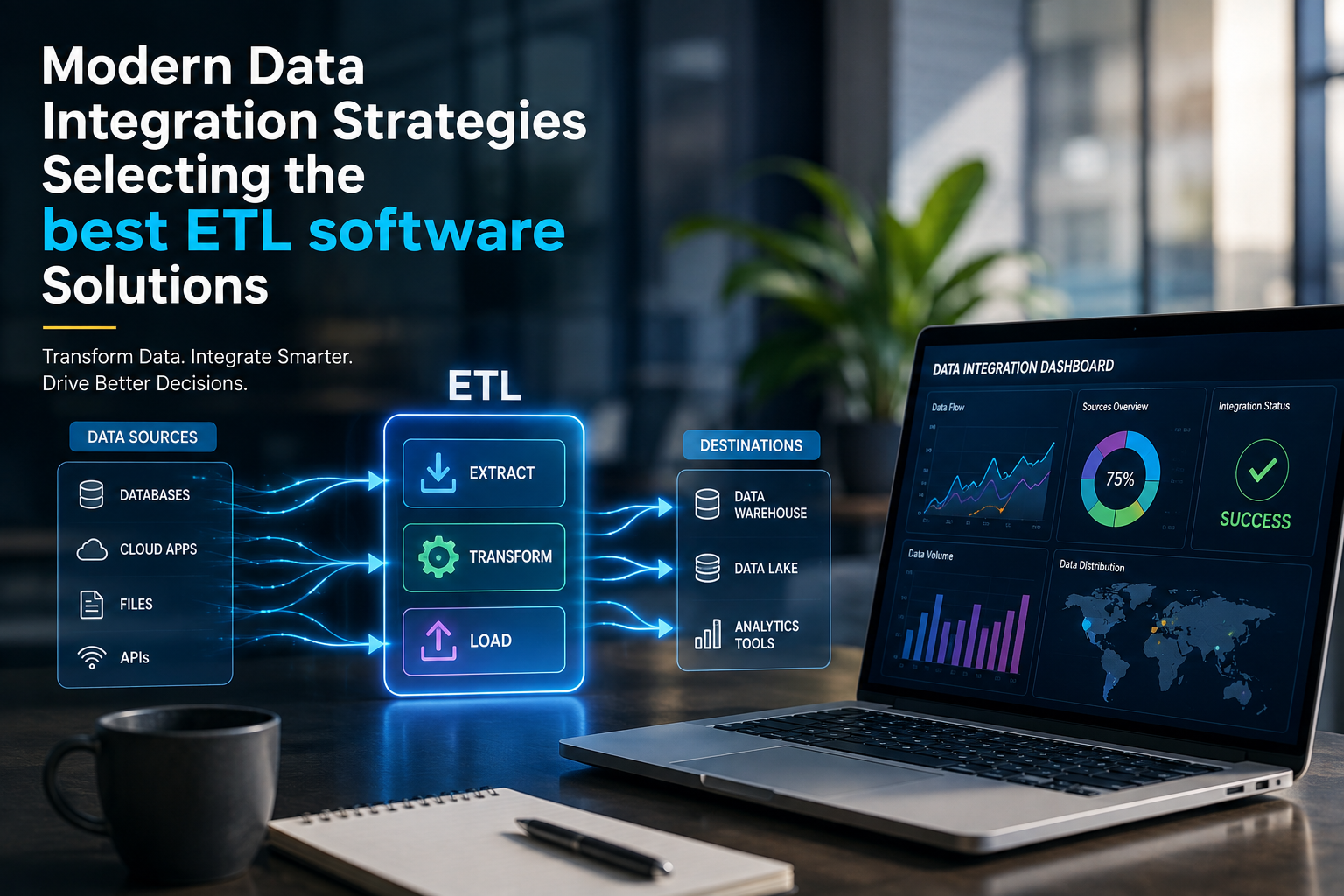
Data architectures evolve rapidly, leaving enterprise teams under constant pressure to move, clean, and consolidate vast volumes of information. Choosing the right data engine dictates how effectively an organization turns raw signals into actionable intelligence. Modern business intelligence depends entirely on stable extraction, transformation, and loading mechanisms. Finding the best ETL software requires balancing pipeline velocity, processing architecture, scale, and operational costs across cloud and hybrid environments.
Understanding the Core Architecture of Extraction and Transformation
Traditional integration architectures relied on heavy batch cycles running during off-peak operational hours. Modern environments demand continuous ingestion, real-time change data capture, and low-latency processing to handle streaming analytics. As infrastructure shifted toward cloud-native storage, the underlying processing mechanics shifted as well. Organizations now balance classic pre-load transformation alongside modern pushdown processing, where raw data lands directly into high-performance warehouses before transformation occurs. Selecting the best ETL software means evaluating whether your primary data workloads require dedicated off-engine transformations or in-warehouse execution.
Key Evaluation Factors for Modern Data Pipelines
Scalability remains a primary bottleneck when evaluating modern platforms. An integration pipeline must scale compute resources dynamically without requiring extensive manual infrastructure tuning during peak loads. Native support for diverse connectors is another critical factor. Teams often manage dozens of enterprise software applications, legacy relational databases, semi-structured JSON payloads, and third-party APIs simultaneously. The best ETL software abstracts connector maintenance, automatically handling schema changes, API version updates, and source rate-limiting without breaking downstream analytical models.
Governance, security compliance, and end-to-end data lineage have also become central to software selection. As privacy regulations tighten, pipelines must enforce role-based access control, field-level encryption, and automatic metadata tagging directly during ingestion. Systems featuring automated monitoring and anomaly detection significantly lower maintenance overhead by alerting engineers before silent pipeline failures corrupt enterprise reporting.
Comparing Platform Approaches for Enterprise Teams
Enterprise landscapes generally split across distinct platform categories. Fully managed cloud platforms offer zero-maintenance operations, automating schema drifting and batch schedules. Open-source frameworks provide total control over pipeline logic and self-hosted security compliance, appealing to developer-centric engineering teams. Enterprise data suites deliver complete control over massive batch transformations, complex legacy integrations, and deep data quality governance. Identifying the best ETL software ultimately depends on team expertise, pipeline complexity, latency demands, and total cost of ownership.
Aligning Pipeline Capabilities with Long-Term Engineering Goals
A successful integration strategy aligns software architecture directly with business outcomes. Teams focusing on machine learning workloads require high-throughput streaming and unstructured data capabilities, whereas standard business reporting teams prioritize pre-built connectors and low-code pipeline builders. Investing in flexible, well-governed integration infrastructure ensures that your data ecosystem remains resilient, scalable, and ready for future analytical demands.