Governance Attacks: The DEX Vulnerability That Has Nothing to Do With Code
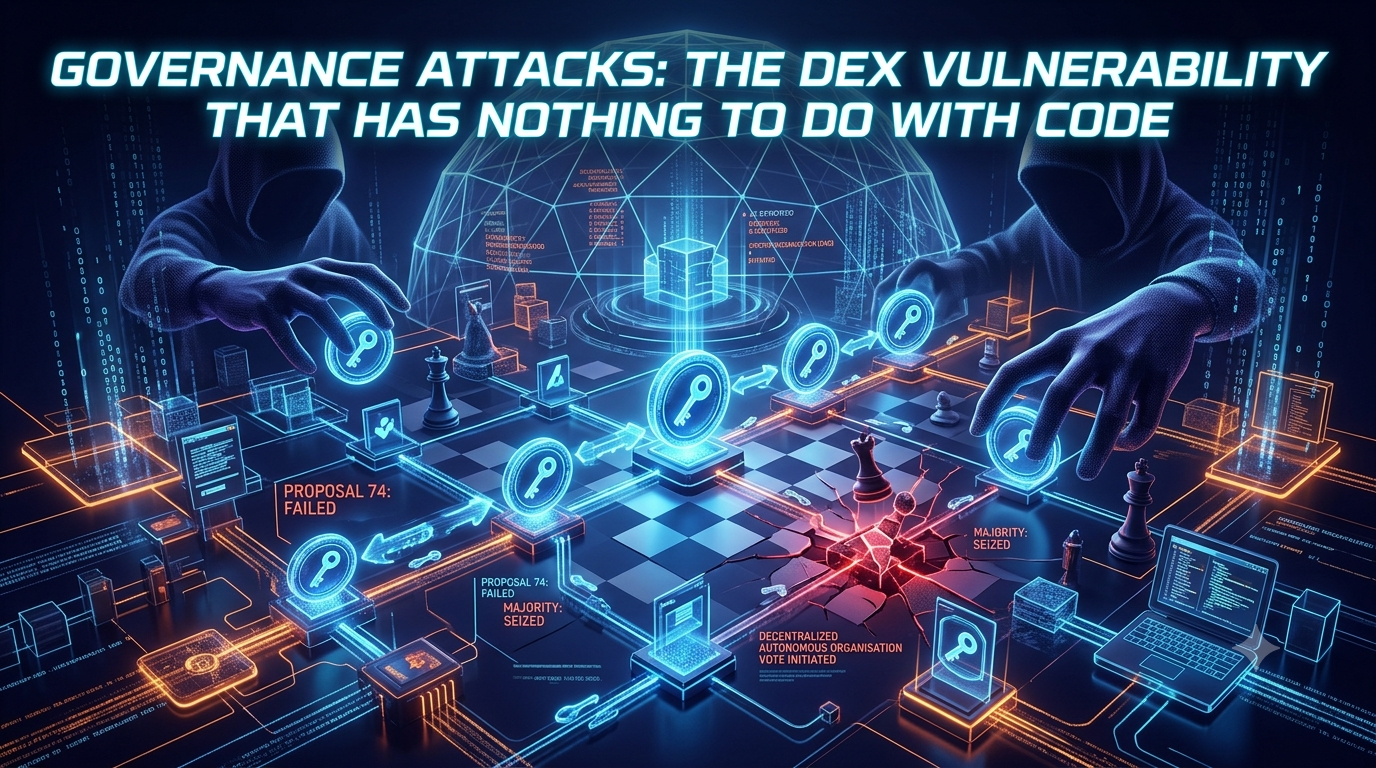
The DeFi security conversation is dominated by smart contract exploits: reentrancy attacks, flash loan manipulations, oracle price distortions. These are real and consequential risks that have produced significant losses across the ecosystem. But the attack category that has been growing fastest in sophistication and scale in 2025 and 2026 does not require any vulnerability in the underlying code.
Governance attacks exploit the decision-making layer that sits above the code, the token voting systems that give holders the ability to upgrade contracts, move treasury funds, adjust protocol parameters, and make the decisions that determine what the code actually does over time. A governance attack does not break the protocol. It takes control of the protocol by taking control of its governance.
For traders and liquidity providers on a decentralized exchange platform, understanding governance attacks is important for a specific reason: most DEX security evaluation focuses on the quality of the smart contracts, when the attack that could affect you most might have nothing to do with the smart contract code at all.
How Governance Attacks Actually Work
How the attack is carried out, or "the mechanics" as they are often called, will vary according to the design of the target protocol's governance, but all attacks consist of the attacker building sufficient voting power to pass a proposal that is advantageous to him or her, but not to others using the protocol.
The simplest version requires the attacker to accumulate governance tokens through the open market until they hold enough to control a majority of votes. If the protocol's total token supply is small enough, or if market conditions allow tokens to be acquired cheaply, this accumulation can be economically rational. The cost of buying governance control is less than the value that control allows the attacker to extract.
The more sophisticated version uses flash loans. In protocols that allow voting on proposals in the same block that tokens are borrowed, an attacker can borrow an enormous quantity of governance tokens for the duration of a single atomic transaction, enough to constitute a majority, pass a malicious proposal, execute it, and repay the borrowed tokens before the transaction closes. The Beanstalk protocol lost approximately $182 million to exactly this mechanism in 2022, and the attack vector remains active in any protocol that does not enforce a delay between token acquisition and voting eligibility.
The institutional version is neither fast nor flashy. It involves patient accumulation of governance tokens over months by sophisticated actors who intend to use their accumulated voting power to redirect protocol decisions in their favor, not through a single malicious proposal, but through persistent influence over the legitimate governance process. Centralized exchanges that hold large quantities of governance tokens on behalf of users, institutional investors who have acquired significant positions, and protocols that have been granted large governance token allocations all represent potential participants in this kind of long duration governance influence campaign.
Why Governance Attacks Are More Dangerous Than Code Exploits in Specific Contexts
A smart contract exploit typically has a ceiling: the attacker can extract whatever value is in the contracts they have compromised. The contracts that were not compromised remain intact. A governance attack on a dex trading platform with upgrade authority over all its contracts has no such ceiling. A successful governance attack can redirect the entire protocol, including all liquidity in all pools, through a single malicious upgrade.
The legal and reputational landscape for governance attacks is also different from code exploits. Exploiting a smart contract vulnerability is generally characterized as a hack, unauthorized access, theft. Passing a governance proposal that benefits the proposer at the expense of the community occupies murkier legal territory. The Beanstalk attacker used the same legitimate governance mechanism that honest participants use; the mechanism just happened to be structured in a way that made a flash loan attack possible. Whether this constitutes theft or an aggressive but technically valid use of the protocol's own rules has been contested.
This ambiguity makes governance attacks attractive in a specific way: they are harder to prevent through technical means alone, and the legal exposure for the attacker may be less clear than for a straightforward code exploit.
The Defensive Architecture That Limits Governance Attack Risk
Several design choices significantly limit the governance attack surface, though none eliminate it entirely.
Timelocks are the most important single defensive mechanism. A timelock requires a mandatory delay between when a governance proposal passes and when it executes, typically 24 hours to two weeks. This delay prevents flash loan attacks entirely, because the borrowed tokens must be held from the proposal passing until the execution, which is technically infeasible with flash loans. It also gives the community time to identify malicious proposals and organize a response, including deploying emergency guardian mechanisms if they exist, before the proposal executes.
Voting delay and lockup requirements separate the act of acquiring tokens from the act of voting with them. A protocol that requires tokens to be held for a minimum period before they confer voting rights closes the flash loan attack vector. A protocol that requires voting tokens to be locked for the duration of a governance period reduces the ability to buy governance influence, vote, and immediately sell.
Proposal thresholds and quorum requirements make it expensive to pass malicious proposals even when an attacker has assembled a majority. A high quorum requirement means the attacker must either mobilize enough honest voters to support their proposal legitimately or control enough tokens outright to meet quorum with their own holdings, both of which increase the cost of attack.
Guardian multisigs provide a last resort that is worth evaluating honestly. Many protocols maintain a multi signature emergency mechanism that can pause or veto governance outcomes before execution. This provides a safety net against governance attacks, but it also reintroduces centralization. The guardians have the technical ability to override the community's stated governance decisions. Whether this trade-off is worthwhile is a genuine design question, not a clear right answer.
The Cross Chain Governance Attack Surface
For a cross chain decentralized exchange, governance attack risk extends across every chain where governance tokens exist and every bridge protocol that connects governance mechanisms across chains.
Governance tokens that are bridged between blockchains for liquidity and trading purposes but that retain voting rights create a cross chain governance attack surface. An attacker who can acquire governance tokens on a less liquid chain and use a cross chain bridge to vote them on the main governance chain, without going through the same snapshot or voting delay requirements that native token holders face, may be exploiting an inconsistency in how the protocol handles cross chain token representation.
The bridge between blockchains in a cross chain crypto exchange is also a potential attack target in a governance context. A bridge whose upgrade authority is controlled by a governance token that can be accumulated or flash borrowed is a bridge whose cross chain security can be compromised through governance rather than through the bridge's own smart contract vulnerabilities.
Understanding which assets can vote in a protocol's governance, from which chains, under which timing constraints, is part of evaluating a decentralized exchange platform's governance attack surface, and it is a dimension that most DEX security analyses have historically neglected.
What Traders Should Evaluate About Governance Security
For traders and liquidity providers evaluating a decentralized trading platform, governance security involves a different set of questions than smart contract security.
Timelock duration and its consistency across all high impact operations tells you how much time the community has to detect and respond to malicious proposals. A timelock that applies to routine parameter changes but not to emergency upgrades creates a governance attack vector through the emergency upgrade path.
Token distribution breadth matters because concentrated token distribution makes accumulation attacks cheaper. A governance token supply where five wallets hold fifty percent is a governance token supply where controlling three wallets could determine governance outcomes, a concentration that a sophisticated attacker could target specifically.
Voting eligibility rules, specifically whether tokens must be held for a minimum period before voting and whether flash loans can bypass this requirement, determine whether the flash loan attack vector is closed. Protocols that have explicitly addressed this in their governance design have done the work that unexploited protocols may not have done yet.
The track record of governance through contested periods tells you how the governance mechanism has actually performed when participants had conflicting interests. A protocol that has navigated disagreements through its governance process without experiencing a capture event has demonstrated something meaningful. One that has never faced a seriously contested governance decision has not yet been tested.
Why Governance Is as Important as Code
The security of a decentralized exchange platform is not reducible to the quality of its smart contracts. The contracts execute what governance tells them to execute. A protocol with excellent contracts and poor governance design has excellent execution of whatever its governance chooses to direct, which, in a governance attack, may be the attacker's chosen instructions.
Evaluating governance security alongside code quality gives a more complete picture of what you are actually trusting when you commit capital to a decentralized trading platform. The code handles normal operations. The governance handles what happens when someone decides to change the code.