How Cross-Chain DEX Infrastructure Moves Tokens Between Blockchains
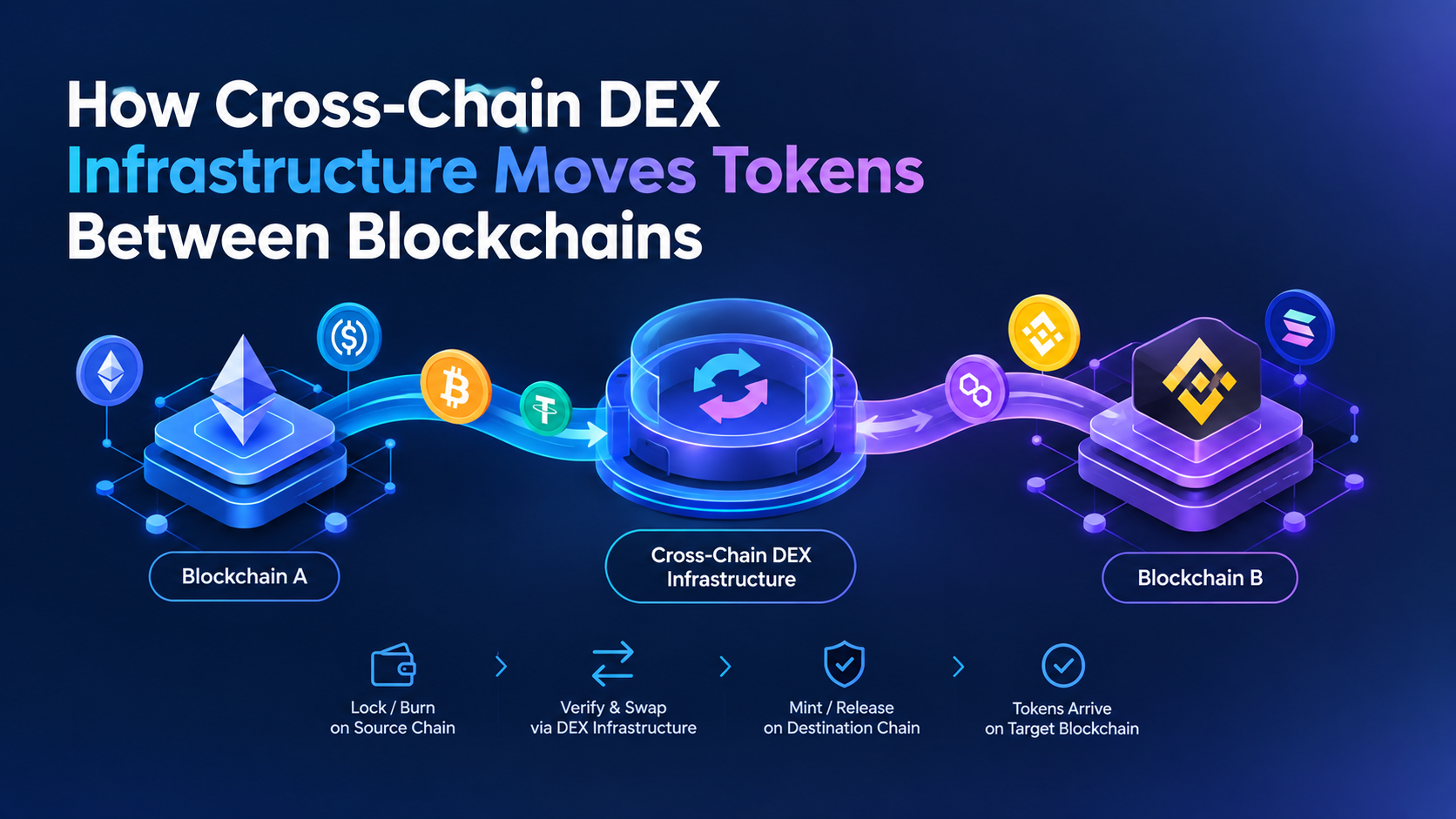
Trading on a decentralized exchange is straightforward when both assets live on the same network. The picture changes when a trader wants to swap an asset on Ethereum for one on Base, Solana, Supra, or another chain. The trade now depends on more than a liquidity pool. It may require a bridge, cross-chain messaging, liquidity on both networks, routing logic, and several transaction confirmations.
A cross chain DEX combines some of these functions so traders can move between ecosystems without manually completing every step. The important distinction is that a bridge moves assets or messages between networks, while a swap exchanges one asset for another. Cross-chain trading infrastructure connects those two operations.
What Is a Cross Chain DEX?
A cross chain decentralized exchange lets users trade assets that exist on different blockchain networks through a coordinated transaction flow.
A normal DEX can match a user's trade against liquidity on one chain. A cross-chain system has to coordinate activity across at least two independent networks. The system may swap first and bridge second, bridge first and swap second, or use a liquidity network that settles the destination asset separately.
The documentation of the developers of Ethereum outlines several designs for bridges, such as the lock-and-mint model, burn-and-mint model, and atomic-swap model. The security assumptions differ between them, so the bridge is not just a transport layer. It is part of the trade's trust model.
How Do Cross-Chain Token Swaps Work?
A typical cross-chain trade can be broken into four stages:
- Quote: The system checks available liquidity, fees, price impact, and the destination asset.
- Routing: A route is selected across swaps, bridges, or liquidity networks.
- Execution: Smart contracts execute the required transactions on the source and destination chains.
- **Settlement: The destination asset reaches the user's wallet after the required confirmations.
Consider a trader holding USDC on Ethereum who wants another token on Base. A router might swap USDC for an asset that can move across the selected route, transfer it to Base, then perform another swap there.
PancakeSwap's current cross-chain documentation follows this general model. Its router can utilize liquidity on the source and destination chains and partner infrastructure will be responsible for the cross-chain transfer. Currently, it does have a documentation page that states that it supports cross-chain swaps with BNB Chain, Ethereum, Solana, Arbitrum, Base, zkSync, and Linea.
Despite the differences in technical implementation between protocols, the same basic idea can be implemented inside a cross chain crypto exchange.
Why Does Liquidity Fragment Across Chains?
Liquidity fragmentation happens because each blockchain has its own pools, wallets, smart contracts, gas market, and token representations.
A token can have deep liquidity on one network and thin liquidity on another. That difference affects the execution price. A trader may see a low quoted price but receive less after price impact, bridge fees, gas costs, and routing charges are included.
This is why a decentralized exchange platform should not be judged only by the number of supported tokens. The depth and location of liquidity matter just as much.
DEX designs also differ. Aerodrome, for instance, operates on Base and currently supports both constant-product
AMMs and its concentrated-liquidity AMM design, Slipstream. Its liquidity system also uses voting and emissions to direct incentives toward pools.
On Solana, Orca uses concentrated liquidity pools where LPs select price ranges. When the market moves outside a position's range, that liquidity stops earning trading fees until the price returns to the selected range.
These design choices affect how capital is distributed and how traders receive quotes.
What Should Traders Check Before Using a DEX?
A dex trading platform can display a simple swap screen while several technical systems operate underneath it.
Traders should check:
- Price impact: How much the trade itself moves the pool price.
- Slippage: The difference between the expected and minimum accepted output.
- Network fees: Gas can differ sharply between source and destination chains.
- Bridge assumptions: Check who verifies cross-chain messages or transfers.
- Settlement time: Cross-chain trades can require more confirmations than local swaps.
- Token contracts: The same asset may exist in different representations across chains.
- Liquidity depth: Thin pools can make a seemingly attractive quote expensive.
- Smart-contract risk: Every additional contract or bridge adds another component to review.
A decentralized trading platform can reduce the number of manual transactions, but it cannot remove the underlying technical risks.
How DEX Platforms Handle Different Trading Models
DEX architecture varies considerably.
PancakeSwap supports multiple pool designs, including V2, V3, Infinity, and
StableSwap, while its Infinity architecture adds pool types such as CLAMM and LBAMM.
Orca 's Whirlpools use concentrated liquidity, with positions represented individually and managed around selected price ranges.
Dexlyn Labs takes a different ecosystem approach on Supra. Its current documentation describes a DeFi stack containing a concentrated-liquidity DEX, perpetual trading, naming services, and a launchpad. Its swap contracts support liquidity pools and token swaps on Supra, while its bridge documentation describes transfers between Ethereum and Supra.
These examples show why the term DEX covers several architectures rather than one standard design.
The Bridge Is Often the Hardest Part
A bridge between blockchains introduces an additional security boundary. Depending on its architecture, users may rely on validators, oracle systems, liquidity providers, messaging protocols, or the connected chains themselves.
A bridge can also affect the economics of a trade. Fees depend on network conditions, route liquidity, and the bridge mechanism. Ethereum's documentation notes that bridge designs involve different tradeoffs around security, connectivity, speed, and cost.
For anyone looking to swap tokens across blockchains, the quoted output is only one part of the decision. The route's trust assumptions and settlement process deserve equal attention.
What Cross-Chain Trading Means for DeFi
Cross-chain trading is less about putting every blockchain behind one interface and more about coordinating independent systems without hiding their risks.
For traders, that means checking the complete route rather than focusing only on the displayed swap rate. For developers, it means deciding which bridges, liquidity sources, message systems, and fallback mechanisms a product should trust.
A cross chain decentralized exchange can reduce manual steps, but the underlying infrastructure still matters.
Liquidity, smart contracts, bridge security, settlement, and wallet control remain visible beneath the interface.
That is likely to remain one of the central engineering questions for decentralized trading: how much of the cross-chain machinery can be abstracted away while still giving users enough information to judge the transaction they are signing?