How Cross Chain DEXs Handle Fragmented Liquidity, and What It Costs Traders
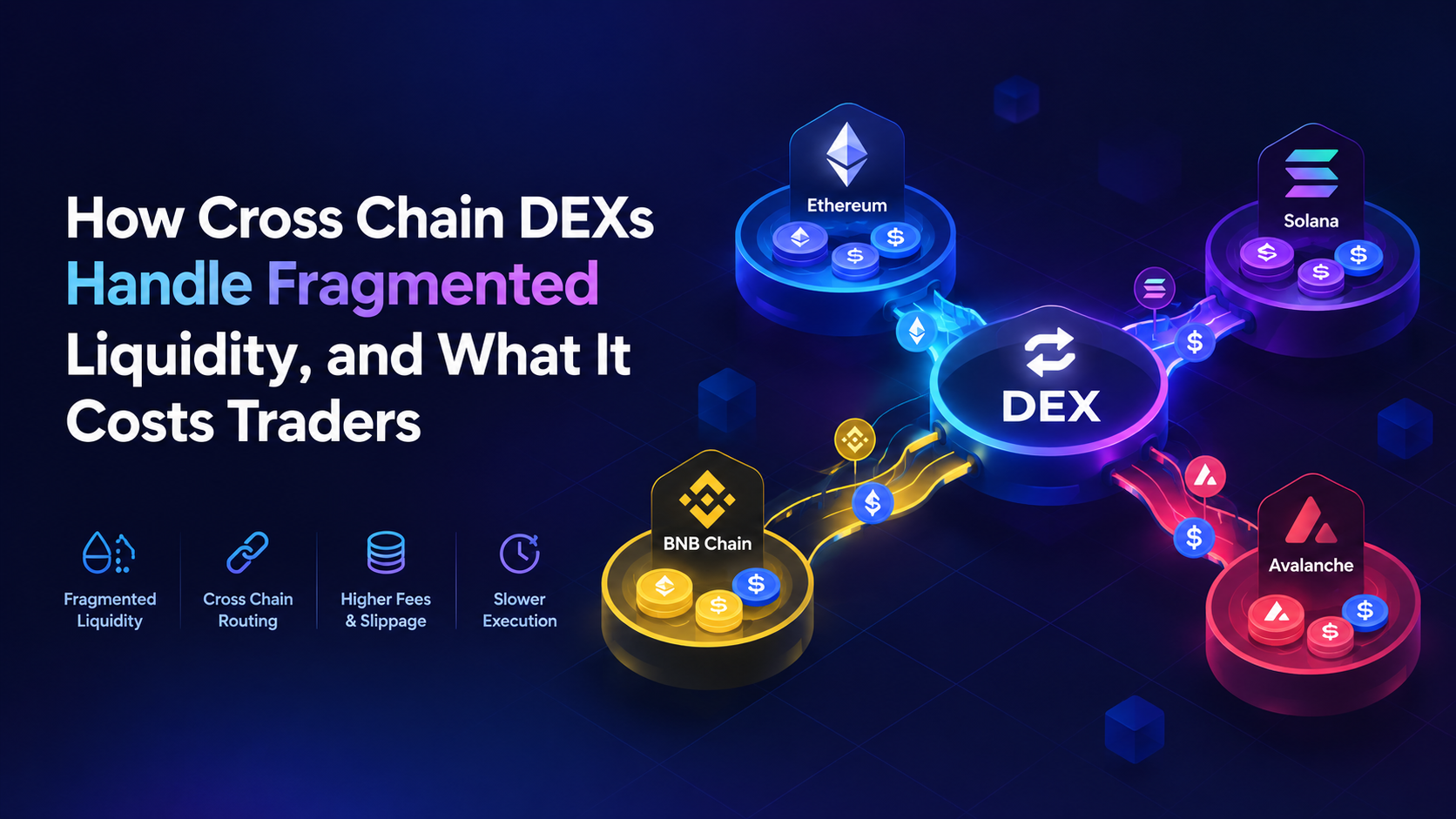
Liquidity in DeFi is spread across dozens of networks. One token can trade on BNB Chain, Base, Arbitrum, and Solana at the same moment, with a separate pool and a separate price on each. A cross-chain decentralized exchange tries to hide those borders. You hand it one asset on one chain, and it delivers a different asset on another in what looks like a single transaction.
How well that works depends on the plumbing underneath. Some cross-chain swaps route through bridges that lock tokens in a contract. Others rely on solvers who front their own capital and get repaid later. The difference shows up in the price you get and in what can go wrong, and most swap screens don't tell you which one you're using.
What Is a Cross-Chain DEX?
A cross-chain DEX is a decentralized exchange platform that lets users swap tokens across blockchains without bridging by hand first. You sign a transaction on the source chain, and the output token lands in your wallet on the destination chain.
On a single chain, a swap is one atomic smart contract call. Either the whole trade settles or none of it does. Separate blockchains don't share state, so a cross-chain crypto exchange has to coordinate two settlements that happen independently. That coordination is the hard part, and it's where designs split.
Why Does Liquidity Fragment Across Chains?
Every network keeps its own pools. USDC on Base and USDC on Arbitrum sit in different contracts, priced by different automated market makers and funded by different LPs. A $50,000 trade that would barely move a deep pool can cause real slippage on a thin one, even when the same pair is deep somewhere else.
Incentives make it worse. Protocols launching on a new chain usually pay liquidity incentives to bootstrap pools, so capital chases rewards instead of trading demand. DeFi ends up with plenty of total liquidity, split into pieces that can't see each other.
One recent response came from the venue side. Aerodrome and Velodrome merged to launch Aero, a spot exchange across seven networks: Ethereum mainnet, Base, Robinhood Chain, Ink, OP Mainnet, Arc, and Arbitrum. Aero also launched Metaswaps, designed to connect trading across those networks using its existing on-chain liquidity. It went live in late October 2026, so it's too early to say how it will perform at scale.
How Do Cross-Chain Token Swaps Work?
Most routes today follow one of two models.
Lock-and-Mint Bridges
The older model locks tokens in a contract on Chain A and mints a wrapped version on Chain B. A bridge between blockchains built this way holds a large amount of locked assets, making it a target for attackers. The Ronin Bridge exploit in 2022 resulted in losses of more than $600 million.
Intent-Based Settlement
Newer designs let you describe the result you want. Say you want to turn USDC on Base into CAKE on BNB Chain. A solver fills the order on the destination chain using its own inventory and gets reimbursed once the source transaction finalizes. In Across Protocol's version, a network of solvers pays users with its own funds on the destination chain and assumes the associated finality risk. Across follows the ERC-7683 framework for cross-chain intents.
PancakeSwap uses this approach. Its cross-chain swaps went live on June 11, 2025, through an Across integration. Across's announcement listed Arbitrum, Base, BNB Smart Chain, and Ethereum as supported networks. At launch, Cointelegraph reported average swap times of about three seconds.
In my view, intent-based routing is a better default for retail-sized trades because user funds don't need to sit in a shared pool waiting to be drained. It does add dependence on solver competition. On thin routes with few solvers, quotes can get wide.
What Should Traders Check Before a Cross-Chain Swap?
- Settlement model: Find out whether the route uses a lock-and-mint bridge, a messaging protocol, or a solver network. Each carries different trust assumptions.
- Destination liquidity: A quote is only as good as the pool on the other side. Check slippage on the output leg, not just the bridge fee.
- Total cost: Add gas on both chains, solver or bridge fees, and the swap fee. A cheap-looking quote can hide a wide spread.
- Refund path: Good routes return your funds on the source chain if a fill times out.
- Token form: Confirm whether you receive the native asset or a wrapped one, since wrapped tokens often have thinner markets.
How Different Platforms Approach the Problem
There's no single correct design, and major platforms have made different bets.
Raydium operates in the Solana ecosystem, offering token swaps and liquidity pools. Solana-based trading venues can help address fragmentation within the network by giving traders access to different pools and liquidity sources.
Jupiter works mostly within Solana. It's an aggregator that splits orders across Solana venues, including Orca's Whirlpools, which use concentrated liquidity so LPs can place capital inside chosen price ranges. Jupiter also runs a perpetual trading product. Its approach to fragmentation focuses on smart token routing across many pools on one fast chain.
PancakeSwap has expanded across multiple chains and added intent-based swaps between them. Aero is trying to bring one venue's liquidity under a single token and incentive system across several Ethereum-compatible networks.
Newer chains face fragmentation at its sharpest because they have to attract liquidity before local pools become deep. Dexlyn Labs is a DEX trading platform built on Supra, a newer Layer 1 blockchain. It was the first DEX on Supra and includes swaps, perpetual futures, liquidity pools, and a token launchpad, with governance tied to the DXLYN token. It also offers a cross-chain bridge connecting Supra to other networks. For a decentralized exchange on a newer chain, the bridge and the trading venue are tied together from day one, making it a useful case to watch.
The Limits Worth Admitting
Cross-chain swaps add moving parts. Every extra contract, relayer, or oracle is one more place where something can fail. Solver models reduce some custody risks but bring their own challenges: solvers can go offline, and routes to less popular chains often have only a handful of them. Wrapped assets also depend on the bridge that issued them remaining secure and solvent.
If you can make the trade on one chain with deep liquidity, that's usually still cheaper and simpler. Cross-chain features earn their place when the asset or market you want exists only somewhere else.
What This Means for DeFi Traders
The swap button looks the same on every decentralized trading platform. The route behind it doesn't. Before trading in size, look at where the output liquidity sits and how the transfer settles. Those two facts say more about your real cost than the headline fee.