How DEX Liquidity Providers Earn Fees and Manage Risk
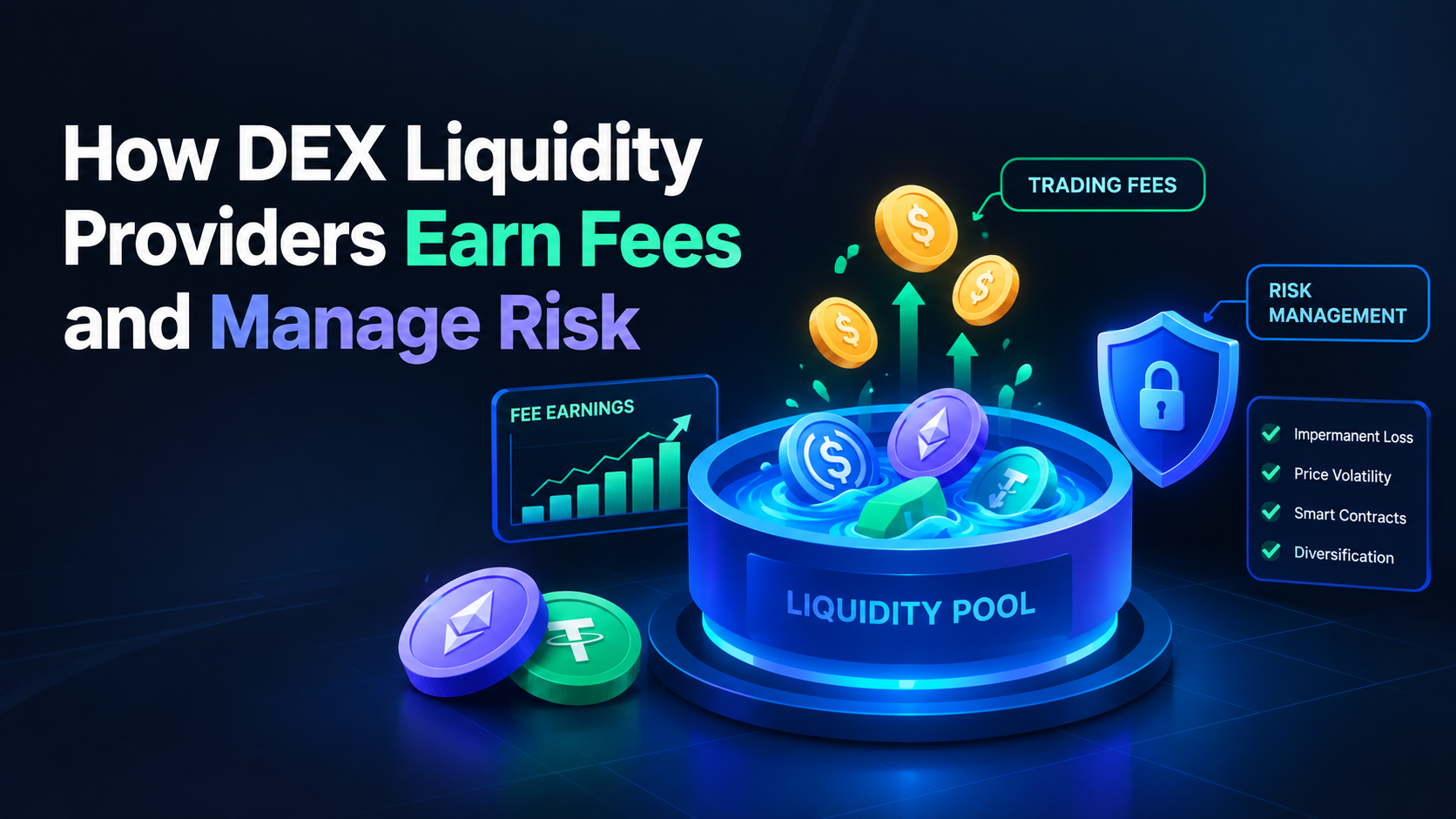
Liquidity providers are one of the key elements in decentralized finance. Traders must have assets on the opposite side of the trade when trading tokens on a decentralized exchange. Liquidity providers provide those assets to pools, and receive a percentage of trading fees in exchange.
Although the process seems straightforward, giving liquidity is more complex than just depositing two tokens and picking up the fees. The results can vary depending on the pool design, trading activity, price ranges, and volatility of the pool and incentive programs.
What Does a Liquidity Provider Do?
An LP, or liquidity provider, is a user of a smart-contract liquidity pool who puts assets into the liquidity pool. That pool is then used by the traders to swap one token for another.
For instance, you can find a pair of ETH and USDC in an ETH-USDC pool. If a trader sells ETH, he/she will get USDC in return and the pool will get the ETH from the trader.
The pool's pricing mechanism adjusts the relative value of the assets as trades take place.
This is in contrast to a more standard exchange in which buyers and sellers place their orders individually. The liquidity in an automated market maker (AMM) is stored in smart contracts and provided based on the liquidity rules of the AMM pool.
Where Do LP Fees Come From?
Every swap can generate a trading fee. Depending on the protocol's design, part of that fee can be distributed to liquidity providers.
The amount an LP earns depends on factors such as:
- Trading volume in the pool
- The pool's fee rate
- The LP's share of active liquidity
- How long the liquidity remains available
- The pool's incentive structure
A pool with large deposits but little trading activity may generate fewer fees than a smaller pool with frequent trading.
This is why total liquidity alone does not tell the full story about an LP position.
Dexlyn's liquidity-pool documentation describes swap fees as a source of rewards for liquidity providers. It also features a concentrated liquidity system which is used to determine some liquidity-mining rewards based on fee performance.
Concentrated Liquidity: What is it?
Traditional AMMs can provide liquidity over a broad price range. Concentrated liquidity is a feature that enables LPs to set a specific price range where their funds will be utilized.
Assume that an LP puts in $3,000 worth of liquidity into an ETH-USDC pair and sets an exit price range of $2,500 to $3,000.Suppose that an LP adds $3,000 worth of liquidity to an ETH-USDC pair and sets the exit price range at $2,500 to $3,000.
As long as the market price stays in that range, the position will be able to swap and earn fees. If the price moves outside the selected range, the position can become inactive for swaps.
Dexlyn's CLMM documentation describes this model using defined price ranges and positions. Its documentation also explains that liquidity outside the active range does not generate swap fees.
This creates a tradeoff. A tighter range may attract more money to the price areas where trading is likely to occur, but the trade may be dormant earlier if the market moves rapidly.
Why Trading Volume Matters
LP returns are closely connected to actual trading activity.
Imagine two pools:
Pool A
- $10 million liquidity
- $100,000 daily volume
Pool B
- $2 million liquidity
- $1 million daily volume
The second pool has less total liquidity but considerably more trading activity relative to its size.
This does not automatically mean Pool B is more profitable for every LP. Fee rates, price movements, incentive rewards and the LP's specific position all matter. It does show why looking only at TVL can give an incomplete picture.
For concentrated liquidity positions, where the capital sits can matter just as much as how much capital is supplied.
What is Impermanent Loss?
One of the primary risks that LPs should be aware of is impermanent loss.
It can occur when the relative prices of the assets in a liquidity position change compared with simply holding those assets in a wallet.
Consider an ETH-USDC pool. If ETH's market price changes substantially, the pool's automated pricing mechanism causes the quantities of ETH and USDC held by the LP position to change.
The LP may end up with a different asset mix than they would have had by simply holding the original tokens.
The loss is called "impermanent" because the difference can change as prices move. It becomes relevant when the position is withdrawn and compared with the alternative of holding the assets directly.
Concentrated liquidity can increase both the potential fee opportunity and the exposure to price movement within a selected range. Dexlyn's glossary specifically identifies impermanent loss as a risk for LPs and notes that concentrated liquidity can increase this exposure.
What Happens When Price Leaves an LP's Range?
This is one of the most important concepts for concentrated liquidity.
Suppose an LP selects a range of $2,500 to $3,000 for ETH.
If ETH rises above $3,000, the position can become inactive. If ETH falls below $2,500, it can also become inactive.
The position does not necessarily disappear. Instead, its liquidity is no longer active for swaps outside the selected range.
If an LP chooses to round the money around the new market price, then they will need to adjust, or even create, another position for the capital.
Concentrated liquidity will need more active management than just depositing assets into a broad pool of liquidity.
What do Liquidity Incentives mean?
There are some decentralized trading platforms that provide extra payouts to bring liquidity to specific pools.
These incentives can come in the form of protocol tokens or other rewards. They can encourage LPs to supply capital to markets that need deeper liquidity.
But incentive rewards should be evaluated separately from trading fees.
A position might receive token rewards while generating relatively little swap-fee income. Conversely, a pool with strong trading activity may generate meaningful fees without large external incentives.
Dexlyn documents a fee-based liquidity-mining model in which rewards are linked to the fees generated by individual liquidity positions rather than simply the amount of liquidity supplied.
What Should LPs Check Before Providing Liquidity?
Before adding funds to a decentralized exchange platform, LPs can examine:
- Trading volume: How frequently is the pool being used?
- Fee rate: What percentage of each swap goes toward LP fees?
- TVL: How much liquidity is already in the pool?
- Price range: For concentrated liquidity, where will the position remain active?
- Volatility: How quickly can the underlying assets move?
- Impermanent loss: What if the tokens' value changes?
- Incentive rewards: Will there be additional rewards, and what are they and what are the conditions?
- Smart-contract risk: What contracts does the deposited money go into?
- Withdrawal rules: Are there restrictions, charges or limitations for withdrawals?
Dexlyn's liquidity interface offers TVL, 24-hour volume, pool fees, and APR earned data, allowing LPs to have multiple metrics that they can review before managing their position.
Liquidity Provision is Not Just About Fees!
Liquidity providers are entities that provide liquidity to decentralized cryptocurrency exchanges, enabling them to trade assets. LPs can, in turn, receive fees and, in certain systems, additional incentives.
However, the return from an LP position is not just determined by the advertised APR, it's also affected by trading volume, fee rates, asset prices, range selection and impermanent loss.
These are the things that it is easier to understand if you are using a DEX trading platform to identify the liquidity that exists and the liquidity that is actively participating in the market.