Gin Market Size, Share and Trends Forecast 2026-2034
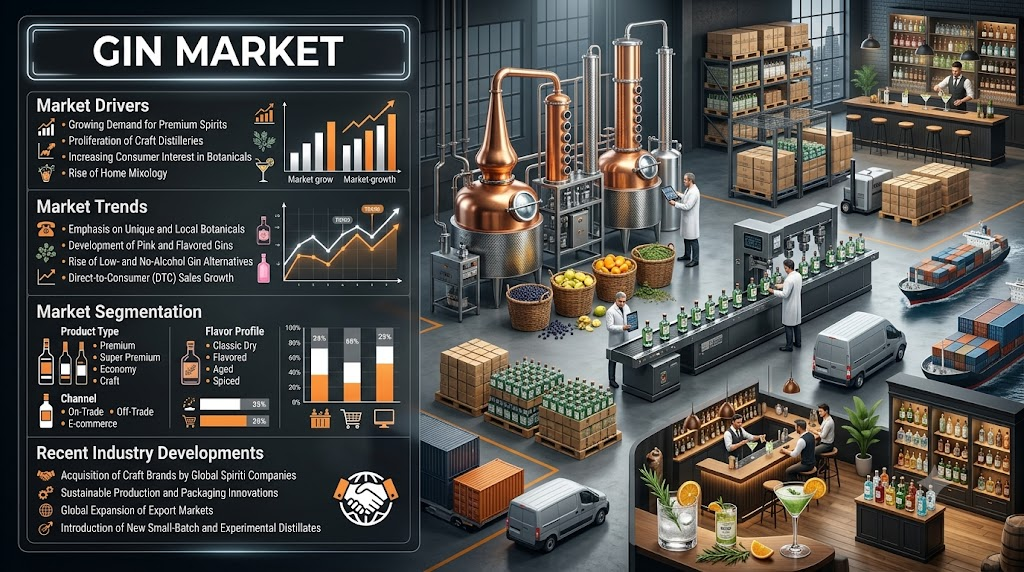
IMARC Group, a leading global market research and management consulting firm, has published its latest market intelligence report on the gin market. The global gin market size reached USD 17.3 Billion in 2025. Looking forward, IMARC Group expects the market to reach USD 24.1 Billion by 2034, exhibiting a growth rate (CAGR) of 3.65% during 2026-2034. driven by rising demand for premium and craft gin, growing popularity of gin-based cocktails, expansion of flavored and innovative gin varieties, growth in low-alcohol and non-alcoholic gin options, and rising emphasis on sustainable and eco-friendly production practices.
The market is on a steady growth path underpinned by a global shift toward premiumization, experiential drinking, and craft distillation culture. Consumers are increasingly favoring quality over quantity, gravitating toward small-batch, botanically distinctive gins over mass-produced alternatives, a trend that continues to reshape category economics across mature and emerging markets alike. Europe remains the cultural and commercial heart of the industry given its deep distilling heritage, while premium and craft producers globally are capturing a disproportionate share of value growth even as volume growth stays modest. London dry gin continues to anchor the category on the strength of its regulated production standards and universal cocktail versatility, while premium pricing tiers and on-trade consumption occasions increasingly define where brands compete hardest for share.
Gin Market at a Glance:
- Market Size 2025: USD 17.3 Billion
- Forecast Size 2034: USD 24.1 Billion
- Growth Rate 2026-2034: CAGR of 3.65%
- Leading Type: London Dry Gin, largest share by type in 2025
- Leading Price Point: Premium, largest share by price point in 2025
- Dominant Region: Europe, the largest regional market for gin
How AI is Reshaping the Future of the Gin Market
- AI-Generated Botanical Recipes: UK-based Circumstance Distillery trained a neural network called Ginette on thousands of botanical profiles and gin recipes to co-create "Monker's Garkel," described as an AI-assisted gin, illustrating how machine learning is entering the earliest stages of product formulation.
- AI-Accelerated Flavor R&D: Beverage R&D teams are using AI to compress flavor development cycles from 6-12 months down to 3-5 months, scanning global flavor databases to surface unconventional botanical pairings that human flavorists had not previously considered.
- AI-Driven Production and Quality Control: Distilleries are deploying AI-enabled vision and sensor systems for bottling consistency and quality control, while operations teams report AI-driven process efficiencies cutting overhead costs by an estimated 10-15%, helping offset margin pressure from rising excise duties.
Grab a sample PDF of this report: https://www.imarcgroup.com/gin-market/requestsample
Gin Market Trends and Drivers:
Rising consumer preference for premium and craft gin is the foundational driver of category growth, with premium gin already accounting for close to 40% of global category revenue as drinkers prioritize distinctive botanicals, artisanal production stories, and small-batch craftsmanship over mass-market volume brands. This premiumization wave is reinforced by the expansion of flavored and innovative gin varieties, which industry data attributes with roughly 40% of total gin sales growth, as producers experiment with berry, spice, herb, and exotic fruit infusions to capture increasingly adventurous drinkers.
A structural, global differentiator shaping the category is the regulatory protection built around authenticity and provenance. The European Union's spirit drinks framework recognizes 47 regulated spirit categories and roughly 250 geographical indications, including gin-linked designations, with GI-protected spirit exports contributing over EUR 9.7 Billion to the EU's positive trade balance and supporting approximately 1.2 million direct jobs, reinforcing why heritage and appellation matter commercially, not just culturally, to gin producers. Alongside authenticity, the rapid growth of online and direct-to-consumer sales channels, up an estimated 42% in a single recent year, is giving both global brands and small distilleries new routes to reach consumers without traditional retail gatekeeping.
Regulatory and fiscal policy is increasingly the swing factor in category profitability, a dynamic that spans Europe, North America, and Asia and is detailed further below. Rising excise duties in mature markets are compressing margins even as premiumization lifts average selling prices, pushing producers toward scale, direct distribution, and operational efficiency to protect profitability.
Global Regulatory, Trade, and Sustainability Landscape Shaping Demand:
- EU Geographical Indication Protection for Spirits: Regulation (EU) 2024/1143, in force since May 2024, harmonizes registration for roughly 250 spirit geographical indications including gin-linked designations, strengthening online protection and empowering producer groups to enforce authenticity claims that underpin premium pricing.
- UK Alcohol Duty Reform and Small Producer Relief: The UK's strength-based alcohol duty system, in effect since August 2023, raised rates by a further 4.3% from February 2026 in line with inflation, while continuing to uprate Small Producer Relief for craft distillers under 8.5% ABV, a critical buffer for the country's craft gin sector.
- US Federal Excise Tax Structure on Spirits: US distillers paid USD 6.7 Billion in federal excise taxes in 2024 alone, with more than 52% of a typical spirits bottle's price now going toward combined federal, state, and local taxes, a structural cost pressure shaping pricing and consolidation across the more than 3,100 US distilleries.
- India's State-Level Excise Liberalization: Indian states are recalibrating excise frameworks to capture premiumization, with Karnataka targeting Rs 40,000 Crore in excise revenue for 2026 and Uttar Pradesh targeting Rs 63,000 Crore off a record 100 functional distilleries, creating a more structured, if fragmented, regulatory runway for gin and other premium spirits.
Key Government Schemes and Policy Programs Supporting the Industry:
- European Union, Geographical Indications Regulation (EU) 2024/1143: In force since 13 May 2024, this regulation creates a single EU-wide registration procedure covering close to 3,700 registered geographical indications for spirits, wine, and agricultural products, strengthening legal protection for gin-linked designations such as Plymouth Gin against imitation.
- United Kingdom, Small Producer Relief and APPA Reform: HMRC's Small Producer Relief, uprated alongside the February 2026 duty increase, continues to reduce the tax burden on craft spirits producers under 8.5% ABV, while the new Alcohol Product Producer Approval system, refined through industry roundtables held in May 2026, has simplified compliance for the UK's craft gin distilleries.
- United States, TTB Craft Distiller Excise Tax Tiers: The federal excise tax structure taxes the first 100,000 proof gallons at a reduced USD 2.70 per proof gallon versus the standard USD 13.50 rate, a tiered relief mechanism that continues to support the more than 3,100 US distilleries, most of them small and craft-scale producers.
- India, Karnataka and Uttar Pradesh Excise Policy Recalibration: Karnataka's 2026 Alcohol-in-Beverage excise system ties duty directly to alcohol strength and targets Rs 40,000 Crore in revenue, while Uttar Pradesh's 2025-26 excise policy targets Rs 63,000 Crore in revenue from a record 100 functional distilleries, both creating more transparent, premiumization-friendly frameworks for gin producers entering the Indian market.
- Rajasthan, India, Excise Policy 2026-27: Rajasthan's excise policy raised annual guarantee amounts for retail licenses by 12.5% and wholesale ex-distillery prices by 5%, while simplifying processes for manufacturing units, directly affecting gin and other spirits pricing and distribution in the state.
Gin Industry Segmentation:
The report has segmented the market into the following categories:
Breakup By Type:
- London Dry Gin
- Old Tom Gin
- Plymouth Gin
- Others
London dry gin holds the largest gin market share due to its established reputation for quality and consistency. It adheres to strict production standards, ensuring a distinct and reliable flavor profile built around traditional botanicals, primarily juniper, and a consistent distillation process. Its versatility in cocktails, historical significance, and sustained marketing investment by major brands continue to bolster its leading position among gin enthusiasts globally.
Breakup By Price Point:
- Standard
- Premium
- Luxury
Premium gin is the largest segment in the global market, driven by consumers' increasing preference for high-quality spirits with unique flavors and superior ingredients. The growing trend of craft cocktails and mixology has fueled demand for premium gin, which is closely associated with superior craftsmanship and artisanal production, while heavy brand marketing investment continues to position premium and super-premium gin as a status symbol commanding higher price points.
Breakup By Distribution Channel:
- On-trade
- Off-trade
On-trade channels represent the leading distribution segment, driven by the experiential and social appeal of consuming gin in bars, restaurants, and clubs. These venues offer curated gin experiences and exclusive cocktails crafted by skilled mixologists, with rising gin-based events and promotions fostering brand loyalty and driving higher per-occasion consumption relative to off-trade retail.
Breakup By Region:
- North America (United States, Canada)
- Europe (Germany, France, United Kingdom, Italy, Spain, Russia, Others)
- Asia Pacific (China, Japan, India, South Korea, Australia, Indonesia, Others)
- Latin America (Brazil, Mexico, Others)
- Middle East and Africa
Europe is the largest regional market for gin due to its rich history and deep cultural association with gin production and consumption. The region hosts several renowned gin-producing countries, including the UK, Spain, and the Netherlands, each with strong heritage distilleries, while the popularity of gin-based cocktails and continuous premiumization trends sustain robust demand. Extensive distribution networks and marketing investment by both global and craft brands further reinforce Europe's dominant position.
Competitive Landscape:
The report provides a comprehensive analysis of the competitive landscape in the gin market with detailed profiles of key companies, including:
- Bacardi Limited
- Davide Campari-Milano N.V.
- Diageo plc
- Forest Spirits by La Hanoudière
- Lucas Bols N.V.
- Mygin
- Pernod Ricard
- Radico Khaitan Ltd.
- Rémy Cointreau
- San Miguel Corporation
- The East India Company Ltd.
- William Grant & Sons Ltd.
Consolidation activity remains steady among global majors seeking to expand premium and craft footprints: Pernod Ricard completed full acquisition of South African craft gin maker Inverroche in February 2025, positioning it as the group's first wholly owned African spirit brand, and is separately investing EUR 25 Million to expand premium gin production capacity at its Miltonduff site in Scotland, while Diageo India took a majority controlling stake in craft gin maker NAO Spirits at an enterprise value of roughly Rs 130 Crore in June 2025.
Market Concentration Analysis:
- Highly Fragmented Globally, Consolidating at the Premium Tier: The global gin market remains highly fragmented, with major conglomerates such as Diageo, Pernod Ricard, and Bacardi competing alongside hundreds of regional craft labels, including over 400 Argentine and roughly 200 Brazilian craft distilleries, even as premium-tier M&A activity accelerates.
- Premiumization Driving Selective Acquisitions: Established players are prioritizing bolt-on acquisitions of craft and regional gin brands, such as Pernod Ricard's Inverroche deal and Diageo India's NAO Spirits stake, over organic volume growth, reflecting a strategic pivot toward margin-accretive premium and super-premium segments.
- Vertical Integration Reshaping Distribution Economics: Major players are reclaiming distribution control from joint ventures and intermediaries, exemplified by Pernod Ricard's 2024 recovery of Tanqueray and Gordon's distribution rights in France, a trend aimed at protecting margins as excise duties rise across key markets.
What Does The Full Report Cover?
- Complete market sizing with revenue forecasts covering the full 2020-2034 projection period
- Quantified growth driver analysis with impact scoring across type, price point, distribution channel, and regional markets
- Sub-segment breakdowns for London dry gin, old tom gin, Plymouth gin, and other types with individual share data
- Country-level data for the United States, Canada, Germany, France, United Kingdom, Italy, Spain, Russia, China, Japan, India, South Korea, Australia, Indonesia, Brazil, and Mexico
- Competitive and key company profiles with strategic landscape assessment
- Porter's Five Forces, value chain analysis, and technology landscape mapping
- Investment and growth opportunity mapping across premiumization, flavored gin innovation, and direct-to-consumer expansion
Recent News and Developments in Gin Market
- June 2025: Diageo India announced a majority controlling stake in craft gin maker NAO Spirits at an enterprise value of approximately Rs 130 Crore, strengthening its position in India's fast-growing premium craft gin segment.
- February 2025: Pernod Ricard completed full acquisition of South African craft distillery Inverroche, establishing it as the group's first wholly owned African spirit brand after initially acquiring a majority stake in 2019.
- February 2026: Pernod Ricard's Beefeater brand invested in a global "Spirit of London" marketing campaign and launched grapefruit-flavored and alcohol-free variants, part of a broader push to defend share amid slowing category volume growth.
- 2026: Pernod Ricard confirmed a EUR 25 Million investment to expand premium gin production capacity at its Miltonduff distillery in Scotland, directly targeting growing global demand for premium and super-premium gin.
- 2025-2026: Bombay Sapphire recorded a 1.8% volume decline in 2025, moderating from a 4.6% contraction the prior year, reflecting intensifying competitive pressure among global premium gin brands.
Note: If you require specific details, data, or insights that are not currently included in the scope of this report, we are happy to accommodate your request. As part of our customization service, we will gather and provide the additional information you need, tailored to your specific requirements. Please let us know your exact needs, and we will ensure the report is updated accordingly to meet your expectations.
Key Questions This Report Answers
- What is the current global gin market size and what is its projected value?
- Which type and price-point segments hold the largest share in the global gin market?
- What are the key drivers of global gin market growth?
- Which region dominates the global gin market and why?
- How are excise duty reforms and geographical indication protections reshaping gin industry economics worldwide?
- Who are the top companies in the global gin market and what are their competitive strategies?
- What are the investment and market entry opportunities across premiumization, flavored gin innovation, and direct-to-consumer channels?
About Us:
IMARC Group is a global management consulting firm that helps the world's most ambitious changemakers to create a lasting impact. The company provides a comprehensive suite of market entry and expansion services. IMARC offerings include thorough market assessment, feasibility studies, company incorporation assistance, factory setup support, regulatory approvals and licensing navigation, branding, marketing and sales strategies, competitive landscape and benchmarking analyses, pricing and cost research, and procurement research.
Media and Sales Contact
IMARC Group
Email: sales@imarcgroup.com
United States: +1-201-971-6302
India: +91-120-433-0800
United Kingdom: +44-753-714-6104