Tequila Market Size, Share and Trends Forecast 2026-2034
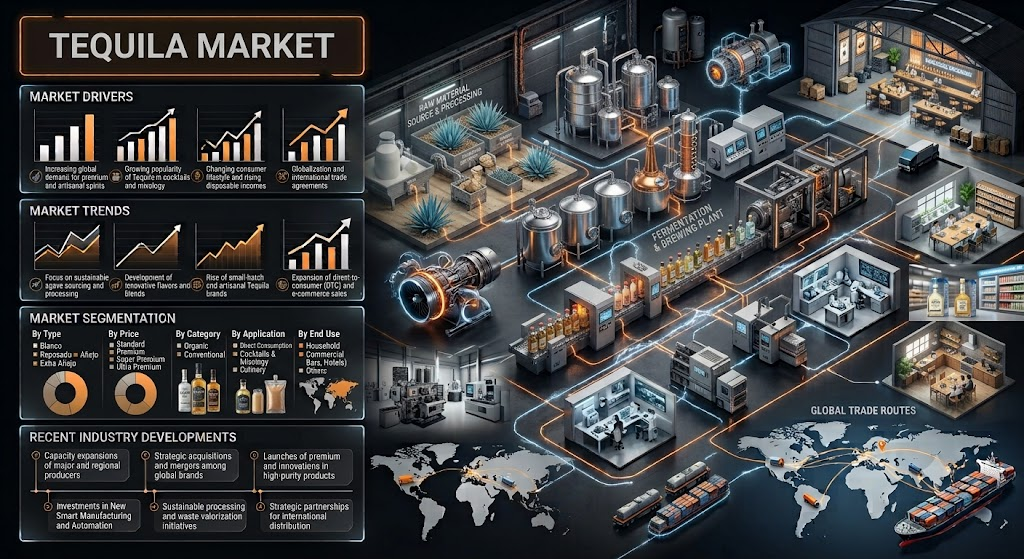
IMARC Group, a leading global market research and management consulting firm, has published its latest market intelligence report on the tequila market. The global tequila market size was valued at USD 20.3 Billion in 2025. Looking forward, IMARC Group estimates the market to reach USD 47.8 Billion by 2034, exhibiting a CAGR of 9.99% from 2026-2034. driven by rising consumer preference for premium and artisanal spirits, expanding cocktail and mixology culture, a wave of celebrity-backed brand launches, and growing e-commerce penetration for alcoholic beverages worldwide.
The market is on a sustained premiumization trajectory, underpinned by a structural shift in consumer preference from value tequila toward 100% agave, premium, and ultra-premium expressions. North America continues to anchor global demand, with the United States importing tequila worth roughly USD 5.2 Billion in 2024 alone, while producers increasingly favor vertically integrated, estate-owned agave supply chains to manage the crop's multi-year boom-bust price cycles. Blanco remains the largest product-type segment given its affordability and versatility in cocktails, even as aged and ultra-premium categories grow fastest on the back of younger consumers' willingness to pay more for authenticity and craftsmanship.
Tequila Market at a Glance:
- Market Size 2025: USD 20.3 Billion
- Forecast Size 2034: USD 47.8 Billion
- Growth Rate 2026-2034: CAGR of 9.99%
- Leading Product Type: Blanco, largest share in 2025 on unaged, versatile appeal
- Leading Purity Segment: 100% Tequila, largest share in 2025
- Dominant Region: North America, currently leading the global market
How AI is Reshaping the Future of the Tequila Market
- AI-Driven Agave Maturity and Yield Prediction: Distilleries are deploying drone-based field monitoring, IoT soil sensors, and AI-driven maturity prediction models to manage blue agave's six-to-eight-year growth cycle, helping producers time harvests more precisely and reduce exposure to the industry's notorious boom-bust price swings.
- AI-Powered Quality and Maturation Analysis: Researchers have applied artificial neural networks to UV-Vis spectroscopy, gas chromatography, and colorimetric imaging data to evaluate the physicochemical and color profile of 100% agave tequila during maturation, offering distillers a data-driven alternative to purely manual quality assessment.
- AI-Enhanced Supply Chain and Inventory Planning: Vertically integrated operators are combining per-parcel agave data with AI-enhanced yield forecasting, climate-adjusted harvest scheduling, and automated standard operating procedures, while spirits producers more broadly are adopting AI-based inventory management platforms to plan long-horizon aging stock against forecast demand.
Grab a sample PDF of this report: https://www.imarcgroup.com/prefeasibility-report-tequila-manufacturing-plant/requestsample
Tequila Market Trends and Drivers:
Consumer demand for premium and artisanal tequila is a foundational driver, with 54% of consumers aged 18-34 expressing a preference for premium tequila as the category shifts decisively toward 100% agave products. Pernod Ricard's 2022 acquisition of a controlling interest in Código 1530 Tequila and the continued expansion of ultra-premium lines by major spirits conglomerates underscore how firmly premiumization has taken hold across the industry, with tequila's versatility as both a sipping spirit and a cocktail base broadening its appeal across demographics.
E-commerce and celebrity-driven brand building are reinforcing this premium shift globally. Online beverage-alcohol sales reached USD 27 Billion in value in 2020 alone, a trend accelerated by pandemic-era shifts toward home consumption, while celebrity-backed brands such as Kevin Hart's Gran Coramino posted more than 80% year-on-year sales growth in 2025 on USD 85 Million in annual sales. As a Denomination of Origin spirit, tequila's supply is structurally concentrated in Mexico's five authorized states, a regulatory protection that also underpins its premium positioning internationally.
Government trade policy is directly shaping where and how fast tequila demand grows internationally, a dynamic that spans North America, Asia, and Europe and is detailed further below. USMCA-compliant tequila continues to enter the United States, the industry's largest market, duty-free, while several Asian and European markets are only now beginning to ease tariff barriers on imported spirits, setting up a more favorable trade environment for tequila exporters through the next decade.
Global Regulatory, Trade, and Sustainability Landscape Shaping Demand:
- Mexico's Denomination of Origin and NOM-006 Standard: Tequila production is legally restricted to five Mexican states under Mexico's Denominación de Origen framework and NOM-006-SCFI-2012, enforced by the Consejo Regulador del Tequila (CRT), with 100% agave tequila required to be bottled in Mexico before export, a structural moat that international producers cannot replicate.
- USMCA Duty-Free Access to the US Market: As of 2026, Mexico accounts for approximately 47.3% of all US spirits imports by value, with USMCA-compliant tequila entering duty-free while non-compliant or non-USMCA origins face tariffs of roughly 10% or higher, giving certified producers a significant structural cost advantage.
- CRT Sustainability Commitments: The Tequila Regulatory Council has set an industry-wide goal for 100% of tequila production to be certified deforestation-free by 2027, reflecting mounting ESG scrutiny of agave land-use practices in Jalisco and neighboring states.
- EU and UK Recognition of Tequila's Protected Status: The European Union and post-Brexit United Kingdom both recognize tequila's Denomination of Origin, allowing premium brands to expand duty-free in the UK and supporting double-digit import growth in markets such as Spain, where premium tequila now accounts for over half of European tequila value.
Key Government Schemes and Policy Programs Supporting the Industry:
- India, Spirits Tariff Reduction under Trade Agreements: India's 2026 free trade agreements have begun cutting historically prohibitive spirits tariffs, with duties on spirits from the EU falling from 150% to 40% and bourbon whiskey duty cut to 50% from 150% under a separate 2025 notification, establishing a template that is expected to ease market entry for other imported spirits, including tequila, as India's premiumizing alcohol market expands.
- United States, USMCA Preferential Market Access: Tequila's duty-free status under the USMCA, combined with mandatory TTB Federal Basic Importer Permits and FDA Prior Notice filings, has helped US tequila imports grow by 1,400% between 2000 and 2024, from USD 350 Million to USD 5.4 Billion, cementing the US as the industry's anchor growth market.
- European Union, Tequila Denomination of Origin Recognition: The EU's formal recognition of tequila's Denomination of Origin protects the category from imitation "agave spirit" products and underpins premium positioning, supporting import growth of premium tequila to over half of total European tequila value in key markets like Spain and the UK.
- Mexico, CRT Certification and Export Licensing Framework: Mexico's CRT-administered export certification process, which includes mandatory Certificates of Authenticity and a formal permit costing approximately USD 1,200 per shipment, ensures traceability across the roughly 527 Million liters of tequila Mexico produced in 2021, a volume up approximately 405% over the preceding two and a half decades.
Tequila Industry Segmentation:
The report has segmented the market into the following categories:
Breakup By Product Type:
- Blanco
- Joven
- Mixto Gold
- Reposado
- Anejo
- Extra Anejo
Blanco accounts for the majority of the market share, driven by its versatile, unaged profile, pure agave flavor, and affordability relative to aged varieties, making it a staple in cocktails and mixology culture as well as a preferred entry point for new consumers.
Breakup By Purity:
- 100% Tequila
- 60% Tequila
The 100% tequila segment holds the largest market share, reflecting rising consumer awareness of ingredient authenticity and a preference for premium spirits made entirely from blue agave without additives, a trend reinforced by clean-label marketing and connoisseur demand.
Breakup By Price Range:
- Premium Tequila
- Value Tequila
- Premium and Super-Premium Tequila
- Ultra-Premium Tequila
Premium and super-premium tequila leads the price-range segment, driven by consumer willingness to pay for meticulous production processes, longer aging, and hand-selected agave, with brands leaning on exclusivity and limited-edition releases to reinforce this positioning in high-end bars and retail.
Breakup By Distribution Channel:
- Off-Trade (Supermarkets and Hypermarkets, Discount Stores, Online Stores, Others)
- On-Trade (Restaurants and Bars, Liquor Stores, Others)
On-trade channels lead the distribution segment, as restaurants, bars, and liquor stores provide an experiential setting where bartenders and sommeliers actively educate consumers on tequila types and pairings, reinforcing its role as a preferred beverage for social and celebratory occasions.
Breakup By Region:
- North America (United States, Canada)
- Asia Pacific (China, Japan, India, South Korea, Australia, Indonesia, Others)
- Europe (Germany, France, United Kingdom, Italy, Spain, Russia, Others)
- Latin America (Brazil, Mexico, Others)
- Middle East and Africa
North America leads the regional landscape on the back of robust consumer demand and established distribution systems, with the United States alone importing distilled spirits worth USD 12 Billion in 2022, according to the USDA. Europe is emerging as a fast-growing secondary market, with Germany importing approximately 4 Million liters of tequila annually and Spain importing close to 3 Million liters, while Latin America benefits from Mexico's own production base of 527 Million liters in 2021, and the Middle East and Africa region is scaling on rising premium spirits demand tied to a young, increasingly affluent demographic.
Competitive Landscape:
The report provides a comprehensive analysis of the competitive landscape in the tequila market with detailed profiles of key companies, including:
- Bacardi Limited
- Becle SAB de CV
- Brown-Forman Corporation
- Casa Aceves
- Clase Azul México
- Diageo Plc
- Heaven Hill Brands
- Pernod Ricard S.A.
- Sazerac Company Inc.
- Suntory Holdings Limited
The competitive landscape is fragmented at the base but increasingly concentrated at the top: Becle (Jose Cuervo, 1800) remains the undisputed global leader with an estimated 29% market volume share, roughly twice that of its closest competitor, while Diageo (Don Julio, Casamigos) holds around 9% share, Pernod Ricard (Olmeca Altos, Código 1530) around 4%, and Bacardi (Patrón) around 3%. Celebrity-backed entrants continue to reshape the mid-tier, with Kendall Jenner's 818 Tequila, valued at an estimated USD 200-400 Million, securing a minority investment and exclusive US distribution deal from Sazerac in April 2026.
Market Concentration Analysis:
- Fragmented at the Base, Consolidating at the Top: While thousands of small and artisanal brands compete for shelf space, the top four global conglomerates, Becle, Diageo, Pernod Ricard, and Bacardi, collectively hold approximately 45% of global volume share, with large spirits groups actively acquiring premium and celebrity-backed brands to expand portfolio reach.
- Celebrity Brand Economics Maturing: The celebrity tequila boom that produced landmark exits like Diageo's up-to-USD-1-Billion acquisition of Casamigos is cooling, with overall category growth expected to settle near just 1% by mid-2026 even as standout brands like Gran Coramino continue to outgrow the category roughly eightyfold.
- Agave Price Cycles Reshaping Producer Strategy: Blue agave prices collapsed from roughly MXN 30 per kilogram at their 2021 peak to as low as MXN 2-5 per kilogram by 2026, prompting vertically integrated producers to lock in long-term agave supply through estate ownership ahead of the next anticipated price peak later this decade.
What Does The Full Report Cover?
- Complete market sizing with revenue forecasts covering the full 2020-2034 projection period
- Quantified growth driver analysis with impact scoring across product type, purity, price range, distribution channel, and regional markets
- Sub-segment breakdowns for Blanco, Joven, Mixto Gold, Reposado, Anejo, and Extra Anejo with individual share data
- Country-level data for the United States, Canada, Germany, France, United Kingdom, Italy, Spain, Russia, China, Japan, India, South Korea, Australia, Indonesia, Brazil, and Mexico
- Competitive and key company profiles with strategic landscape assessment
- Porter's Five Forces, value chain analysis, and technology landscape mapping
- Investment and growth opportunity mapping across premiumization, e-commerce distribution, and emerging-market expansion
Recent News and Developments in Tequila Market
- August 2026: Kevin Hart's Gran Coramino tequila brand continued its rapid expansion, having posted over 80% year-on-year sales growth in 2025 on USD 85 Million in annual sales and having moved 3.6 million bottles in its first three years on the market.
- May 2026: Actors Aaron Paul and Bryan Cranston expanded their Dos Hombres spirits portfolio into tequila, partnering with Tequilera TAP Distillery in Jalisco to launch a Blanco priced at USD 39 and a Reposado priced at USD 49.
- April 2026: Sazerac, owner of Fireball and Buffalo Trace, took a minority investment stake in Kendall Jenner's 818 Tequila and became its exclusive US distributor, with the brand valued at an estimated USD 200-400 Million.
- April 2026: Becle SAB de CV (Jose Cuervo, 1800), the global market volume leader with an estimated Enterprise Value of approximately USD 4.7 Billion, signaled a challenging 2026 tied to the restructuring of its US distribution network amid softer North American spirits demand.
- December 2024: Louis Vuitton-Moët Hennessy introduced Volcan de Mi Tierra, a high-end additive-free tequila brand made from 100% Blue Weber Agave, in India, spanning Blanco, Reposado, Cristalino, and Volcan X.A expressions.
Note: If you require specific details, data, or insights that are not currently included in the scope of this report, we are happy to accommodate your request. As part of our customization service, we will gather and provide the additional information you need, tailored to your specific requirements. Please let us know your exact needs, and we will ensure the report is updated accordingly to meet your expectations.
Key Questions This Report Answers
- What is the current global tequila market size and what is its projected value?
- Which product type and purity segments hold the largest share in the global tequila market?
- What are the key drivers of global tequila market growth?
- Which region dominates the global tequila market and why?
- How are trade agreements and tariff reductions reshaping tequila export opportunities worldwide?
- Who are the top companies in the global tequila market and what are their competitive strategies?
- What are the investment and market entry opportunities across premiumization, e-commerce, and emerging-market expansion?
About Us:
IMARC Group is a global management consulting firm that helps the world's most ambitious changemakers to create a lasting impact. The company provides a comprehensive suite of market entry and expansion services. IMARC offerings include thorough market assessment, feasibility studies, company incorporation assistance, factory setup support, regulatory approvals and licensing navigation, branding, marketing and sales strategies, competitive landscape and benchmarking analyses, pricing and cost research, and procurement research.
Media and Sales Contact
IMARC Group
Email: sales@imarcgroup.com
United States: +1-201-971-6302
India: +91-120-433-0800
United Kingdom: +44-753-714-6104