Buy gold exposure (futures/ETFs) and short miners against it - a classic dispersion trade
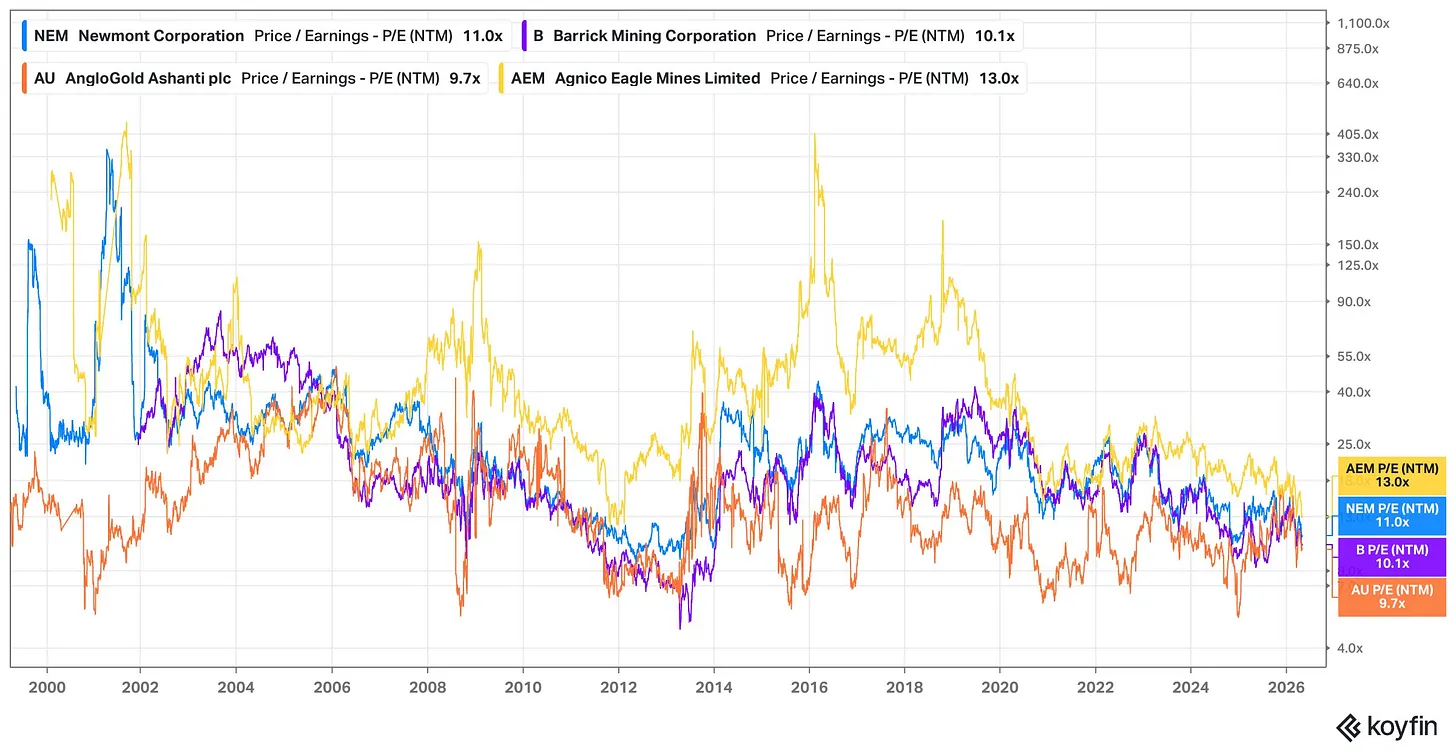
What looks cheap in gold miners usually carries a long memory rather than a hidden bargain. Across the sector (Newmont Corporation, Barrick Mining Corporation, Agnico Eagle Mines Limited, AngloGold Ashanti plc) multiples sit in a tight, unimpressive range despite a supportive macro backdrop. Investors see the same numbers everyone else sees, but they refuse to assign higher valuations, because past cycles taught them how quickly attractive margins fade and how reliably capital gets misallocated when conditions look strongest.
The sequence begins with a rise in gold, often driven by falling real yields, liquidity injections or geopolitical tension that pushes capital toward safety. Mining companies experience a sharp improvement in reported profitability, because the selling price of gold adjusts immediately while their cost base reacts with a delay. Earnings expand, free cash flow improves and for a brief window the equities behave like leveraged exposure to the metal, drawing in momentum capital and optimistic forecasts that extrapolate recent gains too far into the future.
That window closes at first, then all at once. Energy prices climb alongside the broader commodity cycle, labor becomes more expensive, suppliers reprice contracts and governments take a larger share through taxes and royalties once profits rise. Within a relatively short period, the cost base catches up, compressing margins even if the gold price holds steady, which turns the earlier earnings surge into something far less durable than it appeared during the initial upswing.
The more damaging layer comes from management decisions taken at precisely the wrong moment in the cycle. When cash flow peaks and balance sheets look strongest, companies tend to expand aggressively, acquiring assets at elevated valuations, approving projects that only make sense under optimistic price assumptions and committing capital with a confidence that rarely survives the next downturn. This pattern played out in full before the 2011-2013 gold market downturn, when years of spending and deal-making collided with a falling gold price and exposed how fragile those returns really were.
The unwind leaves a deeper imprint than the rally that precedes it. Revenues fall quickly when gold declines, while costs remain elevated for longer than expected, squeezing margins from both sides and forcing companies to write down assets, repair balance sheets and dilute shareholders. Investors who lived through that phase remember that the downside in mining equities tends to exceed the move in gold itself, because operational leverage and prior decisions amplify every negative shift in the underlying commodity.
This memory shapes how large funds position today. Gold itself offers a direct expression of macro views, reacting cleanly to interest rates, currency dynamics and systemic risk, while miners introduce layers of uncertainty tied to execution, geography and capital allocation. Many institutions therefore prefer to hold gold through futures or ETFs while shorting mining equities, capturing the macro upside while hedging against the industry’s tendency to erode its own gains over time.
Such positioning keeps valuations anchored even when the broader narrative appears favorable. Investors assume that a portion of future cash flow will be reinvested at poor terms, absorbed by rising costs or exposed to political shifts in the regions where mines operate. The discount reflects caution built over multiple cycles, reinforced each time the industry repeats the same sequence of margin expansion, aggressive spending and painful correction.