Digital vs Physical Card Games: Pros and Cons
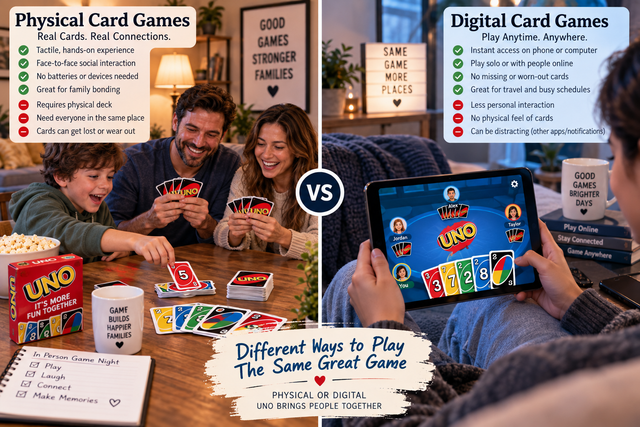
There used to be only one way to play a card game. You needed an actual deck, a flat surface, and enough people in the same room to make it worthwhile. Now that same game might live on your phone, playable during a commute or a quiet moment between errands, with no cards, no table, and sometimes no other humans required at all. Both versions have real strengths, and neither one has fully replaced the other, which says something about what each format offers that the other simply cannot.
This article looks at the convenience of digital card games, the tactile appeal that keeps physical decks relevant, a hybrid approach a lot of players end up settling into, and a few of the better digital Uno options worth trying if you want to give the online format a shot.
Convenience of Digital Play
The biggest advantage digital card games offer is simply accessibility. A physical deck requires you to actually have it with you, in decent condition, with all fifty two or however many cards intact. A digital version lives on a device you are probably already carrying anyway, ready to go the moment you open an app or load a website.
This convenience matters most in situations where a physical game simply is not realistic. Waiting at an airport, riding public transportation, or squeezing in a few minutes during a lunch break are all moments where pulling out a phone for a quick round beats trying to find a table and enough players for a physical game. Digital versions also solve the perpetual problem of missing cards, since a worn deck that has lost a stray card or two over the years becomes a genuine annoyance during physical play in a way that never happens digitally.
Matchmaking is another meaningful convenience. Many digital platforms let you play against computer opponents or get matched with random players online, removing the need to gather a specific group of people in one place at one time. According to IGN's roundup of top mobile card games, this always available matchmaking has been one of the biggest drivers behind the rising popularity of digital card games generally, since it removes the single biggest barrier that physical games have always faced, which is simply finding enough willing players at the same time.
Tactile Appeal of Physical Cards
Despite all the convenience digital versions offer, physical cards have not gone anywhere, and there are good reasons for that. There is something genuinely satisfying about the feel of shuffling a deck, the snap of a card being played, and the visible reactions on other players' faces when a rough hand or a well timed Draw Four changes the mood of the table.
Physical play also creates a shared social experience that a screen simply cannot replicate in the same way. Sitting around a table with friends or family, reacting in real time to whatever unfolds, builds a different kind of connection than playing against a username on the other side of a match. The small talk, the laughter, the friendly trash talk between turns, all of that happens more naturally in person than it typically does through a digital interface.
There is also a sensory element that some players genuinely miss when playing digitally. Holding your cards, physically sorting them by color or number, and the tactile act of drawing from a pile add a layer of engagement that tapping a screen does not fully capture. For younger kids especially, this hands on element plays a real role in how they learn and stay engaged with a game, which is part of why physical decks remain a staple in households with young children even as digital options continue to grow in popularity. Teachers and parents who use card games to reinforce number recognition or color matching for younger kids often point to this hands on quality as one of the reasons physical cards remain a preferred teaching tool over a digital equivalent, even when the underlying rules are identical.
Hybrid Approach
Rather than choosing one format exclusively, a lot of players end up settling into a hybrid approach that uses each version for what it does best. Physical decks stay in rotation for in person gatherings, family game nights, and situations where the social atmosphere of playing together in the same room matters most.
Digital versions fill in the gaps around that core physical experience. A quick solo round during downtime, catching up with a distant friend through an online match, or teaching a new player the rules through a digital version that automatically enforces them correctly are all situations where the online format genuinely adds value without competing directly against physical play.
Some families use digital versions specifically as a teaching tool before introducing kids to physical cards, letting the automated rule enforcement build familiarity before moving to a real deck where house rules and social dynamics come into play. This kind of layered approach lets each format support the other rather than treating the choice between digital and physical as an either or decision.
Travel is another situation where the hybrid approach shows its value clearly. A family heading out on a road trip or a flight might bring a physical deck for evenings at the destination while relying on a phone app or browser game to fill the actual travel time itself. This flexibility means the group never really goes without a card game option, regardless of what the immediate environment allows for at any given moment.
Cost also plays into how people end up splitting their time between the two formats. Physical decks are inexpensive but can wear out or lose cards over years of use, while many digital options are free or low cost and never degrade with repeated play. Weighing durability against the tactile experience often nudges casual players toward keeping a digital backup even if they still prefer physical cards for their main sessions.
Best Digital Uno Options
Among the various digital options available, a few consistently stand out for accessibility and ease of use. Official mobile apps published directly by Mattel offer the most polished experience, closely mirroring the physical rules while adding smooth animations and reliable matchmaking against other players.
Browser based platforms that require no downloads or account creation offer a simpler alternative for casual play, letting you jump straight into a round without committing to installing an app first. According to CNET's coverage of popular card game apps, browser based options remain a popular entry point precisely because they lower the commitment required to try a digital version, which matters for casual players who just want a quick game without navigating an app store first.
unopeli.fi stands out as one of the best free digital Uno options for exactly this kind of casual, low-commitment play, offering a straightforward way to play a round or two directly from a browser without any account setup required.
A quick review from TechRadar's roundup of the best card game apps notes that ease of access, rather than flashy features, tends to be the biggest factor separating popular digital card game platforms from ones that fail to build a lasting audience, which lines up with why simpler, browser-based options continue to hold their own against more feature-packed dedicated apps.
Final Thoughts
Digital and physical card games each bring something genuinely valuable to the table, and the choice between them rarely needs to be permanent. Digital play offers unmatched convenience and accessibility, letting you fit a quick round into almost any spare moment, while physical cards preserve the tactile, social experience that has made games like Uno a household staple for generations.
Most players, when given the choice, end up using both depending on the situation rather than picking one format and abandoning the other entirely. Keeping a physical deck on hand for family gatherings while also having a reliable digital option ready for quieter, solo moments gives you the best of what each format has to offer, without forcing a tradeoff that does not really need to exist in the first place. Whichever way you lean personally, the fact that both formats continue to thrive side by side is a good sign that the underlying game itself, however it gets played, still has plenty of staying power left in it.