Halloween Film Essays #1: In the Mouth of Madness (1994) 🎃👻🕸️
John Carpenter, cosmic horror, and the terrifying power of fiction
Director: John Carpenter
Year: 1994 (US theatrical release: 1995)
Starring: Sam Neill, Julie Carmen, Jürgen Prochnow, Charlton Heston
Screenplay: Michael De Luca
Warning: This essay contains major spoilers.
There are horror films that frighten us while we watch them, and then there are those that continue to trouble us long after the credits have rolled. John Carpenter's In the Mouth of Madness belongs firmly in the latter category.
I've always had a particular fondness for horror films that offer something beyond the immediate pleasures of suspense, atmosphere and the occasional well-placed shock. The best examples of the genre are often those that leave us with questions we cannot easily dismiss. Questions about identity, consciousness, faith, the nature of evil, and the rather uncomfortable possibility that our understanding of reality is far less secure than we would like to believe.
As Halloween approaches, I thought I'd revisit some of my personal favourites, beginning with a film that seems to grow more fascinating with every viewing.
Released in 1994, In the Mouth of Madness is the concluding instalment of Carpenter's loosely connected Apocalypse Trilogy, following The Thing (1982) and Prince of Darkness (1987). All three films explore humanity's encounter with forces that challenge its privileged position in the universe. Yet In the Mouth of Madness takes the idea a step further. Here, the greatest threat is not simply that something terrible exists beyond our understanding.
It is that our understanding may be the only thing holding reality together.
The Investigator Who Refused to Believe
At the centre of the story is John Trent, played with wonderful conviction by Sam Neill. Trent is an insurance investigator, a professional sceptic whose livelihood depends on exposing deception. He believes in facts, evidence and rational explanations. When something appears inexplicable, he assumes that someone is trying to fool him. He is, in other words, precisely the sort of protagonist Carpenter enjoys dismantling.
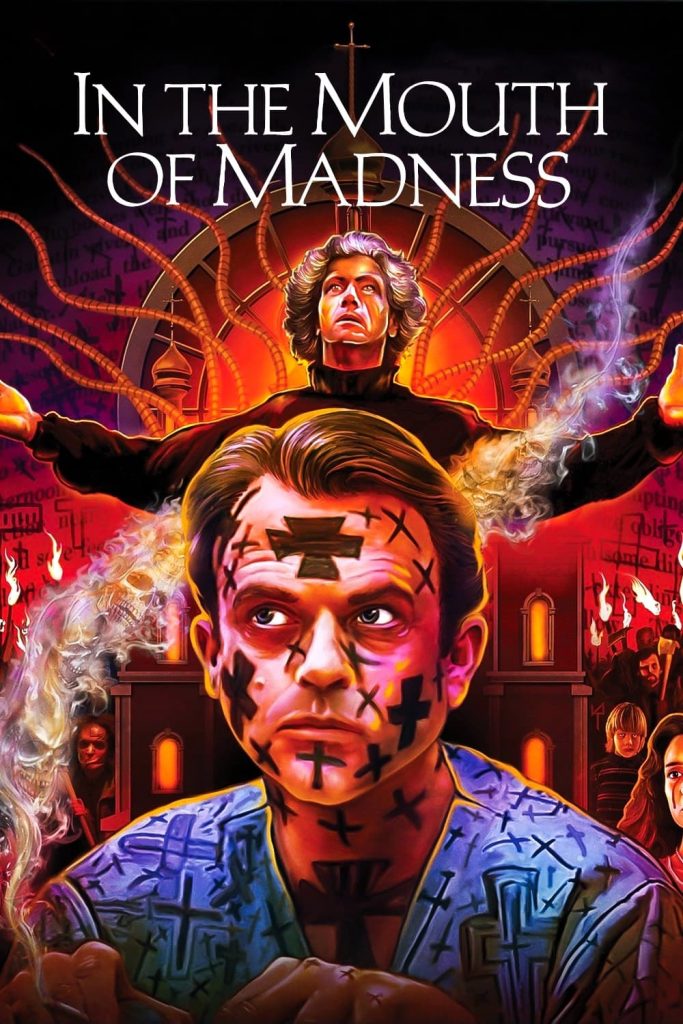
Trent is hired to investigate the disappearance of Sutter Cane, an enormously successful horror novelist whose books have acquired an almost fanatical following. Cane's readers are becoming increasingly disturbed, sometimes violently so, and his publisher is desperate to locate him before the release of his latest manuscript. Trent suspects an elaborate publicity stunt.
Following clues concealed in Cane's book covers, he eventually travels with editor Linda Styles to Hobb's End, a seemingly fictional New England town that appears in Cane's novels. What follows is a gradual disintegration of everything Trent believes to be true.
The town exists, although it should not. Its inhabitants behave as though they have wandered out of a nightmare. Scenes described in Cane's fiction begin unfolding before Trent's eyes. Roads lead nowhere, familiar places become unfamiliar, and the distinction between past, present and future begins to dissolve. Throughout it all, Trent clings desperately to the belief that there must be a rational explanation.
What makes his predicament so effective is that his scepticism is initially entirely reasonable. We share his reluctance to accept the impossible. Yet as the film progresses, the very intellectual framework through which he interprets the world becomes increasingly inadequate. Carpenter does not merely frighten his protagonist. He destroys the foundations upon which his identity rests.
Lovecraft and the Horror of Cosmic Indifference
The influence of H. P. Lovecraft is unmistakable, beginning with the film's title, which recalls At the Mountains of Madness. Lovecraft's distinctive contribution to horror was his rejection of humanity's central importance in the universe. Traditional Gothic horror often presupposes a recognisable moral order, even when that order is violated by supernatural forces. There may be ghosts, demons or vampires, but these creatures generally operate within a universe whose fundamental structure remains intact. Lovecraft's universe is considerably less reassuring. Human beings are not the culmination of creation. They are temporary, insignificant creatures inhabiting a cosmos whose true nature is almost entirely beyond their comprehension.
The greatest danger lies not necessarily in being killed by some ancient monstrosity, but in discovering that our most cherished assumptions about existence are fundamentally mistaken. This is the world Carpenter invites us into.
The entities lurking behind Cane's fiction are not merely monsters waiting to escape their imprisonment. They represent an older order of existence, one that threatens to replace the reality humanity has taken for granted. And yet the film introduces a particularly interesting variation on Lovecraft's worldview. The ancient beings cannot simply return through brute force. They require something from humanity. They require belief.
Sutter Cane and the Creation of Reality
This, to my mind, is where In the Mouth of Madness becomes genuinely fascinating. Sutter Cane is initially presented as a grotesquely exaggerated version of the bestselling horror novelist, complete with a devoted readership and enormous commercial influence. The parallels with Stephen King are obvious, although Cane's literary universe owes considerably more to Lovecraft. But Cane is not simply an author. He is a creator whose words possess the power to transform existence.
As his books reach an ever-growing audience, the distinction between the fictional and the real begins to collapse. What people believe, read and imagine gradually acquires an independent existence. There is an almost theological dimension to this idea.
In the opening of the Gospel of John, creation is inseparable from the Word, or Logos. The world is brought into being through divine reason and creative utterance. Cane represents a disturbing inversion of this principle.
His words do not establish a harmonious, intelligible cosmos. They dismantle one.
Where the divine Logos traditionally signifies order, meaning and intelligibility, Cane's creative power introduces chaos, fragmentation and madness. His fiction becomes a kind of counterfeit revelation, a sacred text for a new and monstrous religion.
The parallel is especially striking because Cane himself is not entirely in control. He eventually acknowledges that the entities beyond our world have been guiding his writing, using him as an instrument through which they can enter human reality.
He is both author and medium. Creator and creation. Prophet and puppet.
The implications are deeply unsettling. If Cane's imagination is being directed by forces outside himself, who is ultimately responsible for the reality he creates?
And if Trent exists only because Cane has written him into existence, what does that suggest about the nature of free will?
The Church at Hobb's End
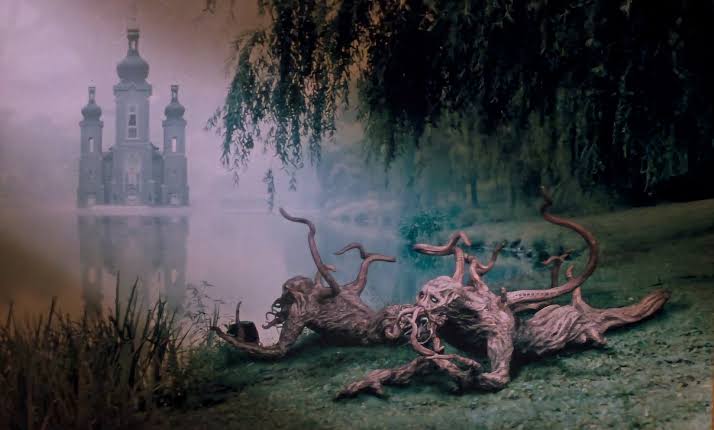
One of the film's most suggestive images is the enormous black church looming over Hobb's End. Churches traditionally represent sanctuaries, places where the sacred enters the ordinary world and gives human existence a connection to something transcendent.
Carpenter reverses this symbolism. The church in Hobb's End is not a refuge from evil. It is the place from which the town's corruption appears to emanate. Inside, Cane sits at his typewriter, producing the words through which an alien reality takes shape. The building becomes a kind of inverted cathedral, a temple devoted not to salvation but to the dissolution of the world.
One could interpret Cane as a false prophet, offering revelation through a medium that gradually enslaves its audience. His followers consume his writings with religious intensity, surrendering their ability to distinguish their own thoughts from those implanted by the author. There is also something distinctly Gnostic about the film's conception of reality.
Certain strands of ancient Gnosticism imagined the material world as the creation of a lesser or flawed divine being, a demiurge whose dominion concealed a more fundamental spiritual truth. Carpenter's film offers a dark variation on this possibility.
Trent believes himself to be an autonomous individual inhabiting an objectively existing universe. But he eventually discovers that his entire existence may be the product of another intelligence.
The world he inhabits is not necessarily false in the sense of being an illusion. It is false because its apparent independence conceals a deeper level of authorship. There is an important distinction here. I am not suggesting that Carpenter consciously constructed an elaborate Gnostic allegory, or that the film should be reduced to a particular esoteric doctrine. Rather, these philosophical and religious parallels help illuminate why its central premise is so disturbing. The real horror lies in discovering that the world may have been authored by something that does not have our interests at heart.
Fiction, Belief and the Modern World
There is another dimension to In the Mouth of Madness that strikes me as increasingly relevant. The film was made in the early 1990s, before the internet had transformed the circulation of information, before social media and algorithmically driven content had become such powerful influences on public consciousness.
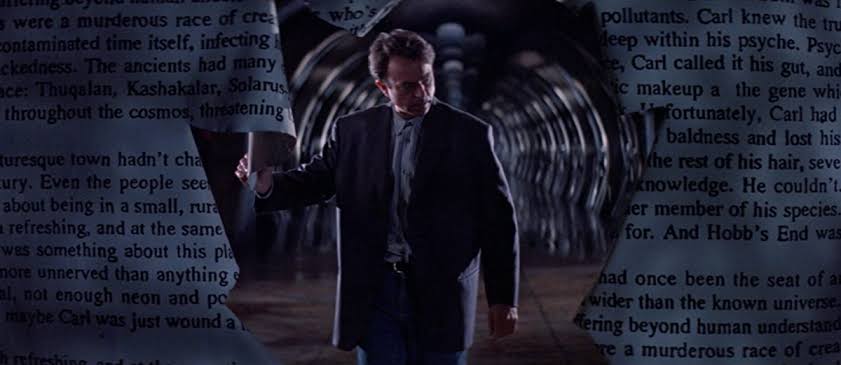
Yet its central premise feels remarkably contemporary. Cane's books spread through society like an infection. Readers absorb their contents, gradually lose their independence and begin interpreting reality according to the fictional universe they have consumed.
The mechanism is supernatural, but the underlying observation is recognisably human. Stories shape the way we understand the world. Religions, political ideologies, national myths, cultural narratives and even our individual identities depend upon shared systems of meaning. We do not encounter reality as entirely neutral observers. We interpret it through inherited concepts, assumptions and beliefs.
This does not mean that reality is merely whatever we happen to believe it to be. It means that our experience of reality is mediated by stories, and that sufficiently powerful stories can transform human behaviour. Carpenter takes this familiar phenomenon to its terrifying logical extreme.
What if a narrative became so influential that it no longer merely described the world?
What if it began replacing it?
The film's concern is not simply with manipulation or mass hysteria. It is with the possibility that human consciousness itself can become a doorway through which something fundamentally alien enters our world. Cane's audience does not merely read his books. It participates in their fulfilment.
The End of the Story
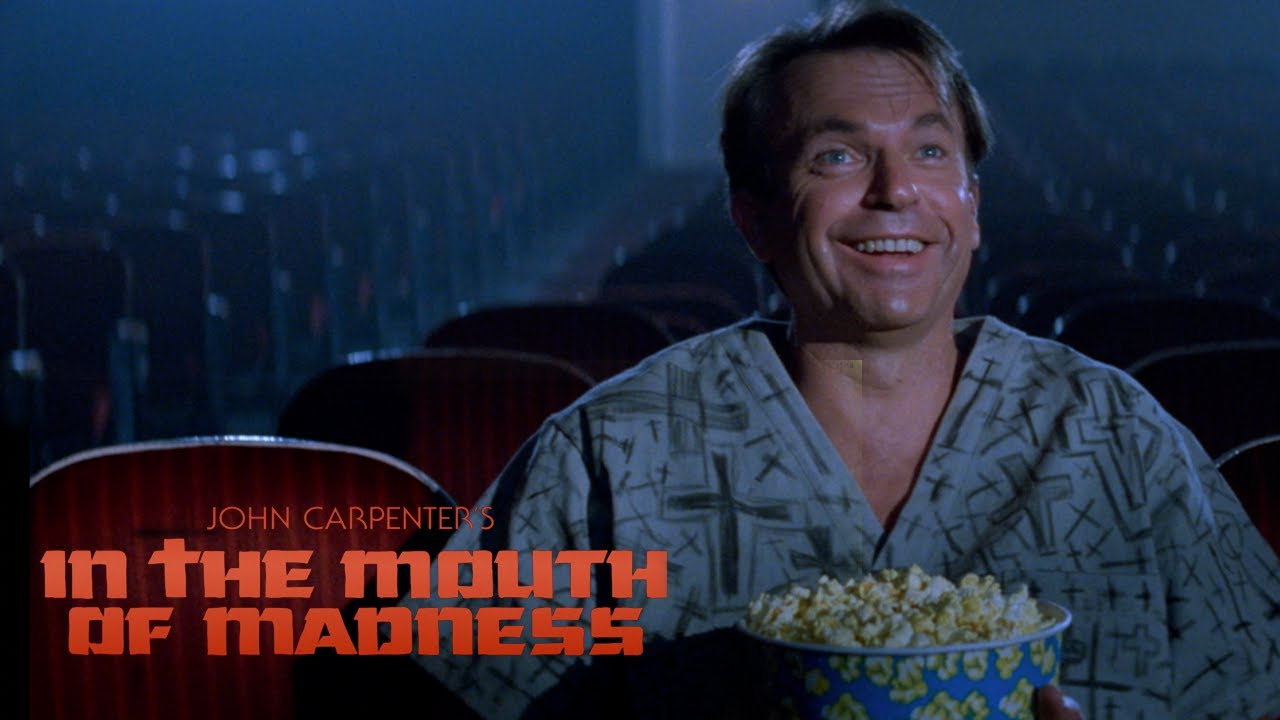
The final sequence remains one of my favourite endings in horror cinema. Having apparently escaped the nightmare of Hobb's End, Trent discovers that Cane's fiction has overwhelmed the outside world. Society is collapsing, and the distinction between the author's imagination and objective reality has all but disappeared. Eventually, Trent enters a cinema screening a film entitled In the Mouth of Madness.
He sits down and watches.
On the screen, he sees the events we have just witnessed, including himself. At first, he reacts with disbelief. Then, as the terrible implications become unavoidable, he begins to laugh. It is a remarkable moment.
Trent has spent the entire film attempting to establish that he is a rational individual inhabiting a coherent universe. Now he discovers that he may be nothing more than a fictional character, trapped within a story whose ending has already been determined. But the scene contains one final, particularly cruel twist. We are watching him watch the film. For a moment, the boundary between the fictional world and our own becomes uncomfortably thin. If Trent can discover that his existence is merely a story, how can we be certain that our own position is fundamentally different? Of course, Carpenter is not presenting this as a serious philosophical proof that reality is fictional. He is doing something more interesting.
He is exploiting the peculiar relationship between cinema and belief. For the duration of a film, we willingly surrender ourselves to an artificial reality. We become emotionally invested in people who do not exist, fear dangers that cannot harm us and accept worlds that would collapse under ordinary rational scrutiny.
The filmmaker becomes a temporary creator, constructing a universe through images, sound, editing and narrative. And we, the audience, willingly enter that universe. The final joke of In the Mouth of Madness is that we have spent the entire film doing precisely what Sutter Cane's readers do. We have allowed a fictional world to take possession of our imaginations.
A Few Reservations
For all my admiration, I don't think In the Mouth of Madness is a flawless film. Some of its supporting characters are little more than instruments of the plot, and the dialogue occasionally becomes awkwardly expository. The pacing is uneven, particularly once Trent arrives in Hobb's End, and some of the creature effects are less convincing than the atmosphere surrounding them. There is also an interesting tension between the film's philosophical ambitions and its more conventional horror elements.
The most disturbing moments are often those in which Carpenter merely suggests that reality has become unstable: an impossible journey, an inexplicable repetition, a familiar face appearing where it should not. When the film finally reveals some of its monstrous inhabitants, the mystery occasionally gives way to something more recognisably grotesque.
Yet these weaknesses seem relatively minor when measured against the sheer audacity of the central concept. Carpenter has always been particularly effective at creating worlds in which familiar institutions and assumptions suddenly become unreliable. Here, he takes that talent to its logical extreme.
Not even the narrative itself can be trusted.
Final Thoughts
What makes In the Mouth of Madness so memorable is not its monsters, its violence or even its increasingly surreal imagery. It is the way it turns the very act of storytelling into a source of existential terror. Most horror films ask us to imagine what might happen if something terrible entered our world. Carpenter asks a more disturbing question:
What if our world was never truly ours to begin with?
The film can be enjoyed as a wonderfully atmospheric piece of Lovecraftian horror, a darkly humorous satire of literary celebrity or an elaborate exercise in cinematic self-reference.
But beneath those layers lies something more troubling: the possibility that reason, individuality and even reality itself depend upon foundations we have never fully examined. And perhaps that is why the film continues to resonate with me. It reminds us that the most frightening monsters are not necessarily those lurking in the darkness.
Sometimes, they are the ideas that make us question whether the darkness is all there ever was.
Happy Halloween, and welcome to the first instalment of my Halloween film series.
Have you seen In the Mouth of Madness? Do you interpret Sutter Cane as a creator, a false prophet, or merely an instrument of something far older? I'd be interested to hear your thoughts.