🌍 OLDEST COUNTRIES IN THE WORLD: INDIA ON THE LIST 🇮🇳
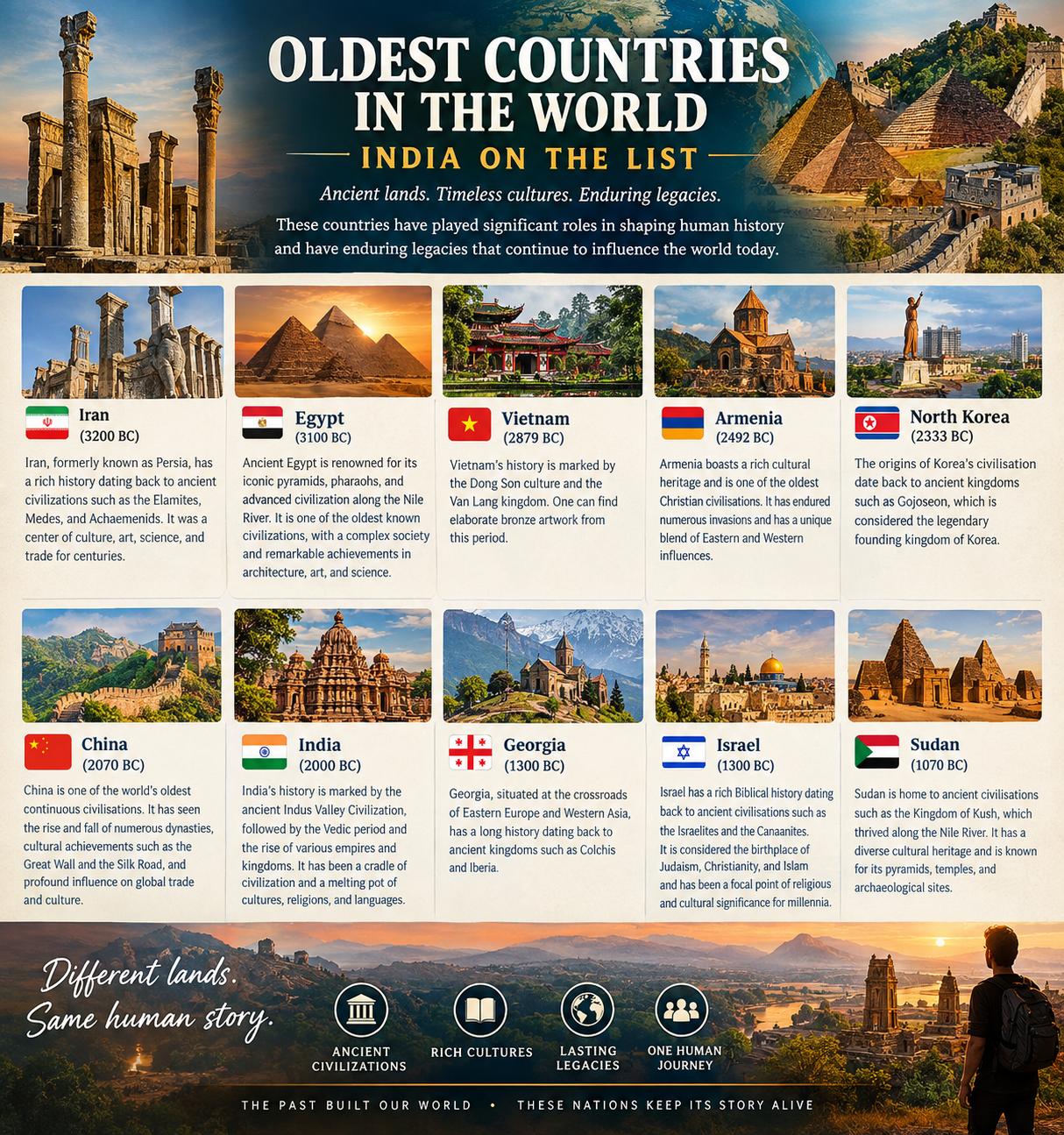
Ancient Civilizations, Timeless Cultures & Stories That Shaped Humanity 🏛️
When we look at the modern world map, it is easy to think that countries have always existed in their present form. But the reality is very different. The borders, governments, names, and political systems of today's countries have changed many times throughout history.
Long before modern nation-states existed, ancient civilizations developed along rivers, mountains, deserts, and trade routes. They built cities, developed writing systems, created art and architecture, traded with distant regions, developed religions and philosophies, and left behind traditions that continue to influence the modern world.
Some lists describe these places as the "oldest countries in the world." However, this phrase needs an important clarification: ancient civilizations are not the same thing as modern countries. Many dates refer to the beginnings of civilizations, kingdoms, or traditional founding stories rather than the establishment of today's states.
With that in mind, let's explore some of the ancient civilizations and historical traditions associated with countries on this list—and especially India's remarkable place in this story. 🇮🇳
🇮🇷 1. Iran — Around 3200 BC
The land that is now Iran has one of the world's deepest recorded histories.
Ancient civilizations such as the Elamites flourished in southwestern Iran thousands of years ago. Later came powerful kingdoms and empires, including the Medes and the Achaemenid Persian Empire.
Persia became one of the great political and cultural powers of the ancient world. The Persian empires influenced administration, architecture, art, trade, language, and culture across a huge area.
Places such as Persepolis remain powerful reminders of this ancient heritage.
Iran's history demonstrates how civilizations can transform politically while continuing to preserve important cultural traditions.
🇪🇬 2. Egypt — Around 3100 BC
Few civilizations are as instantly recognizable as Ancient Egypt.
The unification of Upper and Lower Egypt around the beginning of the 3rd millennium BC marked a major milestone in Egyptian history. Over thousands of years, Egypt developed powerful kingdoms, complex religious traditions, writing systems, engineering techniques, and monumental architecture.
The pyramids, temples, tombs, statues, and hieroglyphs show the extraordinary organizational and technical abilities of ancient Egyptian society.
The Nile River played a central role in Egyptian civilization, supporting agriculture, transportation, trade, and settlement.
Even today, Ancient Egypt remains one of the most studied civilizations in human history.
🇻🇳 3. Vietnam — Traditionally Dated to 2879 BC
Vietnam has a long and complex history extending deep into antiquity.
Traditional Vietnamese histories associate the legendary Hùng Kings and the kingdom of Văn Lang with very early dates. Archaeologically, cultures such as the Đông Sơn culture are especially important for understanding ancient Vietnam.
The Đông Sơn tradition is famous for its sophisticated bronze objects, including the iconic bronze drums.
Vietnam's history also reflects centuries of cultural interaction between different societies in Southeast Asia and East Asia.
This combination of local traditions and outside influences helped create the distinctive cultural identity of Vietnam.
🇦🇲 4. Armenia — Ancient Heritage
Armenia has a remarkable history at the crossroads of Europe and Asia.
The region was home to several ancient cultures and kingdoms, including the Kingdom of Urartu and later the Kingdom of Armenia.
Armenia is also historically significant because it became the first kingdom to officially adopt Christianity as a state religion, traditionally dated to the early 4th century AD.
Its mountainous landscape, ancient monasteries, distinctive alphabet, and cultural traditions have contributed to a strong historical identity.
It is important to note that some very early dates associated with Armenia in popular "oldest country" lists come from traditional chronologies rather than firmly established archaeological evidence.
🇰🇷 5. Korea — Traditionally Linked to 2333 BC
Korean traditional history traces the founding of Gojoseon to 2333 BC through the legendary story of Dangun.
Whether treated as historical chronology or cultural tradition, the story has played an important role in Korean identity.
Over the centuries, the Korean Peninsula saw the development of several kingdoms, including Goguryeo, Baekje, and Silla.
Korean civilization developed distinctive systems of government, art, literature, technology, architecture, and cultural traditions.
The modern political division between North and South Korea is very recent compared with the much older history of Korean civilization.
🇨🇳 6. China — Ancient Civilizational Continuity
China is widely recognized as having one of the world's oldest continuous civilizational traditions.
The traditional chronology places the Xia dynasty around the early 2nd millennium BC, although the historical identification of the Xia remains debated. Archaeological discoveries, including evidence associated with the Erlitou culture, continue to shape scholarly understanding.
Later dynasties such as the Shang, Zhou, Qin, and Han played enormous roles in the development of Chinese civilization.
China's historical legacy includes writing, philosophy, engineering, agriculture, ceramics, metallurgy, mathematics, and major trade networks such as the Silk Road.
The Great Wall and numerous ancient cities, tombs, temples, and archaeological sites demonstrate the enormous scale of China's historical development.
🇮🇳 7. INDIA — One of the World's Great Ancient Civilizations 🇮🇳
And now, India.
India's place in ancient history is extraordinary.
The Indus Valley Civilization, also known as the Harappan Civilization, developed across parts of present-day India and Pakistan. Its mature urban phase is generally dated to around 2600–1900 BC, although the roots of settled communities in the region go back much further.
Cities such as Harappa, Mohenjo-daro, Dholavira, and Rakhigarhi reveal sophisticated urban planning, drainage systems, craft production, trade networks, and standardized weights and measurements.
One of the fascinating features of the Indus civilization is its still-undeciphered writing system.
After the decline of the mature urban phase, different cultural traditions continued to develop across the Indian subcontinent. The Vedic period, the rise of Mahajanapadas, the Mauryan Empire, the Gupta period, and numerous regional kingdoms all contributed to India's enormous historical landscape.
India also became a major center of philosophy, mathematics, astronomy, literature, medicine, architecture, and religious traditions.
Concepts and traditions that developed in the Indian subcontinent influenced generations of people and continue to be studied around the world.
So when we talk about India's ancient history, it is better to think of it not as a single starting date, but as a long and complex process of civilizations, cultures, kingdoms, languages, and traditions developing over thousands of years.
🇮🇳 India's history is not just one chapter—it is an enormous library of human civilization.
🇬🇪 8. Georgia — Ancient Kingdoms
Georgia sits at an important crossroads between Europe and Asia.
Ancient kingdoms such as Colchis and Iberia played important roles in the region's history.
The area was connected to major trade and cultural routes linking the Black Sea, Caucasus, Anatolia, Persia, and surrounding regions.
Georgia also developed a distinctive Christian culture, architecture, literature, and writing tradition.
Its ancient fortresses, churches, monasteries, and archaeological sites preserve evidence of its long historical development.
🇮🇱 9. Israel and the Ancient Levant
The land associated with modern Israel has an exceptionally long archaeological and religious history.
Ancient societies including the Canaanites and later Israelite kingdoms developed in the region during the 2nd and 1st millennia BC.
The region became central to the history of Judaism, Christianity, and Islam, making it one of the world's most historically and religiously significant areas.
However, it is important to distinguish the ancient history of the region from the modern State of Israel, established in 1948.
This is another example of why the phrase "oldest country" can be misleading when discussing ancient history.
🇸🇩 10. Sudan — Kingdom of Kush
Sudan is another country with an extraordinary ancient heritage.
The region was home to the Kingdom of Kush, which became a major power along the Nile.
Kush developed its own political institutions, culture, architecture, and religious traditions. The ancient city of Meroë is particularly famous for its pyramids and archaeological remains.
Sudan contains hundreds of ancient pyramids and numerous temples and archaeological sites, showing that the history of civilization along the Nile extended far beyond Egypt.
🏛️ Why Are These Civilizations Important?
Studying ancient civilizations is not simply about finding out which country is "older."
It helps us understand how human societies developed.
Ancient people built cities without modern construction equipment. They developed systems of writing, agriculture, taxation, government, trade, mathematics, astronomy, art, religion, and engineering.
They faced problems that may sound surprisingly familiar today:
How should a city be organized?
How should resources be distributed?
How can people trade with distant societies?
How should laws be created?
How can knowledge be passed to future generations?
Thousands of years later, humanity is still dealing with many of these questions.
🌏 Ancient History Is a Shared Human Story
Every civilization on this list has a unique story.
Iran gave rise to powerful Persian empires.
Egypt created monumental architecture along the Nile.
Vietnam developed distinctive Southeast Asian traditions.
Armenia preserved a unique cultural and Christian heritage.
Korean civilization developed across the Korean Peninsula.
China maintained one of the world's longest civilizational traditions.
India developed remarkable urban civilizations, philosophical traditions, sciences, and cultural systems.
Georgia connected different worlds across the Caucasus.
The ancient Levant became central to major world religions.
Kush demonstrated the extraordinary civilizations of ancient Sudan.
But these histories should not be viewed only as a competition for the title of "oldest."
Civilization is not a race.
Different societies developed at different times, interacted with one another, influenced each other, competed, traded, migrated, and exchanged ideas.
That is what makes human history so fascinating.
🇮🇳 India on the List — A Reminder of a Very Long Journey
India's ancient heritage is one part of a much larger story that stretches across the Indian subcontinent.
From early settlements and the Indus Valley Civilization to later kingdoms, universities, scientific traditions, literature, art, architecture, and diverse cultures, the subcontinent has experienced thousands of years of continuous change and development.
The past is not simply something that belongs in textbooks.
It can still be seen in archaeological sites, monuments, languages, traditions, art, architecture, festivals, manuscripts, and cultural practices.
Ancient civilizations may disappear, transform, or become part of new societies—but their ideas and legacies can continue for thousands of years.
🌍 Different lands. Different cultures. One shared human story.
📌 Final Thought
The next time you look at a modern world map, remember that today's borders represent only a small moment in a much longer human story.
Behind every modern country are layers of ancient settlements, kingdoms, migrations, languages, cultures, conflicts, inventions, and traditions.
History reminds us that the modern world did not appear overnight.
It was built over thousands of years—one civilization, one generation, and one idea at a time. 🏛️🌍
musstt visit this ebook
https://bit.ly/4rgikWP