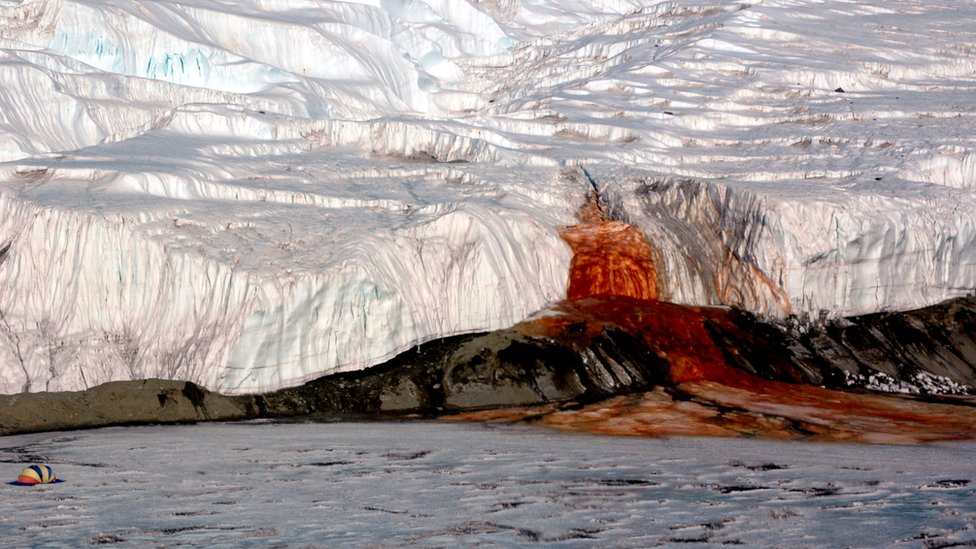
Discover the origin of Antarctica's Blood Falls.
in Popular STEMlast month

Discover the origin of Antarctica's Blood Falls.


Souce


The origin of Antarctica's Blood Falls has been discovered, and it is a very curious—and quite surprising—finding. A study published just days ago reveals that the "blood" in the falls actually consists of microorganisms—many of them still alive—of marine origin. These organisms have persisted since the time when the area was a fjord.


That was a period when Antarctica was warmer and the region was not as ice-covered as it is today; Antarctica featured significant fjords—the landscape would have resembled southern Greenland. What is now the Taylor Glacier was once a fjord. Researchers estimate this occurred between 1.5 and 2 million years ago—according to one theory, as the dating is not yet precise—while another theory suggests a timeframe of 2.5 to 5 million years ago. These were periods when the planet was warmer, Antarctica was warmer, and the entire area was a vast fjord.


What happened? Over time, Antarctica cooled down. When the planet was warmer, sea levels were higher, of course; but as the planet cooled and the Antarctic ice sheet formed, sea levels dropped. Yet, the water remained—trapped within that ancient fjord. That ancient seawater contained microorganisms that survived and remain there, deep beneath all that ice.


There is a reservoir of ancient water from an ancient sea, containing microorganisms that have persisted there; what we see emerging from these fissures includes many dead ones, evidently, but there are living microorganisms as well.


The images show a fissure through which they emerge, but deep within the glacier—underneath—lies water that is over a million years old, perhaps even up to five million years old. Within that water—that ancient sea—are the microorganisms that survived the freezing process and the transformation into the surface landscape we see today; for beneath it all, that seawater remains. Furthermore, there are significant quantities of brine; everything is mixed with brine.


To me, it looks a lot like the red lines seen on Jupiter's moon Europa. Those red lines are actually cracks in Europa's icy crust—since the surface isn't static; it shifts and fractures, allowing water from the moon's subsurface ocean to escape. As the water rises, it carries salts and other materials with it; once exposed to the surface, those salts are baked by Jupiter's radiation, turning reddish. However, some suspect that these red zones along the cracks might contain more than just salts—there could also be microorganisms that lived in that ancient ocean and were carried out along with the water when the crack opened.


What do you think?


Study Source


The images without reference were created with AI
Thank you for visiting my blog. If you like posts about #science, #planet, #politics, #rights #crypto, #traveling and discovering secrets and beauties of the #universe, feel free to Follow me as these are the topics I write about the most. Have a wonderful day and stay on this great platform :) :)


! The truth will set us free and science is the one that is closest to the truth!


Sort:  

Congratulations!

Your post has been selected and upvoted by the SteemPro Team 🚀

Explore more on SteemPro:
🌐 https://www.steempro.com
🎮 Play SteemHeights: https://www.steempro.com/games/steem-heights
💬 Join our Discord: https://discord.gg/Bsf98vMg6U

💪 Supporting the growth of the Steem ecosystem together.

🟩 Vote for witness faisalamin:
https://steemitwallet.com/~witnesses
https://www.steempro.com/witnesses#faisalamin

steempro-cover-black.png
This is an automated message.