🌌 Could Mars Become Our Second Home? | A Journey Into the Future
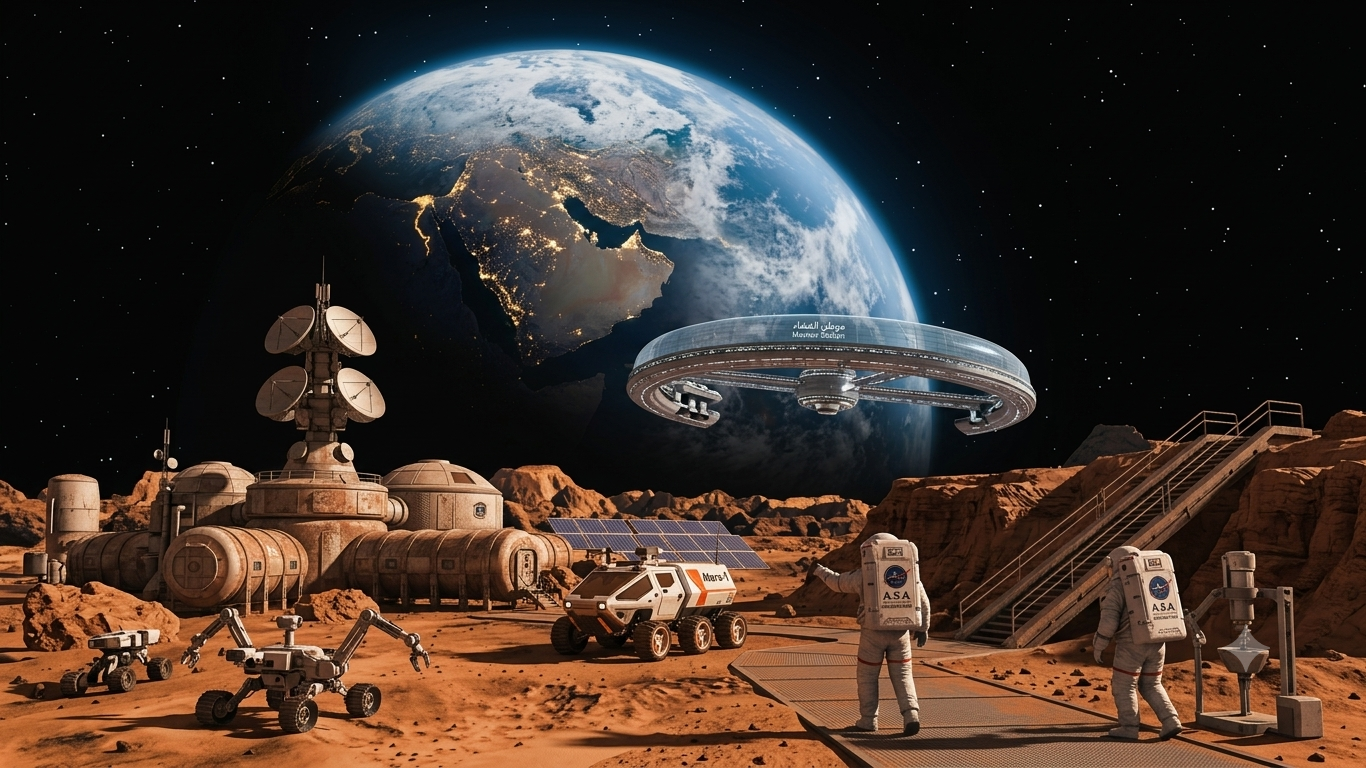
Imagine waking up in the morning, opening your window, and instead of the familiar blue sky, you see a vast red horizon with rugged terrain below—while Planet Earth shines like a brilliant blue marble in the sky above!
What used to be pure science fiction is rapidly becoming the center of attention for space agencies and private aerospace companies worldwide.
🚀 Why Mars?
Among all the planets in our solar system, Mars is considered the most viable candidate for human habitation:
Day Length: A Martian day (called a "Sol") is remarkably close to an Earth day, lasting about 24 hours and 39 minutes.
Water Resources: Strong evidence confirms substantial amounts of water ice stored beneath the surface and at the polar caps.
Solid Ground: Mars features a rocky, solid surface capable of supporting physical structures and habitats.
🏗️ Major Challenges to Martian Colonization
Despite the optimism, building a life on Mars presents extraordinary hurdles:
Atmosphere & Breathability: The atmosphere is thin and composed mostly of carbon dioxide, requiring sealed biodomes for oxygen generation and agriculture.
Cosmic Radiation: Lacking a strong global magnetic field, Mars is exposed to harsh radiation, necessitating underground bases or heavily shielded structures.
Extreme Cold: With an average temperature around -60°C (-80°F), reliable long-term heating and energy systems are essential.
🎨 A Vision of the Future
The image above illustrates what human presence on Mars might look like:
Modular habitats and research domes equipped with deep-space communication arrays.
Autonomous rovers and exploration vehicles traversing the terrain.
Orbital stations designed to manage logistics and interplanetary transport.
💬 Community Question:
If given the chance to be one of the early pioneers living in a Martian colony, would you take the leap, or do you prefer staying on our blue home planet? Share your thoughts in the comments below!